“Who or what inspires you?” I asked.
“Traveling. I’m the happiest when I’m not at home. Okay, that doesn’t sound great,” she laughed. “But I love seeing new things. Where I live, 40 minutes away from Hamburg, it’s just so boring, and people aren’t as open as they are in big cities. When I have my gap year, I’ll go to New York. I’ve been there before with my best friend, and it made me so happy.” Her voice was calm and soft.
“What’s the first thing you do when visiting a new city?”
“I try to see what the people are like.”
“And what are people like here in Vienna?”
“Yesterday, I went to ‘Zum Schwarzen Kameel’, and I noticed people there had their noses up, not even glancing at me, as if they were better than me. The way they spoke to the waitress stood out too. For example, a man accidentally knocked a cup off the table, and he didn’t even look down or say anything to the waitress.”
“And what is it about New York that attracts you so much?”
“I went to a football game—it’s not really my thing—but the people were so friendly. They just talked to me, genuinely wanting to get to know me. And New York itself? I love the vibe of it, you know?”
“Is there a question that’s been bothering you recently?”
She answered immediately, “What I want to do with my life. I’ve been struggling to figure that out for a lo-o-ong time. I should’ve finished school two years ago, but I couldn’t do that because of my mental health for such a long time. Just a year ago, I started going to school again, and it was really hard for me.
But I think I’m starting to find myself—though I still don’t know what my purpose is. I’ve always felt like I’m just alive but not really living, you know? I want to find out what will make me feel like I’m truly living, so I can finally be happy.”
“Would it be fair to say that you believe it’s possible to always be happy?”
“I think it’s 99% possible. I remember traveling for the first time after Covid. I went to Spain, to the beach, and in that moment, I felt so happy. But then I had to go back home, and everything felt shitty again.”
“What is it about your home that feels shitty?”
“I don’t even know—that’s the problem,” she said, shaking her head. “I feel like I should be okay, given everything I’ve overcome. I always thought that once I eventually got through it all, I’d be happy.”
“What have you overcome?”
“I struggled a lot with socializing and had so much anxiety. For a long time, every day was spent in a mental clinic. I had to do one big thing a day and earn a reward for it. My ‘big things’ were simple things, like going to a cafeteria and ordering something. Because I couldn’t do things like that.”
“What was difficult about it?”
“I don’t know—I’d just panic. But I did it because I really wanted to. Another hard thing for me was learning to say ‘no’ to someone. That was actually the hardest. And now, when I see where I am, how easy those things are for me, I’m proud of myself. But for some reason, coming to you caused me a lot of anxiety. Still, I’m proud that I came.”
“What exactly about coming to me caused your anxiety?”
“The unknown. It’s very scary for me. I’ve been in therapy since I was four because something really bad happened to me when I was very young. I think that’s what destroyed my trust in other people.”
“Would you mind sharing what happened?”
“I was…” she began, but her voice faltered, and nothing came out. She took a deep breath. “I’m sorry. I had to stay at… When my mum and dad needed to go somewhere, they’d leave me with our relatives. And my grandma’s boyfriend… sexually assaulted me. At the time, I didn’t understand what was happening, but it still affects me. He also threatened me, saying, ‘If you tell anyone, I’ll hurt your mum.’ And my mum is my favorite person in the world. I always felt super safe with her. But without her, I’d panic. Even being in a room without her was unbearable.”
“Did you do homeschooling?”
“My mum always wanted to, but in Germany, it’s not allowed. I think it’s so shitty because I would’ve been so much happier if I didn’t have to go to school. In total, I only spent about five years in school, and even then, not consecutively—I had months or even years of breaks.
I was kind of okay with the kids, but the teachers… when they raised their voices, I’d start panicking, even if it wasn’t directed at me. I still feel it now with people older than me. Even when they’re being nice, it makes me anxious.”
“How does your panic attack feel?”
“My heart races, like there’s this huge weight pressing on me. And I always feel like there’s a belt around me, tightening so much I can’t breathe. I remember when I was twelve, my mum drove me to school, and I told her, ‘I can’t go there anymore.’ Her voice cracked, and she started crying. “I said, ’I can either go like… not being here anymore, or you just stop taking me there.’ I’m sorry.”
“There’s no need to apologize.”
“That was the moment she decided to put me in a clinic.”
“Did you like it there?”
“As far as I remember, yeah. But those first few weeks, I just sat there motionless while the other kids played with each other. I wouldn’t move until my mum came to take me out.”
“What has changed since then?”
“I don’t know exactly. Somehow, I became more confident. I got real friends, and they’ve helped me a lot. When I’m out with them and get anxious—like in front of a cashier—they’ll order for me. But they also encourage me to do things myself.
I don’t really know what changed. Maybe I just grew up a little bit. I certainly haven’t forgotten anything, but I think I’m trying to walk past it now.”
“What would you say is the most important lesson life has taught you?”
“Don’t trust anyone except my mum.” Her tears streamed down her youthful, beautiful face. “Oh my God, I’m so sorry.”
“It’s okay,” I said, offering her a paper towel.
“Thank you!” She dried her eyes and then, after a pause, added, “There’s no one in my life, except my mum, who hasn’t let me down at least once.”
“Do you let yourself down as well?”
She choked on her tears. “I let people walk over me again and again.”
“For example?”
“My ex-boyfriend treated me terribly. He cheated on me, abused me, and made me believe that everything he did was my fault.” She paused, then smiled faintly. “I forgot the question. What was it?”
“I asked if you let yourself down.”
“Yeah. I let him do that so many times. And not just him, which is dumb of me.” She fell silent for a moment before continuing, her voice quieter. “When this thing happened when I was four, I never got an explanation for why it happened. Even worse, no one believed me or my mum.” She paused, gathering her thoughts. “I didn’t really understand what he had done, but I told everything my mum because it gave me a weird feeling. She wanted to sue him, but the police didn’t believe her. They said there was no evidence, that it could’ve all been in my head. And there was even another girl he’d done the same thing to a few years before me, but they still didn’t believe us. I couldn’t comprehend it.” Her voice wavered. “A four-year-old kid can’t come up with something like that on their own.”
“Aside from that incident, is there anything in your past you’d want to change?”
In a tearful voice, “That I would have gone to school normally. I feel like it would’ve changed so much for me now. When you go to school, that’s when you meet all your good friends—the ones you see every day for so many years. Now, in the class I started in September, I met a really good friend, but we’ll only be together for a year. Then the school will be over. I think if I had more people I could trust, I’d be so much happier. I wouldn’t just sit in my room and do nothing.”
“And what is it that you’d like to entrust to people?”
“I just need to trust someone. It’s a good feeling—to tell them things I can’t share with anyone else, you know? I want to feel comfortable enough to say whatever is on my mind. But it’s more than that—I want to trust someone with my body, too. It’s been taken advantage of so many times. That’s a very good question you asked. I think if I want to feel comfortable around people, I have to trust them.”
“How do you cope with loneliness?”
“I cry,” she chuckled. “I can manage being on my own for a day or two, but sometimes it gets so bad I can’t even get out of bed unless someone takes me out. The worst thing in those moments is my phone. I scroll through other people’s stories, and I’m just sitting there in bed thinking, ‘Why can’t I have that kind of fun?’ But I know my anxiety won’t let me. I can’t handle being in a room with strangers. I get so mad at myself for missing chances. Like on New Year’s Eve in Hamburg—just over a week ago. I could’ve gone to a party with people I know, had a good time, but I was too anxious, too scared of the unknown. So I stayed home. At midnight, it was just me and my mum. I was so, so sad, watching stories of my friends having fun. It would’ve been so cool to be there too. But I’m trying to work through those fears—like coming here to meet you.”
“To whom would you most likely say sorry, and why?”
“My mom. I know she feels sad whenever I’m sad, especially when I say I don’t want to be in this world anymore. I know how much that hurts her. She’s done so much to make me feel good—she’s done everything. But when it came to that law that I had to go to school, she tried everything to prevent this. So when she was finally forced to send me, it broke her heart. I feel so sorry for making her go through all of that.”
I handed her more paper towels.
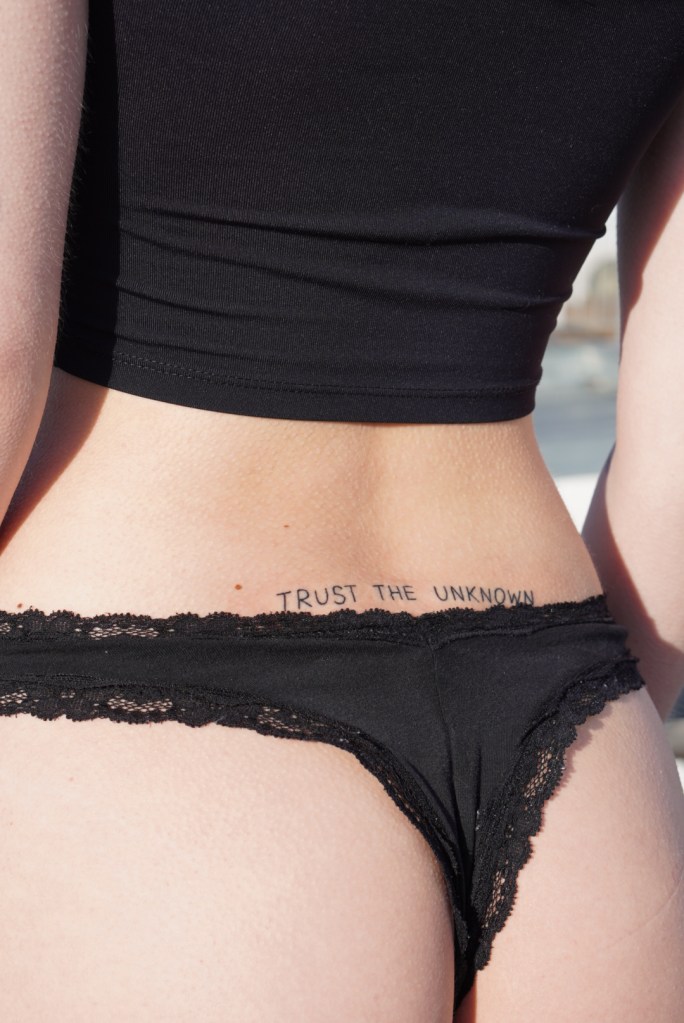
The tattoo I had proposed to her was “trust the unknown.” She liked the idea so much that no other suggestion stood a chance. Perhaps that’s what she truly needed at the time.
I conducted this interview almost two years ago, and now, reflecting on her story, I realize those words no longer feel appropriate—in light of what she endured. As I write her story, with tears welling up inside my chest, the only words I would offer her now are, “tread your path with care.”
Discover more from Your Story, By Me
Subscribe to get the latest posts sent to your email.
