I placed the recorder in front of him. He chuckled and said, “This thing is scary.”
“I used to have a more discreet recorder,” I replied, “but it broke.”
“Where’s your space for relaxation?”
“Probably in the distant past. It’s not here yet.”
“And what was in the distant past?”
“There was a bed. But I can’t really say Chelyabinsk was great. On one hand, my parents. On the other, there was school. And then there were my ambitions that never aligned with where I was. So, I’ve never really felt a sense of home.”
“And what is home to you?”
“I don’t know. I think I found something like home when I started dating Julian. He’s my first in every sense of the word. We’ve been together for almost seven years now, and what’s fascinating is that it just keeps getting better—better sex, better understanding. Maybe it’s because we don’t see each other often. Sometimes, he’s gone for a year or more for work. But we don’t have an open relationship.”
“And how do you cope with his absence?”
“It’s his return I have to cope with now. You get used to one way of being, and then it’s a challenge to readjust to each other all over again.”
“Do you ever feel lonely without physical intimacy with him?”
“Not at all. I masturbate, and that’s fine. Honestly, I feel more comfortable without intimacy. I never had warmth in my family, and I don’t have it now. My life has always revolved around art, and working feels easier than trying to navigate closeness with someone. I guess work is my home. The only time I can truly relax is when I’m consumed by something—when I’m creating, chasing an idea, or lost in a fantasy. But when the work stops, I feel empty. It scares me every time. You finish a book, release it into the world… and then what? It’s terrifying! I know it’s not entirely healthy to think this way. I should take better care of myself, especially since my health isn’t great. I’m sick again, actually. But I still made it here!” His smile persisted, unwavering.
“Describe the feeling of emptiness.”
“It’s like confronting my own ridiculous fears.”
“For example?”
“It’s the fear that comes with growing up and realizing that life isn’t how you imagined it would be. And with that, the fear of missing out on something important.”
“So when you’re not working, do you feel like you’re missing out?”
“Exactly. I fall into this neurotic need to always be doing something.”
“What’s your biggest fear?”
“I often think about it, that I’m dying like this,” he laughed, “thinking, ‘Oh, shit, everything sucks.’ It’s tied to missed opportunities. But what’s strange is that when I finally get what I thought I wanted, it turns out it’s not what I wanted at all, and there’s always this sense of disappointment. The more successful my career becomes, the more disappointed I feel. And after talking to others, I’ve realized I’m not alone in this. Success is like this beautiful, enticing candy. It looks perfect, and you think it’s going to taste amazing. But then you take a bite,” he gasped as if reliving the moment, “and you realize it’s not satisfying at all, and you start craving something else. But at the same time, you can’t just walk away. You’ve spent your whole life working to get that candy, so how could you not eat it? It’s such a paradox. A career, it turns out, looks nothing like what I thought it would.”
“Then why do you keep going?”
“There’s nothing else to do. I’d gladly choose another job. I don’t want to sound like a victim, but honestly, I’d love to have a job where I could actually take a vacation,” he said, bursting into laughter.
“What would you do if not art?”
“That’s the problem—it’s a vicious cycle, like a terrible drug I just can’t quit.”
“What disappoints you?”
“The endless difficulties that seem pointless. All the books, exhibitions—they take so much effort, and in the end, I don’t even feel any satisfaction from them. The problem is, I can’t do it any other way. I don’t know how to do anything else. It’s like a cross I have to bear, forcing me to keep doing something that doesn’t always make me happy.”
“And what are the moments when you’re happy?”
“When I’m actually doing art. It’s like a swing—there are highs and lows. When the difficulties hit, I’m not happy, but I guess that’s normal. For me, happiness is in the process of searching.
When my career shifted into business—about four years ago, when I started working with producers—I realized how much of it has nothing to do with creativity. There are so many rules you have to follow. I used to think those rules could be broken.”
“What rules can’t you break now?”
“The rule of doing what I want. Because when I try, there’s no response. That’s why I don’t want to go to America—though I probably will—because I know exactly how I’ll be seen there: the Russian who fled to a ‘free America’ after being let down by his homeland. Oh, it’s such a tired cliché. It’s so easy to lose yourself in that narrative.”
“And what are you really like?”
“Reverent, thrilled, kind, not confrontational. Even before I moved to Paris, GQ Germany wrote this piece—something like, ‘Vlad Zorin on Putin’s Russia and how gays are humiliated there.’ And you realize they’re not really interested in YOU. I’m talking about one thing, but they want to hear something else. It makes you feel like a hostage to the system.”
“What makes you reverent and thrilled?”
“I don’t know. I was thinking about it recently and even asked my friend, ‘Katya, have I become tougher?’ She said yes. It terrified me—maybe war affects us all, hardens us, turns us into robots who lose their sense of awe. And for me, awe is everything.”
“What is being a robot like?”
“It’s when you do everything in a standard, mechanical way, and everything around you feels standardized too. Though I have to say, this doesn’t really apply to France. People here are so lively, even with all their formal greeting and farewell rituals. I’ve noticed how loudly they yawn—it’s oddly freeing. They seem so unrestrained. But I’ve become more rigid, probably because of all the responsibility I carry.”
“What kind of responsibility?”
“To do everything right, for the people on the team.”
“And what is ‘right’?”
“Professionally—making sure I don’t let anyone down. Growing up is terrifying. I’m 25 now, and it feels like a turning point—close to 30, but still at 25.”
“Do you have a dream?”
“A few. Small ones, like seeing the northern lights—how the lights fall so beautifully while you lie in the snow. It’s fantastic. Snow has a special meaning for me because I grew up in the Urals. I love frost and snow.”
“What’s your most cherished one?”
“To express and fulfill myself as much as possible through creativity. That’s where the fear comes from—the fear that I won’t have enough time.”
“And why do you need it?”
“I’m telling you, it’s like carrying a cross—I’m a hostage to it. There’s no grand purpose in it; I just can’t do it any other way. That’s what disappoints me: other people choose their work, but I didn’t. I’ve been doing this since I was a kid, and I just keep doing it. Meanwhile, someone else says, ‘Well, at 23, I realized what I want to do.’ And I think, wow, that’s fucking amazing. And here I am, stuck in this constant creative limbo.”
“If you could change something in the past, what would it be?”
“Oh, I’d rather sort out the present. I just got back from a two-week trip where I barely slept—three and a half hours a night, waking up at four in the morning to work on a new book. What would I change? Honestly, who knows? It feels like no matter what I’d change, everything would still turn out the same.
I used to think I was in control of my life—that I was the one shaping it. That used to be a pretty common belief. But now, I see that everything unfolds on its own, and I try to surrender to it. If I have even a little strength, I give it. If I have more, I give that too. It might sound dramatic, but if you see yourself as an artist, then you have to walk this path with dignity, no matter the toll it takes on your health. I remember being invited to the ‘Rain’ TV channel for an interview after my book came out. I hate the whole aesthetic of TV. I’d only slept three hours, and I was sitting there thinking, ‘I’m going to run away. I’m going to run away!’ Then they clipped a microphone on me, and I thought, ‘No, you have to do this.’ And it’s like that every time.”
“A young woman came to me for an interview recently, and the first thing she said when she sat down was, ‘I want to run away.’ It took me a moment to figure out what to say to put her at ease.”
“Wow! I think you could’ve just said, ‘Run away,’ and she wouldn’t have gone anywhere.”
“That would’ve been too harsh.”
“Why did she want to run away?”
“She was nervous. At that moment, there was a camera filming us, and behind it stood a director who had made a documentary about my project.”
“What did you say to her?”
“I asked her a question—something I thought would resonate with her mood and gently guide her into a more reflective state.”
“Did it work?”
“Yes.”
“How would you describe your background?”
“A guy from a small town who was always fighting some kind of battle—in kindergarten, in school. I won first place in ballroom dancing at the Russian Championship, then competed in the World Championship, and ended up in the hospital after that. It’s never been easy for me. When things are easy, it scares me.
I recently realized it’s better not to focus entirely on one thing in your work. If it doesn’t pan out, you’re left with nothing. But at the same time, I am nothing beyond what I’m working on now. Julian always says I’m one-sided, and it’s true—I have nothing but my career.”
“What about your personal life?”
“Nothing, really. I work on projects with Julian. My first project with a bunny was dedicated to him, and now I’m dedicating an exhibition of installations and sculptures to him. In a way, he’s my project.”
“And what is love to you?”
“It’s cute. There’s so little cuteness in the world, but love is cute. When Julian and I see each other, we smile, and it’s just… cute. That kind of thing doesn’t really exist in my world because I don’t have many friends and I don’t communicate much.”
“Why?”
“Well, what for? When?” He laughed. “Communication doesn’t give me much. I like it when I’m lying in bed,” he stretched out the “e” sound, “which is probably why I often film my characters in bed. It’s a kind of comfort zone. When I lived in Chelyabinsk, my bed was also my safe space, where I could close myself off and create. When you live in a place like Chelyabinsk, where it gets dark around three in the afternoon and dawn doesn’t come until ten in the morning, it does something to your imagination. I didn’t have any friends, so I stayed home and drew.”
“What did you draw?”
“What didn’t I draw? Mostly sunrises.”
“Were you lonely?”
“Of course. That’s why I drew.”
“What do you do now when you feel lonely?”
“I write poetry or have conversations with myself.”
“What is success to you?”
“Something unattainable, something you can’t actually feel, because success is an endpoint—a stop.”
“Have you ever had moments in your life when you thought, well, that’s it, now life will change and never be the same?”
“It always feels that way, but then it still ends up being some kind of fucked up thing. It’s all an illusion, so I try to accept that it’s always going to be difficult.”
“Are you afraid of death?”
“Well, yes. But sometimes I feel like I’m not afraid of anything, and everything is fine.”
“What do you think happens after death?”
“I actually think about it often, at least once a week. Just a couple of days ago, I was in Greece, staring at the stars—there were so many of them—and I thought, ‘Fuck, where does the soul go after death? Can you really just hide a soul in a coffin?’”
“What do you love most about yourself?”
“I usually don’t think about things like that. It’s hard for me to even figure out how to shift my mind to not only think about it but to actually come up with an answer. What do I love about myself? That I’m brimming with ideas. And what about you? What do you love most about yourself?”
“My efforts and aspirations to understand others. I rarely give up on that.”
“So that’s what you love most about yourself?”
“Right now, yes. If you ask me in an hour, I might say something completely different.”
“Oh-ah-ah, so I could’ve answered it like that?”
“I don’t know how to do it any other way. When people ask me, ‘How are you doing?’ I genuinely stop to think about it.”
“It’s the same for me! I never know—should I tell you everything? Or just what you want to hear? But if I answer your question, what I like about myself right now, I’d say,” he paused, “I’m fairy enchanting. I can solve problems and make everything around me feel fairly. I love creating magical atmospheres. In my future projects, there are wings everywhere—and blue eyes.”
“What is the most important thing in life for you?”
He paused, thinking deeply, and the silence grew so profound that the distant sound of trains arriving at the Gare du Nord in Paris suddenly became audible.
“Probably to find myself,” he said at last, “to understand what my reference points are. My ideas about the world keep changing, so much and so radically, it feels like I’m flying high, untethered. I want to understand, to touch the ground. But it’s definitely not money. I’ve never really had it, and I don’t want it. And… I’d like to find my people.”
“Is Julian not one of your people?”
“No, he’s not. But we love each other, of course. To understand who my person is, I first need to figure out who I am.”
“Do you feel like you’re opposing something or someone?”
“Of course. When I see that people don’t share the same desires as I do, it feels like I’m the only fool who thinks this way. It makes me feel lonely.”
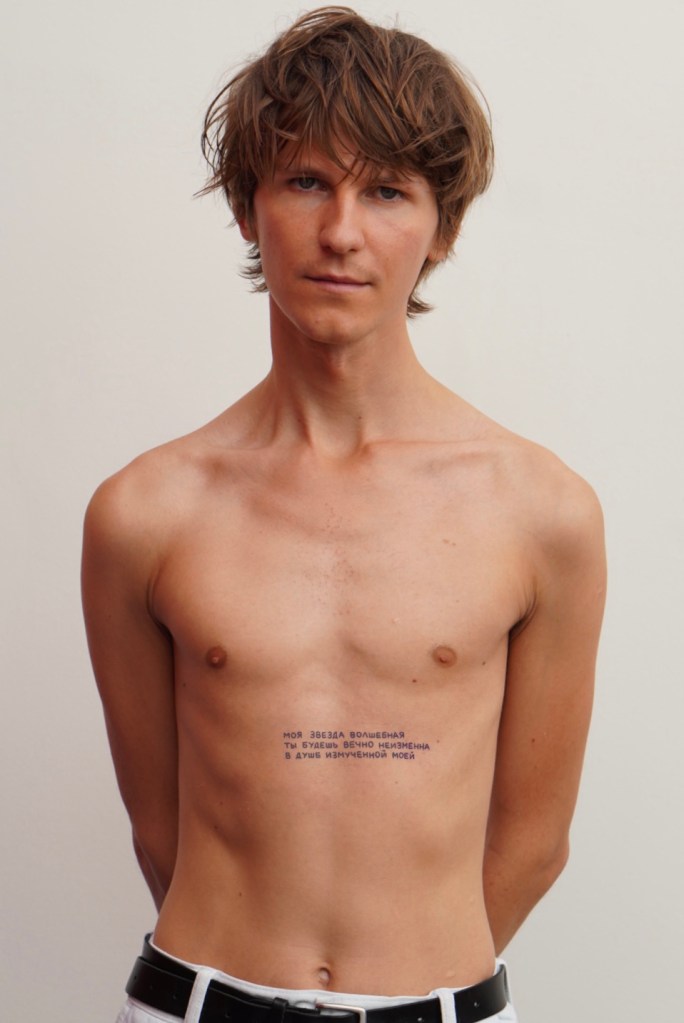
The tattoo, translated from Russian, reads: My Enchanted Star, You Will Remain Unchanged Forever In My Tortured Soul.
Discover more from Your Story By Me
Subscribe to get the latest posts sent to your email.
