“If you had a billion euros, how would you spend it?”
He rubbed his broad forehead and said, “Actually, I have it,” then fell silent.
I stared at him, unconvinced. Maybe he had not understood me. I met his eyes and asked again.
It was Paris, December 2020. Adrien was a stranger, arriving at my studio for his first tattoo, pulling two travel cases behind him. He took off his brown coat. “Like I told you on Instagram, my train leaves Gare de Lyon in four hours.”
I watched him. “We’ll make it. Where are you going?”
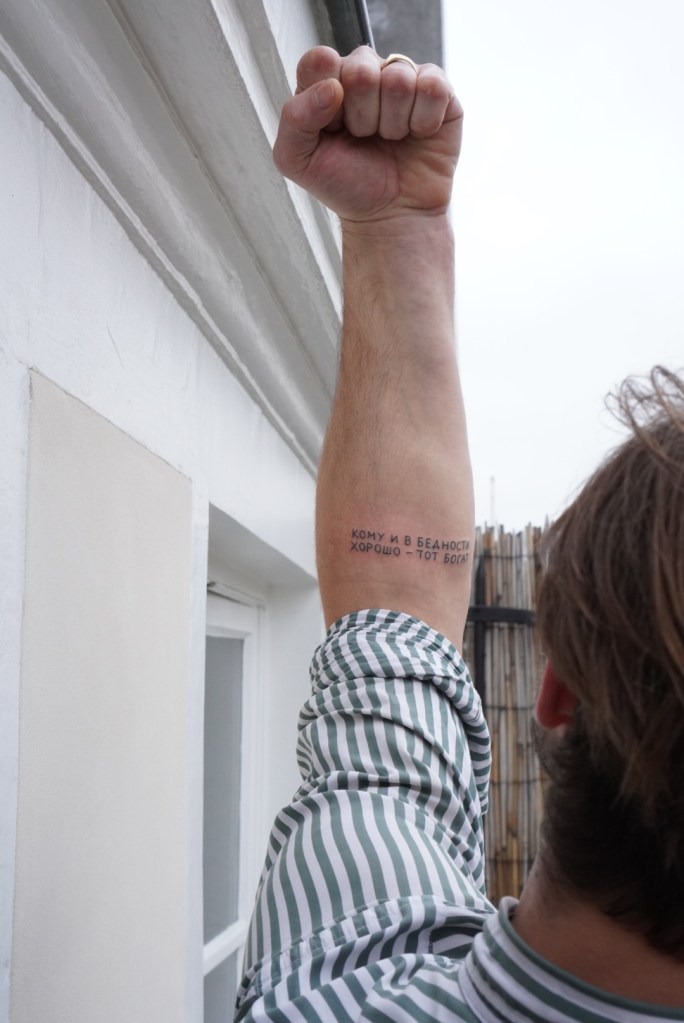
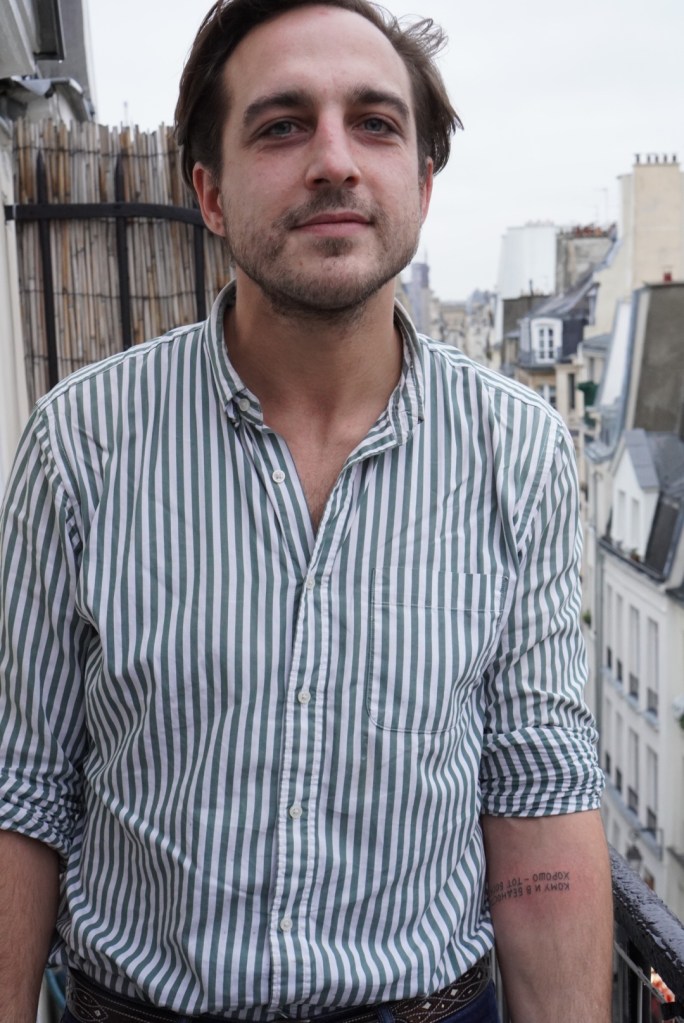
He hung his coat on the wooden rack. “Home. A village called Condillac.” Tall, dark hair, he had a kind, hexagonal face. His eyes looked tired, his stubble self-assured. He wore a striped shirt beneath a brown corduroy jacket—both unbuttoned—blue skinny jeans, and well-worn leather shoes.
“Where were you born?”
“Paris.” He wandered into my studio, glancing around.
I gestured toward the armchairs. “Have a seat. What do you do for a living?”
He sat, crossing his legs. “I’m an antique dealer. I have my own shop in Saint-Ouen, where I restore and sell vintage lamps and furniture. I also make tables from reclaimed wood.”
“How did you get into that?”
“As a kid, I spent every holiday in castles—Belgium, the south of France. Every room was filled with incredible beds, desks, lamps, paintings… Most of them had a soul. No one can imagine the fear I felt. These objects carried stories. The famous people who once owned them, the things written on them, the people who had slept in those beds…” He rolled up his sleeves, revealing athletically muscular forearms. “I was told that in one room, a clergyman had shared his bed with a queen. And that hole in the painting? A bullet mark—from when my great-grandmother, a princess, took up arms against the enemy. But these things weren’t ghostly or creepy. They had presence. Ancestors watching over me. I had to respect that.” He fixed his gaze on me. “I’m sorry, what was the question?”
I smiled. “How did you realize you wanted to be an antique dealer?”
“Ah—yes. Well, whenever I traveled, I hunted for antiques. It became an obsession—to bring something back. To touch the memories of a place through its everyday objects. In India, Nepal, Bangladesh, China… I always thought my trips could pay for themselves if I found enough animist masks, carved wood, or bronze candleholders. But my backpack was always full too soon.”
“Do you remember how this obsession started?”
“It was small objects at first—old books, wooden statues of saints like the ones in my mother’s living room, strange and beautiful candleholders, my father’s typewriter, pocket knives… skulls.”
“Skulls?”
“Yeah. My first was stolen from my biology classroom when I was fifteen. I was in boarding school, fascinated by biology. One night, just before the end of the year, I knew I was leaving, so I took it. A trophy, I guess.”
“I assume you have a lot of trophies.”
He smiled. “Another skull I found in the catacombs. After spending the whole day there, just before exiting, something caught my eye. My flashlight landed on a skull—abandoned, probably by someone else who had tried to take it home. Just like me. So I picked it up. I still feel close to it.” He pronounced “still” the French way—with a soft “l” at the end.
“What do you like most about your job?”
“Woodwork. I need solitude for it. It takes time. Wood is unpredictable, the way it moves. It has depth—like paintings. And I love the finishing work. It gives me peace.”
He massaged his right wrist. “I do everything myself. If my clients in Paris…” He gestured with open palms.
“Is that why your forearms are so broad? From carrying tables? Or were you just born that way?”
He hesitated. “I think both.”
“What’s the hardest part of your job?”
“Feeling stuck. Running constantly—from clients to family, family to clients. The hustle, the noise.”
“What inspires you?”
“Nature. When lightning strikes a field, it leaves a mark that looks like a tree branch. It does the same on people. It’s called a Lichtenberg figure.”
A car honked outside.
“What do you think is humanity’s greatest purpose?”
He exhaled. “I don’t think there is one. Everyone wants what others have. We’re never satisfied. I don’t mean myself, but I’m trapped in it too.”
“So, no great purpose?”
“No. If anything, it’s just… society. The way we think. We create new things—useless, not useless. It’s easy for me to say. I’m lucky. I live in Paris, I have a roof, I eat whatever I want, my kids are healthy… And still.”
“What is love?”
He smiled, exhaling loudly. “Love is sharing. Whatever you can. A smile, a cigarette, a life, money. If you share, you give love.”
“What does your ideal world look like?”
He leaned back, looking up at the ceiling. “Ideal? A world where everyone rides bicycles. If you want to go to China, you go on foot. And…” He smiled suddenly. “A friend returning after four years and bringing you chocolate. And you haven’t seen chocolate in decades. And it’s the best Christmas you’ve ever had. That would be a beautiful world.” He hid his smile, lowering his head.
“What is the most extraordinary thing you have ever done?”
He looked down at the black-gemmed gold ring on his left hand, rubbing it absentmindedly. “Children, really… They give me new meaning. They bring me so much joy and pain, but it’s worth it.”
“What is the hardest decision you have ever made?”
“Mmm… I lost my mom when I was 27, maybe 28. She had a bad disease for four years and… she died. Six months later, my grandmother passed too. At that time, I was empty. I had no energy left for anything. I was ripped apart just from seeing her like that. It was too difficult for me. And it wasn’t really a decision—it just happened that way. I wasn’t running away, but I couldn’t find the courage to be there. And yeah, I have regrets.” He gazed out the window, his focus distant.
“Do you remember a moment, maybe from childhood, when you felt pure happiness?”
“Yeah… but it wasn’t childhood. It was the south of France, on the Atlantic coast. I was 17, I think. I had a big circle of friends, and we were all crammed into a 30-square-meter apartment, maybe 15 of us, with an ocean view.” He stretched his arms toward me, as if measuring the space. “Beautiful waves, an empty beach… It was very early morning, maybe after a long party. And I felt—simultaneously—completely empty and absolutely full. Just pure joy, total simplicity. An instant of grace.”
“If you had a billion euros, how would you spend it?”
He rubbed his broad forehead. “Actually, I have it.” Then he fell silent.
I stared at him. Maybe he had not understood me. I met his eyes. “I mean a billion euros, not a million.”
He lowered his chin toward his chest. “Maybe… not for the record. I don’t know.”
“It seems like we need a second interview. Now, tell me, where’d you get all that money?”
“When I was 25, my mom was already sick. My sister and I started handling her paperwork, and soon we realized—we had a lot of money.
That also meant a lot of responsibility. Managing it takes time. For people who really care about their money, it can be a full-time job. When my mom died three years later, legally, it became mine.”
“How does it feel to be rich?”
He shook his head. “It’s one of my biggest problems. I never consider it mine. It’s an inheritance. And that concept terrifies me. If I had made the money myself, I wouldn’t have a problem spending it. But it came from my mother, from her mother, and her mother before her. I never wanted to be rich. It’s a burden—social, ethical, environmental, local… And finance doesn’t care about those things. So I have to detach myself from the idea of profit.” His face flinched, as if he had just sworn.
“Do you think you could lose all your money in a global economic crisis?”
Two deep lines appeared between his eyebrows, his lips tensing downward. “A global crisis? I don’t know… sometimes I wish it would happen. If the concept of property collapsed or became obsolete, I’d be in the same position as everyone else. Society would have to evolve into something new—good or bad, I don’t know. But I don’t think any crisis would make me as desperate as today’s migrants.”
“Do you mean refugees?”
“Yes, refugees! Again, I’m the lucky bastard.”
“Tell me one last thing: Does the lucky bastard believe in a bright future?”
He leaned back, tilting his head. Then he touched his lips. “No. This is just the beginning. And I think it will only get worse.” His left hand curled around his shirt, gripping the fabric over his heart.
Discover more from Your Story By Me
Subscribe to get the latest posts sent to your email.

Thank you for sharing!
LikeLike