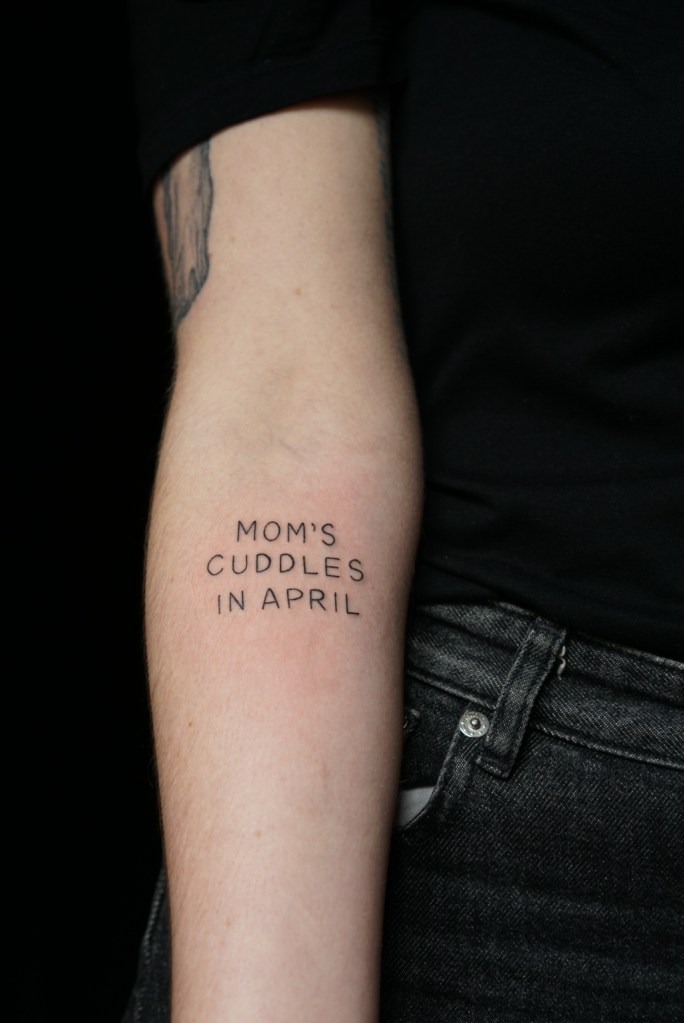
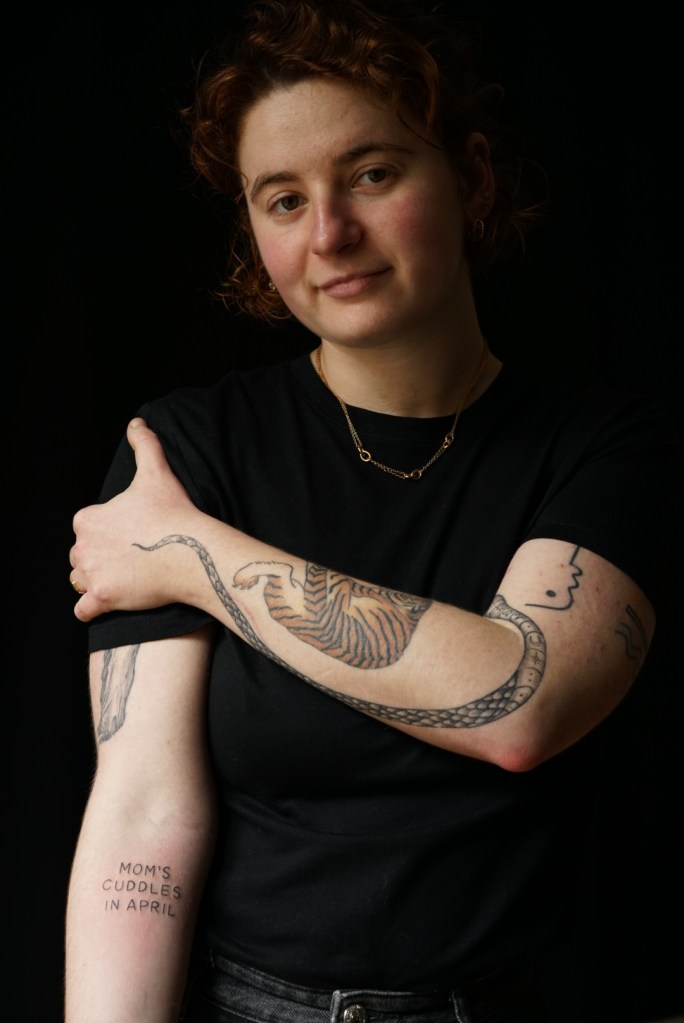
“What makes you suffer the most?” I asked her. “I miss my mom a lot, from time to time,” she said quietly.
“What does it feel like, missing her?” “It’s like an emptiness,” she said after a pause, “a deep ache from her absence. It feels almost primordial. She passed away when I was thirteen. We were so close physically—we cuddled all the time. She was sick for ten years before she died, and she was often tired from chemotherapy. She’d nap a lot, and I’d lie next to her. That became our thing, our main way of being together. We never really had an adult relationship. It was always just a mother and her little child. I can’t say I miss our conversations because most of our bond was nonverbal. But I miss the cuddles.”
“It’s been eleven years since she passed. Do you still miss her as intensely?” “April is the hardest. That’s when she passed. The temperature, the rain, the smell of spring—it all brings her back. The memories are strongest then, and so is the pain.”
“What’s your greatest achievement?” I asked her. “I think I’m fortunate when it comes to making connections with people. I feel loved by them, and that makes me feel truly rich,” she replied.
“What does it mean to connect with someone?” “It’s when there’s an instant spark, a kind of chemistry that creates a shared desire to see each other again,” she explained.
“You mentioned earlier that some thoughts make your life feel heavy. Can you tell me how those thoughts show up for you?” “They appear when I imagine a future where I’m too lonely—without a family, without a partner.”
“Do you feel lonely now?” “Not now. But I’m deeply afraid that the connections I’ve built over time will eventually fade, and I’ll end up alone.”
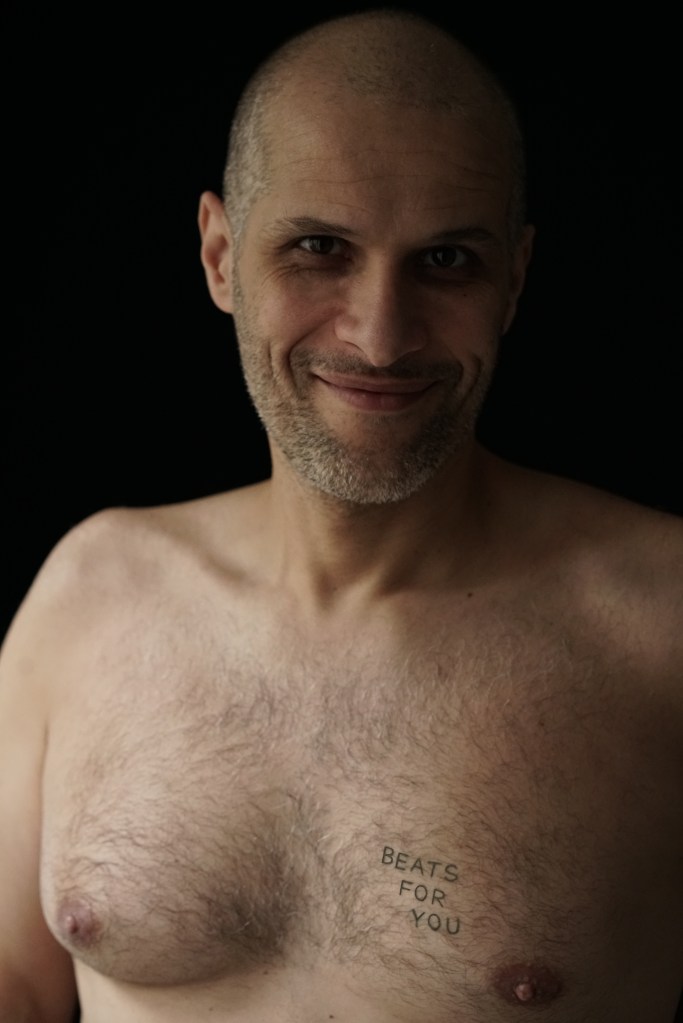
“Is there something you’re trying to avoid in life?” I asked John. “Sure, plenty of things,” he said with a laugh. “Do you mean psychologically or something more concrete?” “Both,” I replied. He laughed again, louder this time. “Well, right now!” he said, his voice booming, almost as if I were in another room. Later, I realized it was part of his expressive, seemingly American style of speaking. Then, more softly, he repeated, “Right now, I’m trying to stay focused on work and keep optimistic. Winters in Paris can get me down, so every year I experiment with strategies to stay afloat. This year’s been pretty good so far. I’ve got a schedule, and I’m sticking to it. You know, as an artist, you’re more or less in charge of your own time, and if you don’t stay reasonably disciplined, everything gets… mushy. So, I’m working to avoid the winter negativity inside me, as well as the distractions outside.”
What kind of winter distractions are you trying to avoid? Well, now that I’m in my forties, I just can’t keep up as easily. A hangover mood can really throw me off. And here in Paris, there are so many people I like and appreciate, but they don’t necessarily nourish me—they can drain my energy instead. You know, you meet a lot of artists who only talk about their work—trying to meet this gallerist, trying to land that show. They might as well be lawyers. I find it so tedious when things feel too professional.
How many people are in your close circle, apart from your husband, Casey? I’m close with my sister and my parents.
You mentioned earlier that your family lives in the States, but you’re here. Does that mean you’re often on the phone with them? Yeah, about once a week. But we text more often than that. Those relationships have become more important to me as I’ve gotten older, he said, then gestured toward a piece of furniture. Is this your massage table? Yes. Do you use it for tattoos or massages? For everything. What else? (laughing mischievously) For relaxation, for instance. You mean just you, by yourself? It could be only me. Just like, face down in that little hole? (laughing) I smiled in response. Oh, right—sorry, back to the close circle. If I’m being honest, in Paris, it’s very small. Even after years here, the most important people to me are still elsewhere. I have plenty of friendly acquaintances, but not many deep relationships.
What do you consider a deep relationship? I’d say it’s when, if I’m upset, I’d want to talk to them. Or when I feel they’re genuinely open to receiving me, especially when I have a problem. Here, it seems like relationships are great when things are good, but not so much when they’re not.
What matters most to you in life? He sighed, falling into a thoughtful silence. Then, in a calm voice, he said, Just living life. Can you explain what that means—living your life? Right now! His voice startlingly loud. Then, as if catching himself, he continued quietly, What does it mean to live my life? I think it’s about moving through different phases. Right now, I’m in a phase of digging deeper into myself. Usually, I swing between two extremes, I’m either entirely focused on work or completely social, with no middle ground. So, I’ve been thinking—what do I want for the second half of my life? I want to find something I genuinely enjoy doing. There’s often this voice in my head, when I look at what I’ve made, asking: Was this truly from within me? Or did I make it just because it’s trendy?
Does that mean you’re pursuing a unique quality in your work? I used to think so, until I realized there’s no such thing as truly unique. So, I told myself to relax and just do what I want to do. I don’t think it’s about feeling special, but I’m still very wary of following the crowd. If everyone is going one way, I instinctively want to go the other. Isn’t that a path toward being solitary? Well, I guess I am pretty solitary. Even when I was younger, I was happy sitting alone in a corner with a piece of paper. Maybe you’ve felt it too, as a foreigner—that sense of being an outsider. It makes me wonder sometimes, what if we had stayed in New York? But even there. I feel like a foreigner now. The city has changed; people have changed. I feel like an outsider everywhere, like I’m not truly part of any place. If I had to leave Paris tomorrow, I wouldn’t miss it. But New York… it still feels more like home, mostly because the culture is native to me. Yet you could meet someone from across the planet and miraculously feel a deep connection. Yeah, totally! And that’s an amazing thing. Do you have those kinds of connections? Yeah… but, honestly, I think I struggle with deep connections. Like, staying in touch over a long period of time. I actually prefer meeting new people. I really love new!” He laughed between sentences, his laughter punctuating his words—it was both odd and strangely captivating. “I’ve had a few close friends since childhood,” he continued, “but maintaining or building new friendships has gotten harder. Maybe it’s because, as you get older, you become more set in your ways, more fully formed. You know, when you’re twenty, you just say, ‘We’re friends now! Let’s do everything together!’ But now, in my early forties, it’s more like, ‘I’m happy to meet you,’ without any expectations.
What is your form? An eagle! (bursting into laughter) This time, I couldn’t help but laugh along with him. It’s a good question, he said, but I’m not sure I have a good answer.
Am I to assume that you miss having a friend? Yes, of course. It would be nice to have more serious friends here. But at the same time… He hesitated, a note of doubt and sadness creeping into his voice. I’m not sure Paris is the city for me in the long term, even though I just had a meeting about my French citizenship—which is funny, isn’t it? He paused, then added, It’s hard to talk about Paris in winter. I really hate it here. I don’t want to blame it all on the weather, but there’s something seasonal about it that pulls me down. And Paris almost embraces those blues, like it’s inviting you to join the winter club: drink all night, smoke cigarettes, and be sad. Oh, God! (laughing bitterly) It feels good for a little while, but at a certain point… fuck, it’s such a drag.
Is there something you dislike about your life? I both like it and dislike it at the same time. It’s this feeling I’ve come to accept—the loss of a primary sense of control over where I live. It’s like I’ve willingly signed up to be a kind of military wife, following where Casey’s battles take us. If it’s New York, we go to New York. If it’s Madrid, then Madrid. And what makes that so difficult? It’s that whenever I tell myself I’m going to fully commit to a place, to really be part of it, I also know I’m equally prepared to leave at any moment. It’s like I never truly unpack my bags—mentally, at least. And now, it’s been eight years of living like this.
Do you have any regrets? I used to… In my twenties and thirties, my temper would go so high it felt like an out-of-body experience—blind rage over nothing. It could be something as trivial as someone stealing my cab. I’d find myself holding the door open, screaming at the person, and then suddenly I’d float over myself, thinking, What’s wrong with you? His voice dropped to a whisper. You are literally out of control. He paused, then continued, It felt extreme, especially with strangers. It’s easier to be mean to them, to dehumanize them, because you think, I’ll probably never see them again. But now, I try to do the opposite—and it’s so much more fun. It usually gets better results, too. If someone annoys me in a small way, instead of snapping, I start by smiling at them. Not in a sarcastic way, just a genuine smile, reminding myself that everyone has their weird moments of irritation. It’s like a magic trick I’ve learned over the past six years.
How does it feel to be in your body now? It’s not always easy, but still more comfortable than when I was younger. Even though you have less energy? Sure, I’d love to have more energy, but I’ve learned how to use it differently—how to direct it, to have some control over it. When I was younger, I was drawn to people with chaotic energy. They were never boring, but, wow, were they exhausting. At first, being with people like that felt exciting, but after a while… it’s always the same thing. Just another chaos person.
What is the most important lesson life has taught you? That we’re so insignificant. And it’s such a relief! Our complete unimportance—it’s so nice. I don’t understand why people want to be important. It’s a privilege to just be a speck of dust that’s part of the universe. We don’t really need more than that. The things we think are more—they’re not more at all. Society’s structures of awards and rewards, the constant drive to attain something else, these endless hoops to jump through—they’ll occupy you, sure, but they’re not important. I heard someone say the other day, let’s be honest, there are probably eight or ten real geniuses out there making discoveries that actually make our lives better—and that’s fine! I’m not going to invent some alternative energy source that saves the world. But maybe I’ll create some artwork that shows a scrap of truth to someone. That’s nice, and it’s more than enough. In the meantime, I’m here, and I just want to juice this orange as much as I can—because life is short.
Why is life short? And what if it were long? I’d probably kill myself. (laughing) Isn’t that the whole thing about vampires? They get so bored of living. Or those tech guys who want to live forever—I always wonder, why? That sounds completely unappealing to me. I find it appealing if I think I’d be able to try out different life scenarios. Right now I feel imprisoned, or maybe just dedicated, to one lifestyle. Yeah, that part does sound cool. Do you think if you became, like, a brain surgeon, you’d be happier? Maybe. But I’d want to try it not for the sake of happiness, but just to experience it. Yeah, I get that. I wish I could have so many more experiences, too. Were we talking about jobs for the day? I nodded. I’d love that! Just a hundred different jobs, one day each. I wouldn’t even need to do the job—just sit next to the pilot on an international flight and watch what it’s like. But wouldn’t you miss the delightful nuances that come with real knowledge? That’s true. But do you have a list of completely different lives you’d try? If you could live just one more, what would it be? A monk, maybe a shaman. Yeah, I’ve been drawn to the idea of being a monk, too. Meditating, growing vegetables, having your whole day regulated and ritualized. Life in a monastery—there’s something about it that appeals to me. Probably because my life is the total opposite of that.
What does love mean to you? Real love is growing and changing with someone. It’s about accepting them, loving through the good parts and the bad. Idealizing love isn’t great. Honestly, I don’t know how I ended up in a relationship that’s lasted this long. I don’t have a secret; I just don’t expect things to be perfect all the time. I don’t expect him to make me happy. It’s strange, but sometimes I feel love the most when bad things happen. Like with my parents, as they’ve gotten older and started having problems, I’ve felt so much closer to them. It’s made me realize how deeply important they are to me. Do you feel less love when things are fine? Yes, I think so. Or at least, I don’t question it as much. Maybe true contentment is one of those things you can’t fully see or appreciate while you’re in it. You only recognize it in hindsight. I have this habit of thinking things were better in the past. It’s like when you take a picture of me, and I hate it in the moment. But three years later, I’ll look at it and think, this is the most beautiful picture. You were so handsome, why didn’t you love it immediately? It’s ridiculous, but I can’t help it.
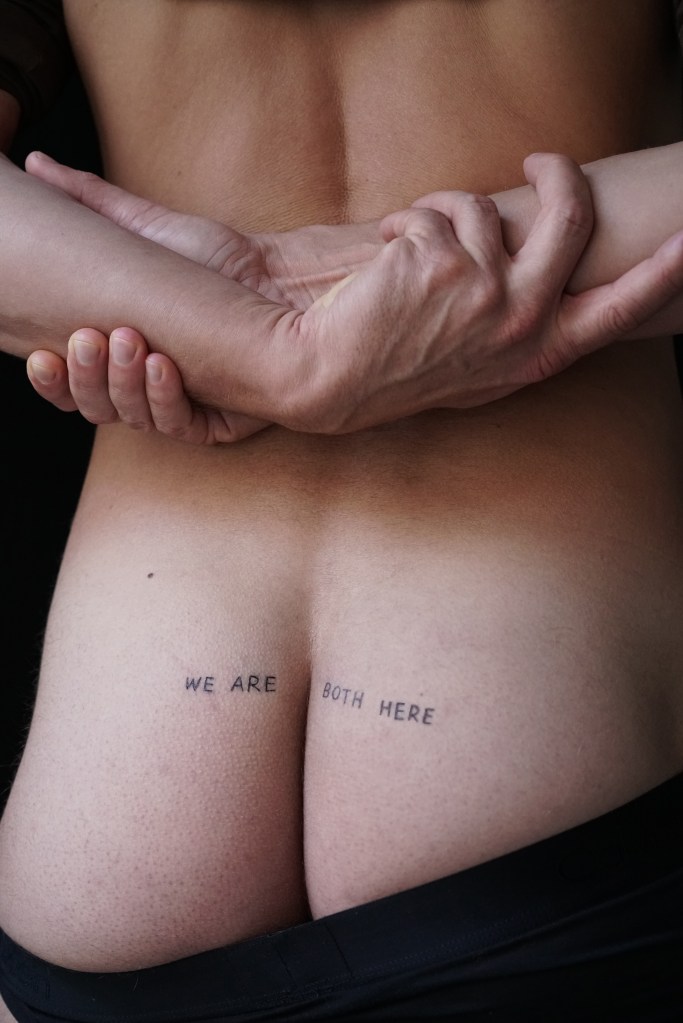
I feel like you radiate charm when you speak. How do you do that? I can feel when I’m doing it, (smiling). Because I can also turn it off. It’s a physical sensation, like opening myself up to someone, being vulnerable. All of that brings me closer to another person. It’s like saying, We’re both here, neither of us knows anything, so let’s just not know anything together. And that’s fine. He oozed a calm, magnetic serenity.
How would you like to be remembered? I couldn’t care less. Life is now. Thinking about how I’ll be remembered feels like such a waste of time.
“I opened my pharmacy in this part of Paris, a central area that’s home to many emigrants, especially those newly arrived. This situation has shaped the way I work, pushing me to adapt and provide genuine support for these people. Being a pharmacist here is nothing like working in the tourist districts, where pharmacies often function as little more than cash machines. Here, I have to be deeply sociable. I can’t turn away from people who are suffering—that’s simply not in my nature. This quality seems to draw people to me. I respect every person who steps through my door and do my utmost to help those in need. It’s this approach, I think, that keeps bringing more and more people to my pharmacy.”
“How do you assess a charge for them and for their need for medicines?“ “I don’t charge them directly. The government provides compensation for the cost of the medicines through prescriptions, but that doesn’t cover the time I spend with these poor people.”
“Does it mean that you are regarded as a doctor?“ “Well, yes—especially those who’ve walked all the way from Afghanistan. They don’t speak a word of French, and to them, anyone in the medical field is considered a doctor.”
“That seems difficult to me, in what language do you communicate?“ “I’ve picked up bits and pieces of their language—words and phrases I’ve learned from other emigrants over time. When needed, I use a translator. Plus, I speak Arabic and Farsi, which often helps bridge the gap.”
“Why is it so important to you to help these people?” “I came to France as an emigrant myself. I was 18, a student—an ideal starting point, in theory. But even then, I struggled a lot with the French bureaucracy, especially when it came to documentation. Opening my pharmacy later on was no less daunting—it was as challenging as any nightmare you could imagine.”
“Did you choose this area on purpose, or was it just a coincidence?” “Yes, I chose it deliberately, though I had no idea it would be so different from other parts of Paris.”
“How do people from Afghanistan, for example, find their way to this area?” “Well, part of it is cultural—their food and community are here. But more importantly, we’re close to Gare du Nord, which is a major transit hub. It’s incredibly convenient, connecting multiple metro lines, trains, and even international routes. Many of them originally intended to go to England, not France, as their final destination. Gare du Nord is the gateway to London, so they arrive here with that hope but end up staying, since France is still relatively welcoming to refugees. That said, most of the people you see on the street can’t afford to live here. They’re actually homeless. They gather in this area, spending time with others in similar situations, and try to earn money by selling goods. What’s ridiculous, especially for the Afghans, is that their refugee status doesn’t allow them to work legally. They receive 400–500 euros a month from the government, which isn’t nearly enough to pay rent in Paris or even cover basic necessities. This forces them into illegal work, like selling cigarettes. And, of course, everyone knows this is happening—the authorities, the government—but they choose to look the other way instead of addressing the root of the problem.”
“Why do you think the state doesn’t want to address this problem?” “They don’t want to allocate more money to refugees than they do to unemployed French citizens. It’s a delicate balance—they’re trying to avoid sparking conflict with far-right politicians and their supporters.”
“Now that you have a French passport, do you see yourself as French?” “I see myself as French, but also as Moroccan, African, and, above all, human. I don’t belong to a single identity—I carry many within me.”
“What does it mean to be human?” “First, to exist. Second, to see others as your equals. Every refugee who comes to me—no matter their condition—is a person deserving of respect. Even if the man standing before me is in terrible shape—sick, coughing, his skin covered in sores, dressed in rags, and carrying the stench of hardship—he is still my brother. It’s my duty to help him and treat him with dignity. I never judge. Instead, I try to put myself in their shoes. If I were in Afghanistan, I’d likely do the same—I’d flee from the Taliban.”
“Are you ever afraid of catching a deadly disease?” “It’s a risk I have to take. When you’re helping people as a medic, you can’t let fear stop you—if you don’t take that risk, they might die.”
“Why do you want to treat people, considering that modern medicine contributes to human overpopulation? Overpopulation leads to resource shortages, famine, and even wars, ultimately resulting in poverty and a population overshoot.” “Should I just leave people to die on the street?” “That’s not what I meant.” “I believe the key lies in education. Well-educated people tend to have fewer children and are more likely to adopt. They’re also generally more eco-conscious. Education addresses the root of these issues without sacrificing compassion for those in need.”
“What do you consider your greatest achievement?” “I remember one day a man came to me with a piece of paper taped to his chest. When I removed it, I found a large, infected wound—a gaping hole. He was on the brink of death from septicemia. I treated him as best as I could. If he had gone to a hospital, they would have demanded documentation, which he didn’t have. He had walked here alone, exhausted and terrified, clearly too afraid to seek help elsewhere. A few days later, he returned to see me. He said, ‘I feel better. You’ve saved my life.’ That moment—that gratitude—felt like the greatest achievement of my life.”
“What is the most important lesson life has taught you?” “That I should never judge anyone by their appearance or first words. The way people look or speak often doesn’t reflect what they carry inside. There’s always more to a person than what meets the eye.”
“How can you know what someone carries inside?” “You just have to give them the opportunity to talk—and then truly listen. For example, I once met a man who seemed shy and kind, almost unassuming. Over time, I learned he was from Chechnya and had been a leader in the rebellion movement against Kadyrov. I translated his documents from Russian, and he was supposed to be dead. If I hadn’t taken the time to speak with him, I would never have known he was a true fighter against the regime.”
“What does kindness mean to you?” “Kindness is treating everyone with the same respect and care, no matter who they are.”
‘“What is your greatest fear?” “That far-right politicians might come to power in France. If that happens, I’ll leave the country.”
“Is it because you can’t align with their views?” “It’s more than that. I’m very passionate about history, so I understand the implications. If extremists like the Nazis were to take power, I’d likely be one of the first targeted. It’s better to leave the country as quickly as possible in such a scenario. Interestingly, when Hitler rose to power in Germany, the largest group of people who fled were Germans themselves. They could read the warning signs in their own language and knew exactly what was happening. In contrast, the people who suffered the most under Nazi exterminations were often from Eastern Europe. Many of them believed it couldn’t happen and stayed, unable to foresee the horrors that awaited.”
“Do you have any idea where we should go if things take a turn for the worse?” “Yes, and it might surprise you—it would be Germany. It’s strange, I know, but countries that have already experienced extreme right-wing governance have taken significant steps to organize their systems and prevent it from happening again. France, on the other hand, hasn’t fully learned that lesson. There’s still a tendency here to believe that their army single-handedly liberated the country from Nazi Germany. That’s not entirely true, as they received substantial support from other nations.”
“Is there something that keeps you awake at night?” “Yes, lately I’ve been losing sleep over Israel and Palestine. I grew up in Morocco, where Jews, Catholics, and Muslims lived together. What’s happening in the Middle East now feels like a tragedy. I’m deeply convinced that peace isn’t just morally right—it can also bring economic advantages.”
“How do you imagine peace between Israel and Palestine?” “Peace would have been possible if the two-state solution hadn’t been undermined by the leaders of both nations. Sinwar and Netanyahu have both violated the Oslo Accords, making peace much harder to achieve.”
“Why does this conflict trouble you so much that it keeps you awake?” “Because it’s deeply sad to see the most educated people in the Arab world fighting each other. Not long ago, it seemed possible for them to avoid this path.”
“I want to quote the Israeli philosopher Yeshayahu Leibowitz, who passed away in 1994. Over 30 years ago, he argued that the continued military occupation of Palestinian territories would lead to the moral degradation of the Israeli Defense Forces, with individuals committing atrocities in the name of state security. End of quote. I believe that degradation is exactly what we’re witnessing today. Just recently, Israel’s Defense Minister, Yoav Gallant, said, ‘We are putting a complete siege on Gaza… No electricity, no food, no water, no gas… We are fighting human animals, and we are acting accordingly.’” “Yeah, the issue is that there are no pro-peace voices in the government.”
“But you said it was possible to avoid this not long ago.” “Yes, but not with Netanyahu in power. He’s an enemy of peace, just like Putin or Hamas. I once heard he said he wanted to turn Gaza into a parking lot—implying its destruction and the deaths of two million people, just like that…” His voice faltered, trembling as if he were on the verge of tears. “You know, I’m against the death penalty, even for the most terrible people. I’m deeply convinced that even the worst person has something good to offer the world.”
“Would you kill someone if you knew it would save thousands, or even millions of people?” “No, I’m against killing under any circumstances. I’m fortunate to have grown up in Marrakech, where there hasn’t been a war since 1912. There have been no weapons there since then, except for hunting animals. I believe that heavily armed countries inevitably use their weapons, and that always leads to disaster.”
“And France is one of them.” “Yes, and one of the biggest arms dealers.” “Isn’t that also a matter of national security?” He made a face. “It’s more about business than security.” “Okay, let’s imagine France disbanded its army. I don’t think that would stop another country from launching a military attack.” “France was occupied during World War II even though it had one of the best armies in the world. Meanwhile, Switzerland, which has no standing army, wasn’t occupied.” “But isn’t it unethical to remain neutral in the face of evil? Shouldn’t we take a stand to fight against it?” “I don’t think so. I believe in dialogue. We should talk to people who are wrong, help them see there’s a better solution than killing.” “Wasn’t it hypocritical for Switzerland to bank for the Germans?” “Yes, but at the same time, they were banking for people like Schindler, who saved 1,200 Jewish lives. The Swiss banking system was in business for everyone around them.”
“What do you think about the comparison between Israel and Nazi Germany?” “That’s absurd.” “But it’s a topic that’s been in the air for a long time.” “Sure, but only for people who’ve never been to Israel. In Israel, you can be an Arab or a Muslim and still have the right to vote, own a business, and even become a member of parliament. Compared to neighboring countries, Israel is indeed a democracy. The problem, however, is that Israelis are becoming increasingly religious, with some pushing to form a purely Jewish state. Defining a country along religious lines signals the end of democracy.”
“Are you religious?” “Yes, I believe in God. I’m Muslim, but I practice alone—I don’t like making a show of it.” “What is it that you practice?” “I observe Ramadan, and I pray.” “What do you pray for?” “I don’t ask for anything specific. I read the Quran, page by page.”
“How do you define God?” “God is love, protection, and hope for a better life.” “And what does love mean to you?” “Love is when my heart beats faster for someone else.”
“If you were face to face with God, what would you ask Him?” “I’d ask Him to eliminate all the weapons in the world.”
“How would you like to be remembered?” “As someone who helped others.”
I met Luc in the Bois de Vincennes, early June, 2022. He was shirtless, white leather pants streaked green. He looked like trouble and peace rolled into one, flashing a slow, dangerous smile while his friends talked about nothing. I sat across from him, lit a cigarette I didn’t want, and watched him watch me. He said he wanted to spend a week alone in the forest. I told him I’d just got out of three years in one. That made him grin wider, like he’d found something rare. He didn’t blink, didn’t break gaze. As the sun dipped behind the trees, everyone else seemed content to stay in the shade with their hummus and laughs, but he and I drifted toward the edge of the lawn, chasing the last rays. We lay down in the tall grass. Spoke low. There was something about his calm and joyful presence that felt romantic. By night’s end, we’d made a plan. His place, Pigalle. Few days.
Is there something you’re waiting for in your life? I’m waiting to be happy. I think sometimes this constant running doesn’t allow me to see that I already am. You know, that strange thing about happiness—it’s often only in hindsight that you realize: that was it. And that frustrates me. It’s rare when I can say, right now, I’m really happy.
When was the last time you felt that? When you knew the moment itself was happiness? A long time ago. It was when I decided to divorce. My husband came to Paris just after the lockdown. I hadn’t wanted to go back to Berlin, to him, so I kept lying—saying there were no flights because of Covid and so on. One day, I was on acid at a friend’s place in the countryside. He called me on FaceTime. I noticed he was in a car that wasn’t ours, so I asked about it. ‘I rented it,’ he said. ‘Why?’ ‘Because I’m coming to Paris.’ I was shocked. He said, ‘Yeah, there are no planes, so I’m driving to pick you up.’ He was so in love. He arrived just as I was coming down from the trip. I jumped in the car, and we drove twelve hours back to Berlin. When we got home, I was feeling so sick that I wanted to vomit. Then I told him: I want a divorce. He started crying. I was talking and talking, trying to explain myself. Eventually, he left to return the car. And when he walked out the door, I felt… wow. It was sunny. I was standing on our pink carpet, completely relieved, excited about my future. It felt like the beginning of something new. I was happy, like a kid the night before vacation.
What went wrong in the marriage? I think I just melted into it. Before him, I only knew crazy, passionate love. Always intense. Always burning. I knew I was in love when it felt like fire, and it was as good as bad for me. But when I met him, he fell in love with me immediately. Everything was easy. We were a good team. He was my best friend, my confidant, the sex was good… but I didn’t feel that fire. I was just okay. And I thought: maybe this is what true love looks like. My friends kept saying, ‘Luc, you always live love like a crazy—maybe it’s time to grow up.’
What do you mean by crazy love? The guy before him—I loved him the most. But we never had sex. He had some issue with his penis, couldn’t go through with it, so we always had kind of the beginning of sex, but then he would leave my house. He was an alcoholic. And we ended up having a real fight in the street. I broke his nose. He broke two of my fingers. I’m not violent—it’s not who I am. He turned me into someone I didn’t like. But when he was near me, I didn’t need anything else. We didn’t even have to talk or touch. Just his presence made me feel whole. That’s what I call crazy. Without him, life lost its flavor.
What happened after the boxing match you had with him? The next day I had to dance at the Opera. Arte was filming me. So I remember seeing myself on TV with a cast on my hand, unable to move it properly. I thought, My God, Love should never do this to anyone. I only have one hand. It’s everything to me. And I hurt it. We hurt it.
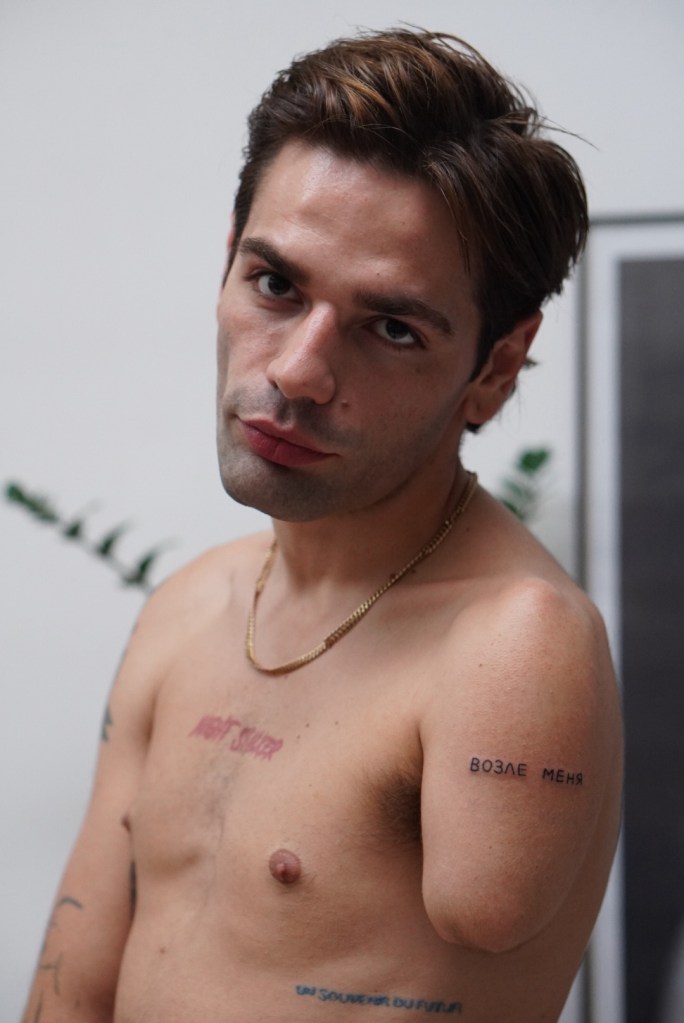
What does love mean to you? Everything. I don’t feel alive if I’m not in love. It’s like my soul is waiting. Also, to be me is to feel always lonely. I was born without an arm, so I was an outsider from the start. I also realised early that I was gay. At 17, I started using heroin. I contracted HIV. All of that took me further from society. I felt so lonely, so misunderstood. People living “normal” lives can’t understand. That’s why love is the only thing that dispels my loneliness. When I’m in love, I belong. I feel seen and accepted for who I am—not validated, just understood. Love lets me share the joy I feel about being alive. And I do love life so much. But life alone has no meaning for me. When I’m in love, I stop thinking about the past or the future. I’m fully present. I have to be. And I love that feeling.’
Do you feel vulnerable in those moments? Vulnerability took work. When I was younger, I didn’t let myself be vulnerable with people I loved. I wanted to remain this fantasy—charming, confident, strong. I modeled for ten years. That’s how I realised I was beautiful and I have an example to give to someone who is, maybe different, but also considered as a beautiful and charming outsider, and actually belongs here. It also gave me the legitimacy to seduce. I thought I have to do it all the time. But now, I’ve discovered the part of me that needs to speak out, to be soft, to be real. And it’s so risky.
What’s the risk? If people love you when you’re vulnerable, they love you. But if they don’t… then you can’t pretend. It means they saw you and didn’t love you. And for me, it’s really hard to accept that someone doesn’t love me. I’m not confident enough to withstand that. I think I’m always searching through other people’s eyes for the love I can’t give myself. Right now, I’m trying to work on that — to find love within my own chest, to be able to be myself no matter what, to be strong and vulnerable at the same time. Because if I’m okay with myself, if I love myself enough and I’m vulnerable in front of people who don’t like me, then I won’t be destroyed anymore. But before… It’s still hard when I’m in front of someone who doesn’t validate me — or even if I hear that someone I don’t know hates me. It hurts me a lot, even though I know I shouldn’t care. But it hurts me deeply. That’s why I have to find love within myself.
What do you love most about yourself? That I understand how big life is, and how small I am in front of it. I love my humility. I know how to observe—because I had to. As a child, I had no friends. Other kids were cruel. So I watched people, studied them. I learned how to belong. And when I applied that knowledge, everything came—modelling, fame. But these aren’t my rules. I want truth. I want people to stop looking from inside their bubbles, assuming they know the world. I want them to see beauty again.
Is there something you deplore about yourself? My insecurity about my body. Once I understood I’m not a teenager anymore, I started aching for a man’s body. I go to the gym, but it’s frustrating. People with two arms can do push-ups and see instant results. Me? If I want to transform my body, I need outside help—a prosthetic that costs €8000 and takes two years to adapt. I hate limits. I hate when my body makes me feel weak. A year ago, I wouldn’t have admitted that. I was too proud. And that pride—that’s part of the problem.
Where does your pride come from? A coping mechanism? Yes. It was my way of hiding insecurity. If you want to be seen as “normal”—not as a disabled guy or a faggot—you have to act strong. You have to be strong. If I showed weakness, people would label me. If I couldn’t be independent with one arm, they’d treat me differently. So I faked normal for so long, I stopped asking whether I was okay. Also, my mum felt so guilty when I was born that she got depressed and I had to be strong for her, too, and to tell her, ‘Mum, it’s not a problem. I’m okay!’ I had to say that so early… I never got the chance to ask myself if I really was okay. And now I know—I wasn’t.
I didn’t know what to say. So I asked him something random. What’s your guilty pleasure? Sex, he said softly, and smiled. Why guilty? Because I love it too much. What’s too much? When I spend the entire day thinking about it. When I have sex without even considering the other person. Sometimes I do it just for the mechanics—just hormones. I’ll go to saunas I don’t even like, just to find guys who’ll sleep with me. It feeds my ego. I feel like I could have anyone I want,—he snapped his fingers—but then I have sex with people I wouldn’t even talk to if we had a two-minute conversation. I regret that. I’ve put myself in awful situations, just because I wanted to feel someone inside me.
I’ve heard that the desire for sex isn’t as raw as hunger, thirst, or sleepiness — that it often stems from something else, like a sense of loneliness. True. When I’m in love, I’m faithful. And it’s not a rule—it’s just how I am. If my partner wants to sleep with someone else, I don’t mind. But I’m a dreamer. I always hope I’ll be enough. When I’m in love, my body belongs to that person. I can still notice someone else is cute, but it doesn’t move me. But when I’m not in love, it’s different. I’m vainly looking for love through sex. And of course I get disappointed. So I do it again and again, hoping the next guy will be enough. I never believed love would just find me—I thought I didn’t deserve it. So I hunted for it like a job. I’m trying to stop that now.
Why did you think you didn’t deserve love? I hate saying this—it sounds like cliché psychology—but it’s the truth: I had a bipolar mother. Sometimes she was loving, sometimes violent. She’d say I ruined her life because I was disabled. It was so harsh. Then she’d cry and apologise. But the words stayed. I believed I was the problem. Now, I’m finally facing the truth. What truth? That my childhood wasn’t unhappy, but my family was crazy. I was kicked out at 14 for saying I’m gay. My dad left without a word—his new girlfriend didn’t want kids around. Everything I have now, I built alone. I’m my only close friend. No one took big risks for me. No one was there when I really needed it. And I don’t blame them—I didn’t share my problems. I was too proud. Too insecure.
Do you have any dreams beyond love? No. He laughed. Even my career is tied to it. I used to think fame would bring me love. As a teenager, I believed that being famous meant people would care. And now that I am famous—at least in Paris—I see it’s the opposite. People are drawn to the image. I don’t know if they love me. It’s lonelier. In my last relationship, that was the problem. He was 22, a young actor. He was in love—but not with me. With the idea of me. He knew so much about me before we even met. And when I realised that… I felt truly alone. I just want to be seen for who I am.’
And who are you? I’m a nice guy. The nicest. I want people to be happy. I don’t care about the things people assume I care about—my image, my clothes. I really don’t. I just want to share my love for life. But people can’t see that because of the image.
What excites you about life? I almost died when I was 19. Heroin and HIV. I went to rehab. Took a bunch of tests. On my 19th birthday, the doctor came in and said, ‘Bad news: you’re HIV positive. And if you don’t stop using, you’ll be dead in two or three weeks.’ That’s when life started making sense. Before that, I never asked if I wanted to live. I was just a kid destroying myself by looking for pleasure.
What makes you sad? Loneliness. Injustice. Stupidity. What do you do when you’re lonely? I have sex. No matter where I am, I create the conditions for it. Do you feel less lonely after? Sometimes. Sometimes it’s a good distraction. Sometimes, I feel even lonelier afterward.
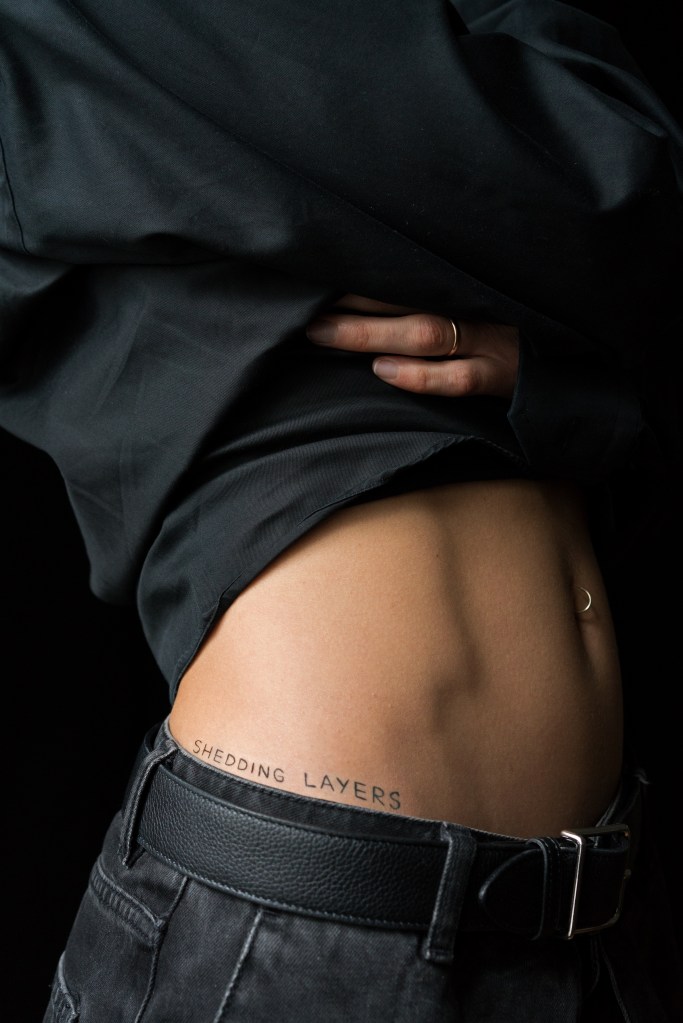
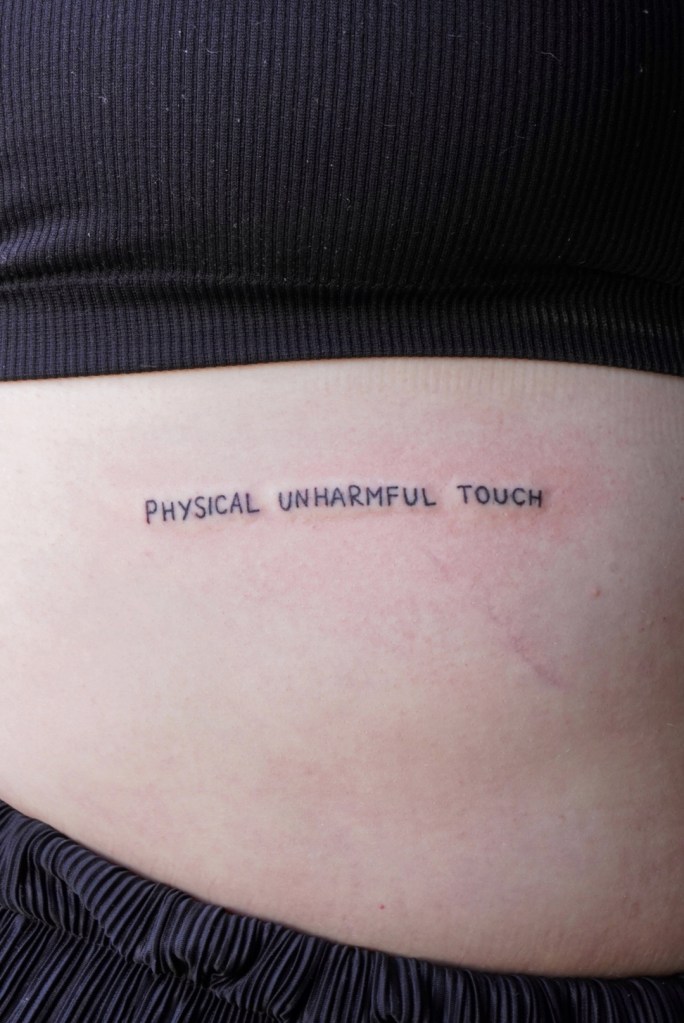
I have an idea for the words I’d tattoo on your left shoulder.
What are your aspirations? I aspire to what my body asks, she said, linking her hands behind her head. And how does it ask you? Affectionately.
Is there something you feel is missing in your life? Yes, a grip on the material world. Interesting. Can you explain? I don’t know how to make money yet, she replied, sliding down the sofa and gazing out the window. It’s like I’m floating in the clouds, and money is this elusive prey on the ground. Sometimes I wonder if I need it at all. But then I think—if I drift too far, I might become an urban madwoman. By the way, they fascinate me. She touched the sofa lightly with her fingers, her black-painted nails tracing its texture.
What’s the most important lesson life has taught you? She grinned. There are many, but the latest was not to live in Moscow, she said, ending with a brief, nervous laugh.
What was that lesson about? Not to stay in a place where I feel joyless. Could you feel joyless and then joyful in the same place? Like when the seasons change? I might feel joyless in Paris, but never because it’s Paris. She sat up straighter.
What’s the hardest decision you’ve ever made? I always choose the easy ones. Was it easy to leave Moscow? Absolutely. How did you end up there? I followed my boyfriend. Did you realize right away you didn’t like it? Yes. Initially, we planned to stay for a few months before moving on. After a year, I went on vacation, she smiled shyly, as if confessing a guilty pleasure. And I decided I’d never go back.
What do you like about Paris? I like what’s happening here, with the people. I enjoy witnessing it, being part of it.
What does love mean to you? She paused. The ability to give. To give what? Anything. But that’s not love itself, just the act of love. What love is—I don’t really know.
When was the last time you cried? When a girl at work corrected my writing about kisses. It felt like she walked into my house, rearranged everything, replaced the beautiful with the ugly, and left as if she’d never been there!
Why do you write? Because I’m very good at it.
What other talents do you have? I have a lot of feminine energy. Though it’s more a gift than a talent.
What’s feminine energy? I can make you feel good. With me, time stops. Her word “you” touched my ears as if she had reached out and caressed them with her fingers.
What do you believe in? I believe we live only once, and that’s wonderful. What’s happening now has never happened before and never will again. Each moment is unique. That’s beautiful. I love it.
Where do you see yourself in ten years? In a bathrobe, barefoot, at my own hotel, surrounded by nature. Is that your dream? Yes. To teach people how to rest, to stop rushing, to feel like there’s no need to go anywhere.
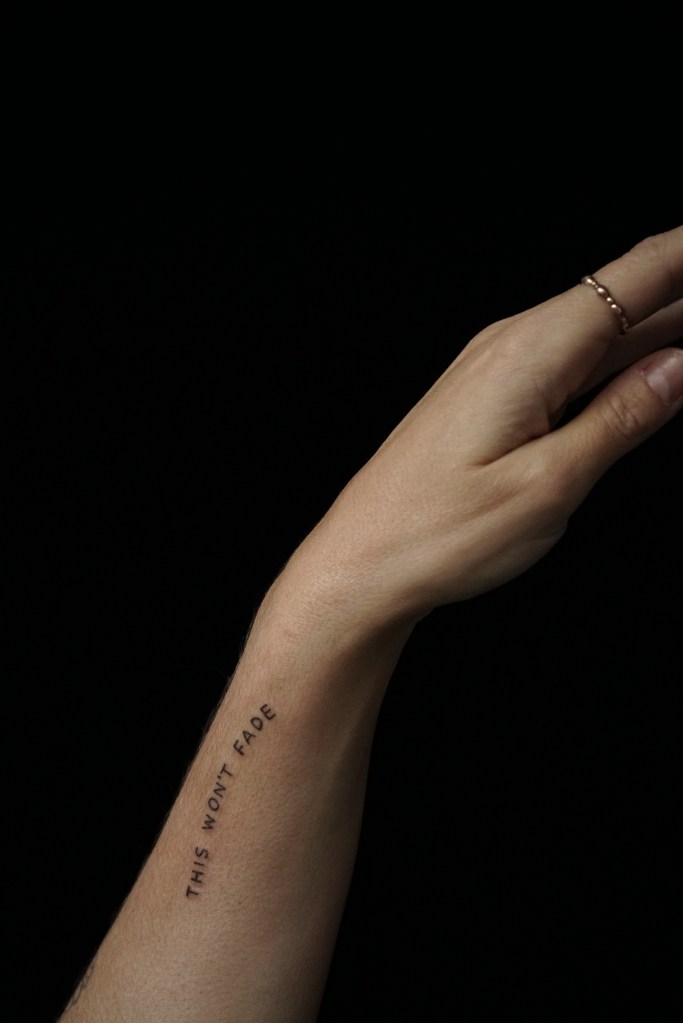
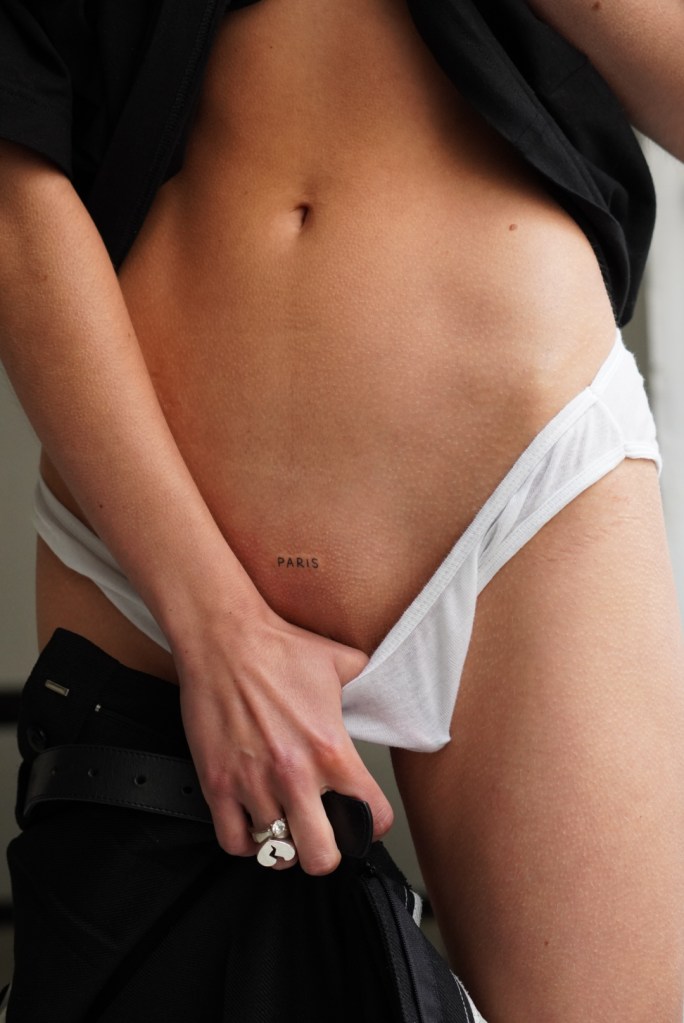
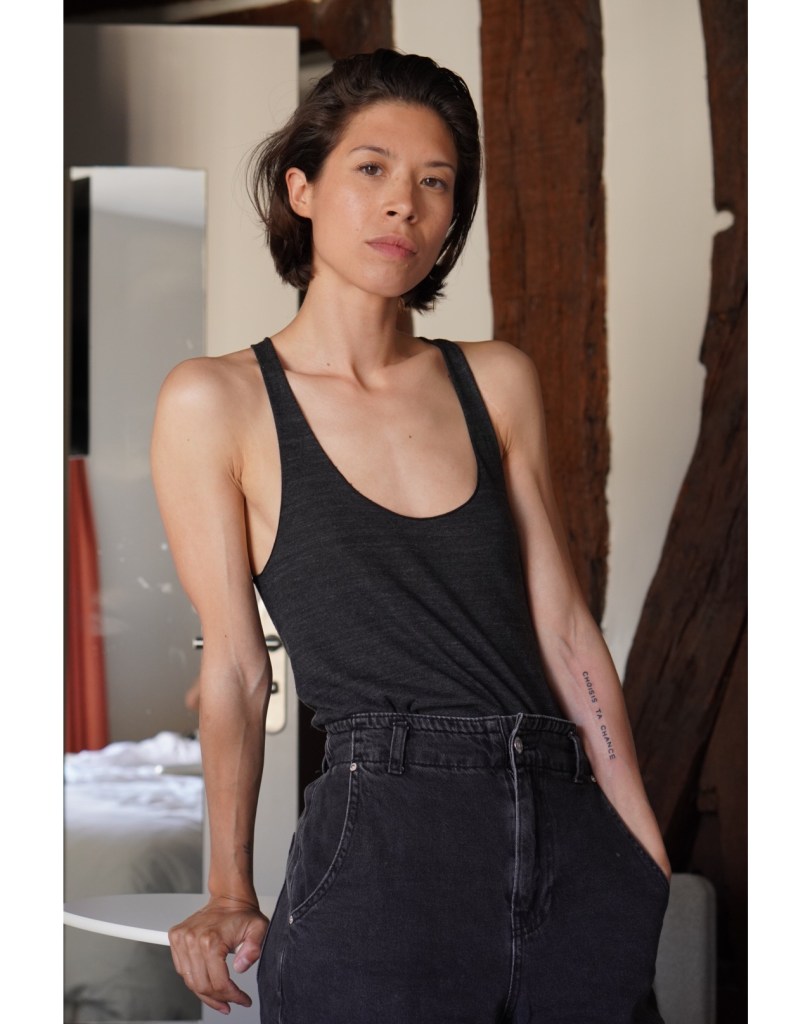
‘No need to go anywhere.’ That suits you well. I’d be glad to tattoo this for you. I like that! But my final tattoo has to be the word ‘Paris.’ My numerologist says I shouldn’t get tattoos, but I’d decided on this one before he told me. And he couldn’t explain why they’re forbidden. Do you smoke? Do you want me to smoke with you? No, I just forgot my cigarettes. You said, ‘no need to go anywhere,’ right? Yes. The other day, I was thinking about the difference between ‘need to’ and ‘have to.’ She picked up her phone, scrolling. ‘Need to’ is about something missing that you once had. ‘Have to’ is asking for what you lack. Let’s get coffee! Impulsive, dynamic, turbulent—she was all of this.
After coffee, we returned to the studio, and she asked me to tattoo “Paris” on her pubic area. I sketched the design, and she stripped naked—perhaps to better visualize how the tattoo would align with her body—and stood before the mirror, deep in thought as she examined her reflection.
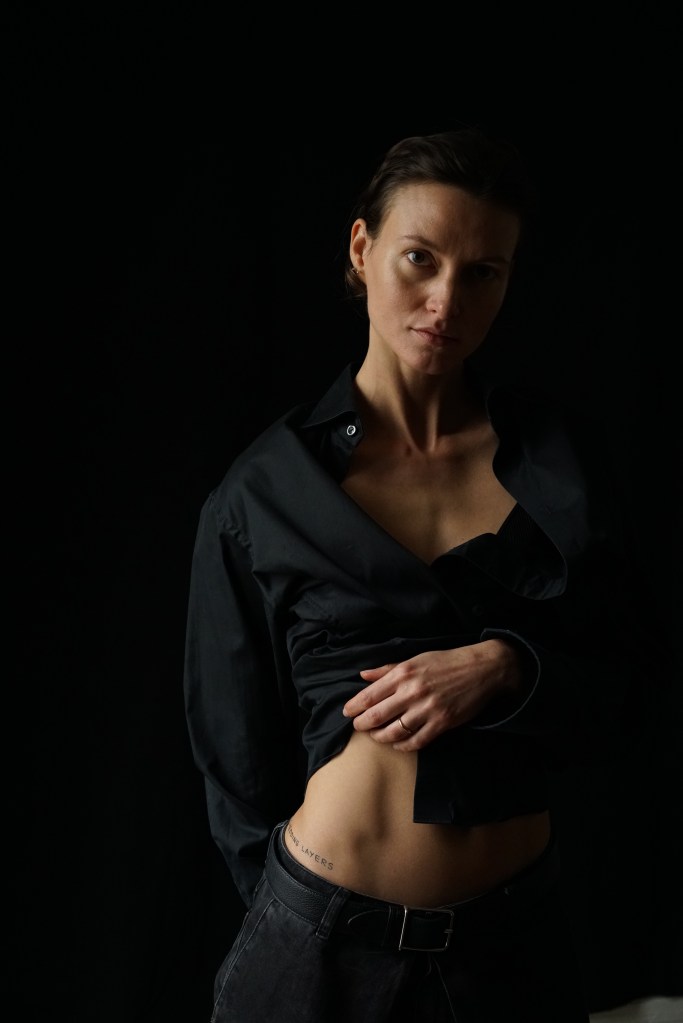
“We cannot protect ourselves only from a specific negative experience in life. When we close our hearts and grow an extra layer of skin we become less vulnerable, but at the same time we shield ourselves from everything subtle, beautiful and spontaneous.”
“How would you describe your character so an actor could play you?” “Her name is Claire. She’s 37, and she’s French, British, and Vietnamese. She’s ambitious, sensitive, and dynamic—a very generous person who loves bringing people together. She’s also deeply loving. If I had to highlight her flaws, I’d say she’s quite self-demanding.”
“I don’t see how age or nationality defines a character.” “It doesn’t define them entirely. But, for instance, when I get a breakdown for a character I’m auditioning for, it usually starts with age, ethnicity, their profession, and a few personality traits. I think when creating a character, you start with ‘Where do they come from?’ and ‘How old are they?’ It’s the foundation—the beginning of everything. After that, there are layers to build on. Don’t you think?”
I shook my head, indicating no. She grinned. “No, you don’t agree. I’d like to know what you think truly defines a character.” “For me, it starts with their state of mind—what emotions dominate them. Then I think about their lifestyle: where they live, who they live with, their routine, how they approach life. What their views on politics, religion.” “I see what you mean,” she nodded. “Those are the layers I was talking about—what comes after the basics.”
“I’d skip the information you’d find on an ID card entirely. To me, it says nothing.” “Really? For me, it does matter. But I understand what you’re saying—things like their lifestyle, who they live with. That’s where I dig deeper: What do they love to eat? What brings them joy? Do they have passions or mental health struggles? Those details flesh out a character.”
“What’s your greatest achievement?” “I have a problem with the word ‘achievement.’ It feels so definitive, and life isn’t like that. Things are always…” “In progress,” I finished. “Exactly! Always in the making. I don’t think I’ve achieved anything. I’ve contributed to building things. Like, I have two beautiful children, but they’re not my ‘achievement.’ They’re becoming themselves, independent of me. Maybe I’ve achieved…” She paused, sighed, then laughed softly. “What came to mind?” “I was thinking about balance—finding it between…” “Your family and career?” “Sort of, but I’m still not fully satisfied. Sometimes I feel like I’ve put my career aside since my second child was born—she’s not even two yet, so I probably need more time to get back on track. But when I think about balance, I feel proud of creating a family. That’s something, isn’t it? Still, I’m constantly frustrated. There’s so much I want to do—so many desires and ambitions—but most remain unrealized. Maybe it’s okay not to accomplish everything. I’m trying to be kinder to myself, to let go of ticking boxes. I know people who’ve ticked all the boxes, and they’re not happy. So, is it even worth it? I’m not sure.”
“How do you define happiness?” She pointed at a vase of pink peonies on the table. “Those flowers.” “Why?” “Because flowers are perfect. They’re gorgeous and graceful, and they have nothing to accomplish but to simply exist. That’s happiness.”
“What does love mean to you?” “When people ask about my religion, I always say love. That’s my belief because it’s the only thing worth living for. Love, to me, is the glue that binds people together.”
At that moment, my recorder stopped without me noticing, and some of the conversation was lost.
“When was the last time you felt stuck?” “Yesterday. I’m doing an actor training program online called ‘Reset.’ It’s a process to recalibrate your tools as an actor. There’s this exercise called the ‘two-dollar exercise.’ You have to go out and ask ten strangers for two dollars—or euros—but with the intention of not actually getting the money. And I haven’t been able to do it yet. The thought of doing it is more terrifying than the act itself, and that’s the point. It’s about freeing yourself from caring what others think. And it’s really difficult, so I haven’t done it yet. Every day I say I’m going to try, but then, I just don’t do it.”
I let her words settle before speaking again. “It seems like we’re all constantly trying—to be a good partner, a good friend, a good parent, successful in our careers, even good at cooking. But could it be enough to simply be a mother without striving to be a good mother, for example?” “That’s a great question. Who validates us, anyway? When it comes to being a mother, I do believe it should be enough just to be one. The idea of a ‘good mother’ is deeply problematic for me. That’s something my organization, Parents et Féministes, tries to address. We want to remind people that every mother is doing her best, and that should be enough. But it’s harder for me to feel the same way about my acting career. What makes a ‘good actress’? Is it being constantly employed? Is it being successful? Or famous? There’s this entire spectrum of what it means to be an actress. And so often, when I meet someone—say, in a taxi or at a party—and I tell them I’m an actress, the first thing they ask is, ‘Oh, really? Do I know you? Are you famous?’ And when I say no, their disappointment is palpable. It’s like their validation of me as a ‘real’ actress hinges on my fame, and that disappointment feels like a rejection of who I am. It used to hurt even more than it does now. I’d smile and laugh it off, saying, ‘No, I’m not famous.’ But recently, I’ve started to push back. I’ll say, ‘Actually, this is uncomfortable for me. You may not have seen my work, but I am an actress—I work, and I make a living from it.’ I try to joke about it sometimes, but it still stings. And sometimes, in those moments, I wonder why I keep doing it—this job that’s so tied to external validation. It can feel messy and painful, but at the same time, I can’t imagine doing anything else.”
“Is it the job itself that’s painful, or the situations it puts you in?” “Oh, the job is wonderful. The problem is that, as an actress, you don’t actually spend much time acting.”
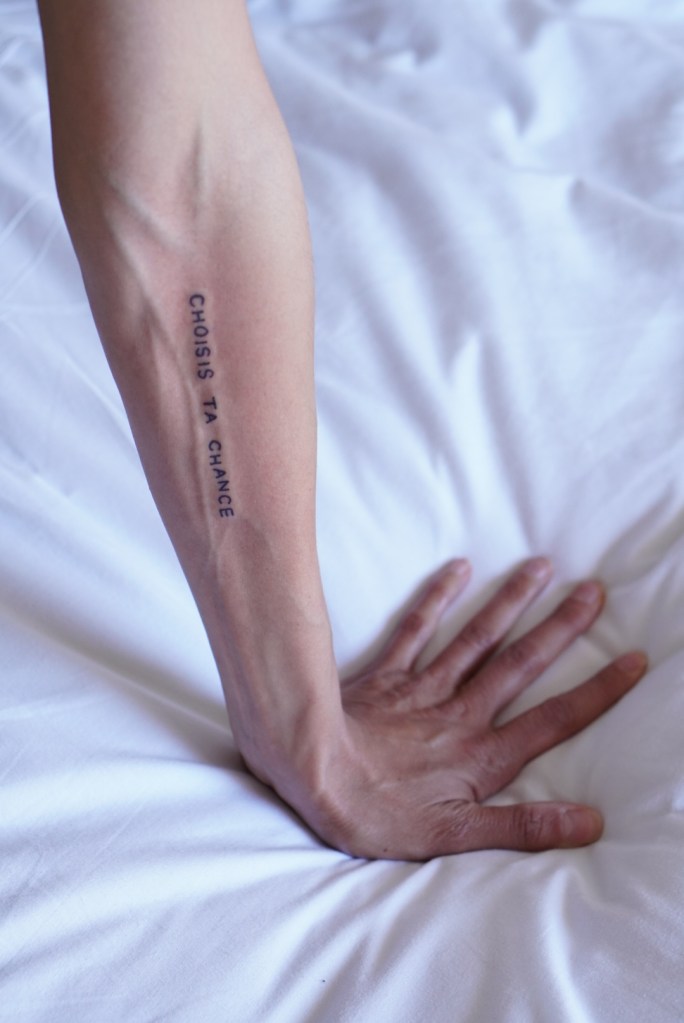
After a pause, I said, “I’m thinking about the words ‘choice’ and ‘flower.’ Do you think flowers have a choice?” “No, they don’t. They’re simply beautiful because that’s what they’re meant to be.”
“For the past two years, I’ve run my own business as a home organizer,” she began, her words quick, with the faint lilt of a Midlands accent. “I do interior design and help people declutter their homes—basically, I create calm, peaceful spaces.” She had come all the way from Long Eaton, a quiet town in Nottinghamshire, just to meet me.
“What made you decide to become a home organizer?” I asked. “I moved around a lot, and never had a proper home base where I could store my numerous belongings. So, I had to create a home for myself wherever I was—learning to feel comfortable no matter the circumstances. Before that, I was a probation officer, working with people transitioning out of prison. It was intense—one-on-one coaching, heavy stories, a lot of stress.” She let out a soft laugh, warm but laced with something unspoken. “I wanted to essentially combine my passion for interior design and coaching. So now I coach people about their houses.”
“What kind of people do you work with?” “It’s a real mix. On one end, there are the severe cases—homes so cluttered I have to physically climb over things just to get inside. On the other, it’s people who are simply overwhelmed—busy working mums or professionals in high-powered jobs who don’t have the time to focus on their spaces. One client told me he couldn’t sleep well in his own home. I adjusted the layout of his bedroom, helped the energy flow more naturally, and he started sleeping better. Honestly, I can work with anyone, but my clients all share one thing in common: they’re uncomfortable in their homes, and I help them change that.” Her aquamarine eyes glimmered as she spoke, and her round face radiated a kind, unassuming warmth.
“Is it an easy job?” “Yes and no. The ‘yes’ side is that I love what I do. I wake up excited, eager to meet new people, tackle new challenges, and keep learning about my work. It’s fulfilling in so many ways. But the ‘no’ comes from the emotional side. I hear so many sad stories. Clients often break down crying, which is fine, but I have to be careful not to absorb all that energy. That’s kind of a reason why I came to visit you in Paris—to escape the heaviness of it for a while.” She paused. “I work alone, so there’s no one to talk to, no colleague to help carry the weight. It’s something I’m still learning—how to leave all of that behind at the end of the day.”
“How do you cope with it all?” “I meditate a lot. And I focus on sensory things—touching, feeling. I’ve designed my house to be a sanctuary for me. I have over 150 plants; it’s like a jungle. Caring for them brings me peace—it’s grounding, almost meditative in itself.”
“What is home to you?” “I know it sounds cheesy to say that ‘home is within,’ but it’s true. I’ve come to understand that home is something I’ve built in my mind. Wherever I go, I feel at home because I’ve created that sense of safety and comfort inside myself.”
“What does it look like in your mind?” “Quiet. Peaceful. Safe.”
“And how do you handle loneliness?” “I’ve always thought of myself as a lone wolf, and for a long time, I was cool about it. But during the pandemic, when I had no real-world contact, I struggled. That’s when I realized how much I needed connection. Since then, physical touch is very high on my list.”
“You know, I live in the forest when I’m not working,” I said, and she nodded. “Being out there gave me the chance to face myself in total solitude. On one hand, it made me stronger. But there were times I was afraid I might lose my mind if I stayed in that isolation too long. There was no one to tell me if I was going too far, no one to stop me. It was freeing but unsettling.” “Yeah, I understand you. I went 70 days without seeing anyone—just Facetime on the internet. One day, I woke up and realized something: there was no one around to tell me if I was acting weird. Then my dog sneezed in another room, and I said, ‘Bless you!’ out loud. Not that saying it to a dog is so strange, but I’d never done it before. For a moment, I genuinely thought the sneeze had come from a person. That was when I started to wonder if I was really okay. That’s when I felt the absence of touch, of human presence. I was so desperate for it that I hung a rope on the back of my door and would wrap it around myself, like an embrace. I didn’t think I was crazy, but I knew it was something I’d never done before—a reaction to loneliness. But honestly, it’s made me stronger, and I don’t look back on it negatively.”
“What do you think makes you a solo person?” She sighed deeply. “I think it’s my struggle with connections. I have a fearful avoidant attachment style—basically, I long to be loved, but I’m also afraid of it. Afraid of letting people get too close. So, I end up pushing them away and isolating myself. It’s something I’m aware of and work on, and it’s not as bad as it used to be. But it’s been a journey, and not an easy one. It started with child neglect and abuse. I felt so isolated, unseen, invalidated. My feelings didn’t matter to my parents, so I learned to keep them inside. I wasn’t taught healthy ways to cope, and it led to an eating disorder—anorexia and bulimia—that I struggled with for years. I did so much damage to my body because I didn’t know how to express anger, even when it was justified. I’m a pacifist, kind-hearted and honest, so I internalized everything. I only recovered three years ago. You wouldn’t recognize me back then—I was painfully slim and extermely unhappy.”
“What’s the most important lesson life has taught you?” “If you’d asked me three years ago, I would have said, ‘Don’t trust anybody.’ But now, I’d say, ‘Trust everyone—until they give you a reason not to.’ Because life gets pretty lonely if you don’t trust anyone.”
“What are the things that hurt you the most?” “I had a negative experience with love growing up. My father was in the military, and he ran our household like a strict squad rather than a family. My mother, a flight attendant, was often absent, so she couldn’t always protect me or be there when I needed her. Both of my parents came from broken homes, and neither of them had a father figure in their lives. They were young when I was born and not prepared for the responsibilities of parenthood. As a result, they made many mistakes along the way. My father, especially, learned to control and manipulate those around him. It’s a terrifying thing to experience from a father, because I never knew if his affection was genuine or if he had an ulterior motive for spending time with me. His pain and anger eventually turned into abuse. Growing up in that environment was suffocating—I lived in constant fear, my stomach in knots, terrified to even cross the threshold of the front door. When my mother was away and my father was absent, I was left to the care of others. I often felt invisible, unheard, or when I was noticed, it was only for my mistakes. At six years old, when I was being looked after by others, I was sexually abused. This went on for years—until I reached the age of eleven—because my parents became people that I couldn’t ask for help. It made me realize that… I don’t really… I don’t know, I felt like a punching bag, constantly battered by the world. I didn’t know what it was like to be loved, to be seen, to be heard, or to live without abuse. Kindness became frightening because it was so unfamiliar. When I had partners who were kind to me, I felt confused and conflicted, which led to problems in the relationship. And most of the partners I chose ended up being unfaithful, which only reinforced the belief that I wasn’t enough for anyone. Over time, I began to notice a pattern. Even though I thought each person I was with was different, the same issues kept arising. I believe life gives you the same lesson over and over until you learn it. It might come in different forms—through different people or situations—but the lesson behind it remains the same, and it won’t stop repeating until you learn what it’s trying to teach you.”
“What is your lesson?” “The lesson is that I am important, I am valuable, simply because I am a kind-hearted and honest person. I can bring something meaningful to any partnership, friendship, or connection. And I’ve learned that it’s not about sacrificing my boundaries or values just to make someone else feel comfortable.”
“What is your relationship with your parents now?” “I blocked my dad’s number three years ago, and just recently, after Christmas, I blocked my mum’s too. They can’t contact me. I need to understand why I feel the need to bring them back into my life. I went from having no boundaries at all to suddenly setting them at one hundred percent. It was an all-or-nothing approach. I couldn’t keep people in my life when I didn’t feel comfortable expressing that something wasn’t working for me. So, I shut the door, took time to reflect on my boundaries, and now I’m slowly considering letting certain people back in. But my parents have been the hardest, and I’m still not sure if I want to allow them back in. I’m still figuring that out.”
“What does love mean to you?” She paused, took a deep breath, and laughed softly. “I don’t know. That’s a tough question!” She thought for a moment. “Off the top of my head, I’d say I don’t really know what love is, because I never had it.”
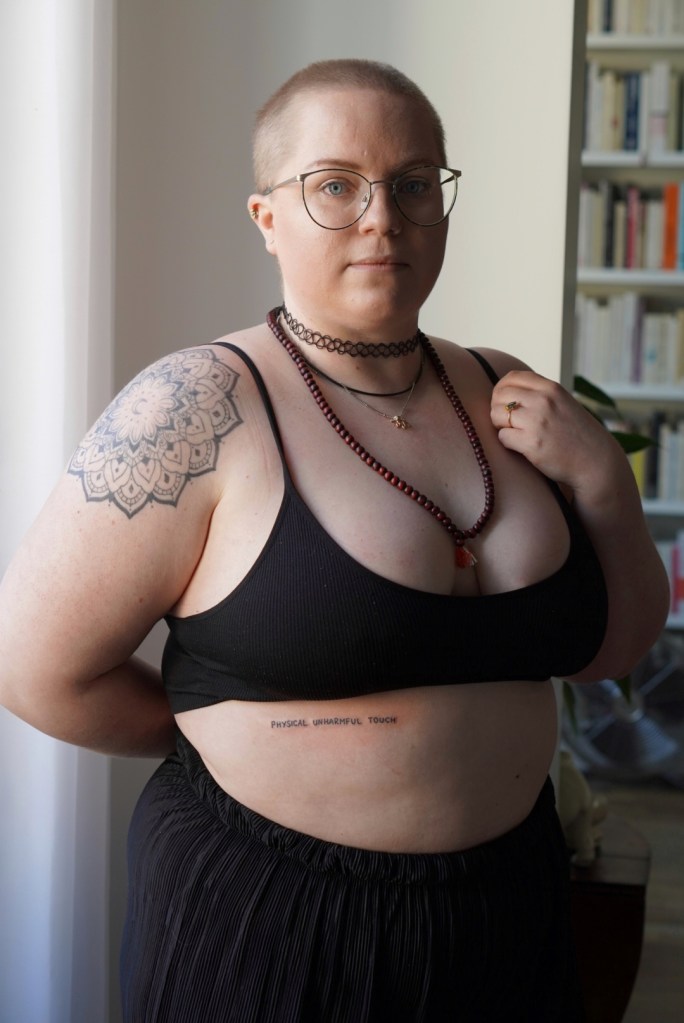
“What are the essentials you need for happiness?” “I like things to be calm. Being around water makes me feel calm and safe.” “Are you sure you’d definitely be unhappy without water and calmness?” I interrupted.“I want you to think about the most essential things.” She pondered. “I’d say physical touch.” “May I ask why that’s so important to you?” “Because the physical touch I’ve experienced in my life has always been abusive. When someone laid their hands on me, it was either to hit me or to hurt me in other ways. So, the kind of touch I long for—the kind that isn’t harmful—is something I long for.”
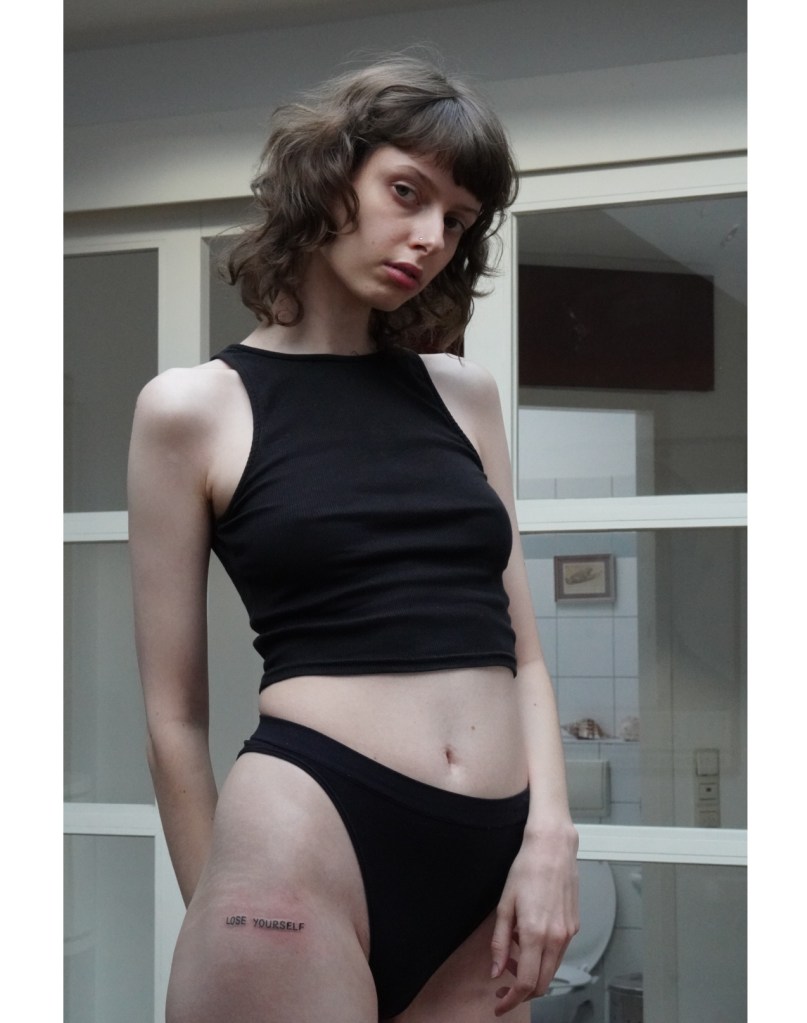
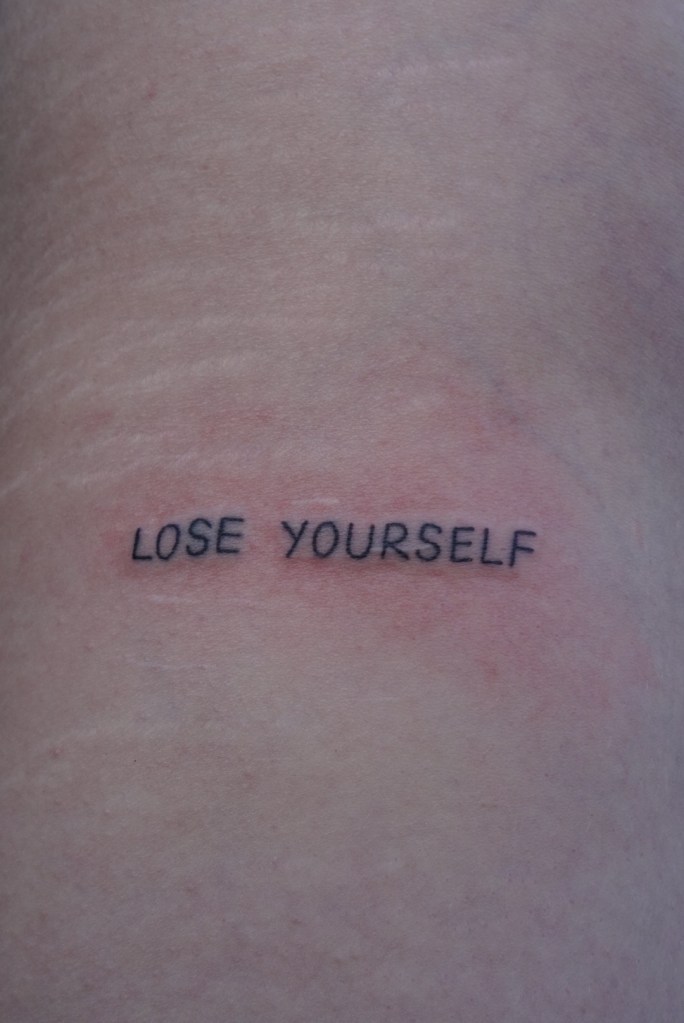
“What is decent sex for you?” “Well, my first boyfriend was really bad at sex. It was kind of boring. I have a vivid imagination, and I’ve always wanted to explore more. After him, I slept with several men and women who weren’t my partners.” “So, what would you consider decent sex?” “It’s when you lose yourself, when you’re detached from reality.” “Most people want to find themselves, but it seems like you want the opposite. Why is that?” “I just want to be free from my anxiety.”