Polina was in Budapest for a few days and wanted to meet for a session. I was four hours away in Serbia with nothing better to do, so I cranked the old BMW and pointed it toward the border. Budapest still felt like a first date — tempting, with curly hair, lemonade, and green tip manicure.
We met on the curb outside her rented studio, deep in the city. She wore loose black pants and a white linen shirt. Her face was young, clear, and watching everything.
“Sorry, I got stuck at the border,” I said. “Mind if I eat before we start?”
She shook her head. I pulled out a corn cob.
“Want some?”
“No,” she said. “It’ll get stuck in my teeth.”
“Cucumber?”
“Why not.”
Why are you interested in human rights?’
A feeling of necessity for justice.
What is justice?
It’s impossible to explain. I just get overwhelmed when something isn’t the way I believe it should be for other people. I understand that it’s probably my problem, I’ve attached myself to all people and feel responsible for them, even though I know I can’t do anything.
Do you think we shouldn’t attach ourselves to everyone?
I don’t think in terms of should or shouldn’t. Even though it’s a problem for me—not sleeping at night because of something that’s bothering me…
Like what?
My first memory of myself as a human being is lying in a room at night, and from the kitchen—our apartment was big, like 140 square meters—so the TV was pretty far away, but I could hear something about a war. And I was lying there thinking: I’m scared, I’m in pain. And that’s how it’s been ever since.
What were you scared of and what was painful?
I don’t know. I guess as a child I was afraid for the future of the world—and for myself in it.
What exactly scares you about the future?
That I exist in it. And at the same time—that I don’t.
Do you see an image?
No. Because if I imagine specific images of what might happen, I immediately think—okay, here’s an image of poverty, but people survive poverty, and I could too. Or the image of someone close dying—it’s hard, but still okay. More often, it’s everyday problems that get to me. Like, today something didn’t go right with this one person. That triggers a thought process: okay, if tomorrow everything goes downhill, then the day after tomorrow I don’t know what kind of relationship I’ll have with this person. I interpret that as most people my age having some kind of future goal to orient themselves by. I don’t have that, so I worry about too many things. Like, I arrived in Budapest—what if something works out? What if I don’t leave? What if I leave but don’t want to?
If you could change one thing globally, what would it be?
The first thing that came to mind—ecology. Because nothing else matters if the planet’s gone. Second would be education.
Would you like to work on solving ecological problems?
It just didn’t turn out that way, I guess. I don’t know why.
Do you have a dream?
No. I kind of felt you were trying to find it.
I smiled.
You have a kind of sly expression on your face right now.
Why does it seem that way to you?
I don’t know. Some kind of spark—but not a sneaky one.
I dropped the smile.
Would you like to have a reference point?
Yes.
When you think of yourself, what do you see?
I don’t know. I don’t feel proud of myself, but I’m not ashamed either. Detached. Because if I start thinking about myself too much, it leads to the same place.
Can I ask where?
I grew up with a problematic dad. He didn’t hit, but he was very scary and always intimidated everyone. Basically, he terrorized us. When you’re lying in your room and there’s shouting and screaming, and you hear a thud—you realize that’s not a person, it’s the wall. But who hit the wall? Who threw who? Did Marina throw Dad? Did Dad throw Marina? Or was it Dad and Mom? I’d text Marina—my older sister.
“Hey Marina. Where are you? What’s going on there?”
“Why don’t you come out and see?”
“I don’t want to. Do you?”
“Okay, I’ll go.”
Dad hit the wall—okay. That’s it.
Why do you think you’re telling this with a smile?
Because it’s madness. It shouldn’t be like that, but everyone’s so used to it. Like—yeah, there’s this sick person and we can’t do anything about it. So it’s lighter to treat it with humor. “Oh look, Dad’s lost his mind again.”
“Lighter” is a beautiful word.
Yeah. And I’m a feather.
Explain.
As kids, we had this inside joke. Always trying to be skinny, beautiful. I was tall and fat. My friend was very tall. Another was super muscular. And we joked that we were all like feathers.
You said “I don’t exist” when I asked what scares you about the future. But if you don’t exist, there’s no fear. So maybe the place where you don’t exist—is the place of peace.
Have you ever been under anesthesia?
No.
I have. Most people are terrified. I wasn’t.
What was the operation?
It was abdominal surgery. I have a scar. And in general, after an open surgery in that area, the body becomes very fragile. If someone hits me—that’s why, unfortunately, I don’t go to protests: because you can’t really tell, but if someone hits me, I might die.
What was the operation for?
Oh. I had skin removed from my stomach because I was fat as a child. I lost 40 kilos twice, very quickly. Even if I’d lost it slowly, like a normal person, the skin would’ve still needed to be cut off. And this kind of operation—they basically cut you open, lift the skin off the muscles that cover your organs, zip one part together, stretch the other. It changes a lot in the body. I had the operation in 2022, and I still get swelling sometimes—healing, inflammation comes and goes. I get it. I don’t do pull-ups.
Why did you want the skin removed?
Because it was hard to look at myself since childhood.
Did it help?
Since I was ready for the scar—yes. At least in clothes, I feel like a normal person.
But you became more fragile, right?
Yes. But as a fat child—I could maybe win someone over with my charisma, but I couldn’t run anywhere—I’d jiggle. I couldn’t join in some activities just because I was fat. Then I lost weight—I was eleven—and I thought I’d be like the other girls. But it didn’t happen. I looked like a woman who had given birth to three kids. And you see that difference in the locker room, so I’d limit myself—wouldn’t sit down a certain way, stand up, dance, wear certain clothes.
How did you lose weight?
In 4th or 5th grade, I made it my goal, started going to the gym and eating less—the standard approach. But then, when you’re going three times a week and need the weight to drop, you just start eating less and less, and slip into starvation—classic eating disorder. I went from 90 to 50 kilos.
Then I started gaining weight again—as it usually happens—and I fell into a depression. The kind where you sit on the windowsill, your mom sits on the bed looking at you, and you just sit there, and sit, and sit. I gained it all back and then lost it again—more calmly that time.
What matters the most in life for you?
People. It just turns out that my people—since they’re around, they’re easier to think about than myself. Maybe it’s because when others are at peace, I am too. And I get an excuse for not working on myself—because I was busy with you. Not very nice, but it’s true.
What’s the most important lesson you’ve learned in life?
Probably that you shouldn’t jump to conclusions. Don’t judge. Don’t condemn.
If you could change something in your past, would you?
No. Even though there were moments where better decisions could’ve been made. But based on my current values, it’s not a big deal that I acted the way I did.
Have you ever wondered whether it was fair that you were fat?
Of course. At first, I definitely thought of my parents…
You thought it was their fault?
Yeah. Their fault that I was fat, their fault that I had to lose weight, their fault for working, their fault for everything.
And now?
Well, what can you do? I don’t really like the concept of blame anymore, so it is what it is. It’s hard not to bring it up when you’re about to have surgery. You have to talk to your mom about it. And when you see in her eyes that I’m basically saying: “Mom, there’s no other option, because I’m trying to get back at least a little of what might have been if not obesity”—which may be your fault, but maybe not, it’s not certain, but it’s possible—and we’ll never really know.
What is beauty?
And why do people worship it? An empty vessel? Or a flame flickering inside? I don’t know. I feel and see beauty in everything. If something catches my interest, it’s beautiful to me.
I never thought of myself in terms of beauty, although I was called beautiful as a child—but it was always like, “such a pretty face—if only this or that.” And people don’t know that, because it’s hidden under clothes. So I always know when they think I’m beautiful, but I think something else. Even when they find out, they don’t understand why. And I have to explain that I have a difficult relationship with myself. That I have to make peace with myself, find myself within me.
Who is making peace with whom, and who are you searching for?
I don’t know how to explain it. How important is your appearance to you? Do you care? Do you think about it?
Sometimes.
Well, when you’ve been obsessed with it for a long time, when it’s all you have, all you worry about—just that you don’t measure up. And then what? You have to tell yourself every time—so what? And then, seeing beauty in everything, why the hell should I think of myself as something I have to “come to terms with”? Why do I see beauty in an imperfect, off-cover person and think they’re beautiful—but not myself? I never found the answer. And since growing up like this caused me a lot of pain, it was a trigger every time. And it’s easier for me to look at the scary scar, the fake belly with stretch marks and a fake belly button, than at the memory of standing in front of the mirror with a knife, saying, “I’m going to cut this off right now!”
That’s my little trauma.
Her eyes were wet, but she didn’t cry. She only smiled.
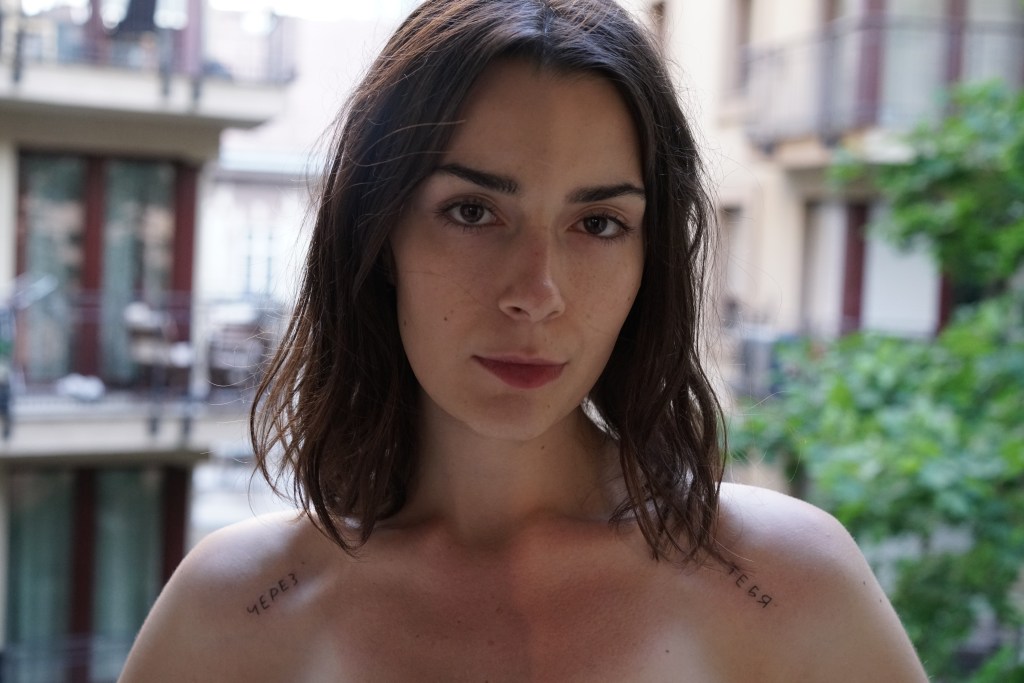
Our interview was in Russian. The tattoo says “through you.”
Discover more from Your Story, By Me
Subscribe to get the latest posts sent to your email.
