Most recently I did some work for an organisation who was trying to write a report about regeneration, and that’s working with mostly Indigenous people, capturing the process of how they’re working together.
Indigenous to which land?
Lots of different ones, working across the world virtually. That noise is gonna get frustrating! — she said, as the dog Chewie began chewing his squeaky toy. But the leaders were from Brazil and India. And it was very interesting, but it got me thinking a lot about how I do research and how I need to decolonise my research practices—so it’s a lot. And I’m glad actually that we didn’t meet before and we’re meeting now, because it was a dark winter. This is a much better time, so thank you for getting in touch.
What was dark about your winter?
I got quite sad sometimes when it’s dark. And we travelled a lot last year, so we spent lots of time in traffic, and I knew it was gonna be a hard winter because of the dark—but the work as well. It was very intense, and I got quite depressed.
She whistled to Chewie and, in a totally different voice, very sweet, said: Come here, join us!
Chewie refused her proposal. Eh, no, she laughed. Yes, it’s sunny now, so I’m happy again.
I was silent. She whispered, tapping the sofa: Come, sit.
Is it your permanent job—to do research?
Nothing is permanent. For now I’m in another time of reinventing myself. So yes, I’m working a job technically for the university, but I’m about to go freelance again and see what happens.
Doing what?
Consultancy work in the same space—but trying to get the people who fund conservation to do it better. So I’m trying to get the people with the money to work with the conservationists in a different way, which is kind of terrifying, but I’m gonna give it a try.
Do you mean forest conservation?
I studied forestry, so mostly forests. But I work at a very high level. In Cambridge, where I live, there are a lot of different conservation organisations, and they work together to do quite big projects—so it’s often not even in one place. It’s like a big initiative. And I’ve worked for a number of these organisations, and now I want to bring funders to work directly with them, rather than just saying: I’m gonna fund a project and you have to do exactly this. It needs to be done differently, because it’s not working.
What’s your intention behind this job?
Fix. Part of why it’s so broken.
Do you feel like you’re fixing it?
At the moment—yeah. Slowly. I’m getting closer to work that I find actually really rewarding. I don’t make a lot of money, but I’m at peace with that, and I work more with people that I like, which is good. So yeah—I feel very lucky.
Why is it important for you to fix?
I mean, what’s going right in the world at the moment? Nature is in trouble. Capitalism, generally—which I can’t fix myself—but trying to find better ways to…
Isn’t it we who are in trouble, not nature?
Yeah, yeah. Our relationship with nature is in trouble. And helping people reconnect with each other—but also with nature. Unfortunately, there’s so little money in conservation. So that’s part of what I’m trying to fix: to find better ways to bring money in to actually do things in a way which acknowledges the complexity of it all.
Why is it important to reconnect with nature?
Because we’re part of nature and we forgot that?
But if we’re part of it, how can we be disconnected from it?
Oh, we just are. Most people. I mean, I don’t live in the centre of London, but although there are nice green spaces, people don’t realise that we are connected. They don’t think about it. They don’t spend time in nature. They don’t see that the things they do that are wasteful are not sustainable. Makes me sad.
So the connection with nature for you means understanding and realising that you’re part of it?
Yeah. For me, I just—I’ve always understood that. But I think many people don’t, because they haven’t had the opportunity to see that or to understand that. It’s not my mission to help, you know, directly connect people with nature, but I hope that the work that I do—along with others—is helping, generally. Am I making sense?
You are.
It’s nice to see my kids making a connection to nature—that’s a lovely thing.
How do you see that?
Oh, small things. I think they get it because we talk about it a lot, and we’ve been very lucky to spend a lot of time in cool places outside. But even in our neighbourhood at home, you know, like—I don’t care if it’s the most common thing ever—they’re still excited by it. And it’s like, yes, exactly. It doesn’t need to be like… it’s just a ladybird, though! You know, the small things even amaze them.
Like my daughter—she has stick insects now in her room and she just loves them. These small things matter.
What matters the most for you in life?
In general—life, joy, and relationships. Obviously family. But I’m lucky to have lots of amazing people in my life and have relationships with them. But then also, work matters a lot to me. I need to feel like I’m doing something positive for society—which brings me joy.
Isn’t that just the story you tell yourself? You can do the job and feel like you’re doing something positive, but another day you could feel like there’s nothing positive in the very same job.
Totally! And I wasn’t feeling very happy about it in the winter, she laughed. That’s for sure. But I think—even one piece of a shit time at work, and it’s not going well—you can still feel like you’re working towards something bigger and positive on a bigger scale. If I don’t have that, I find it hard. And it might not be that I’m making a big difference—I’m not being unrealistic in what I can achieve, I don’t think. I just—I need that in some way.
But it comes in different ways, like—to get out of a job that I hated relatively recently, I quit it and I set up a painting business in my village. And that brought me joy for a while. It got me out of a bad situation and I met some lovely people in the village, so that was good—for a while.
When you place joy on the pedestal of paramount importance, how do you cope with joyless moments?
When I say joy, I don’t mean that it’s always being happy and smiling and wonderful. Like I said—you know, if I’m stressed and working on a really big problem and I feel like I’m doing something, that’s still bringing me joy. So it’s not only like happy-blissful all the time.
But how do I deal with moments where I’m not feeling joyful and I can’t find that—well, it’s hard. And I definitely have moments like that—I’m like this. I’ve never been just sturdy. My husband is very sturdy and calm—and I wouldn’t change it—but I’m all over the place. So yes, there’s definitely moments when there’s no joy. But I will get back there. And I have faith I’ll get back there.
What would be the opposite of joy?
I don’t know. What’s the point of life if it’s not to have joy and pleasure?
You tell me. Some people would say the point is spiritual growth and helping others.
True. I said relationships. It’s not just joy for me. It’s joy for the people around me. And I’m a person who absorbs a lot from the people around me emotionally. And I hope that helps. Maybe joy is not the right word—but helping the people around me, that’s important.
Yeah. Someone said a word recently, which I hadn’t used in relation to myself—but I’d only just met her during work—and she said: “Oh, you’re an empath,” like it was obvious. And I was like—I have to look it up and think about it—and I was like yeah, I guess I am. I can really sense other people’s emotions. And when people have something they need to tell someone, they tend to come to me. Which can get heavy and be not joyful. But hopefully in those interactions, it’s helpful to others. Yeah, that’s important too. I find it hard to say a single thing. What is the purpose of life? I probably haven’t spent enough time thinking about it.
Let’s find the definition of joy.
Hm, she paused, amused. I don’t know. It’s more than happiness. Because like I said, doing something difficult can bring joy. Fulfilment—maybe that’s a better word.
What fulfills you?
Spending time with the people I love.
And what is love?
You always ask people this—I noticed that. And I thought: what am I gonna say to that question? And I don’t know. I think people usually have a simple answer—and I don’t think it’s that simple. I think people tend to think of love between two people, and it’s just that typical thing where people accept one another for who they are. That’s one type of love, and that’s important. But you know, I can love a tree. Or I can love a stranger that I’ve just met.
So what is love? Lots of things? Connection. Connection comes a lot.
Describe the loving connection.
I’m trying to think. I think it’s obvious between people, but I’m trying to think—there’s a tree near my house. I love this tree. I love it. And it’s going to be cut down. And that makes me very sad. So how can I describe my connection to that tree? Appreciation? Just acknowledgement that it deserves to be there? Connection.
Loving connection evolves depending on what the relationship is. And kind of stems in respect, I guess.
I was saying to my husband the other day that, if anything, I feel guilty that I have lots of amazing connections in my life right now, particularly with lots of women—good friends, family members—and I don’t have enough time for a few of them.
What makes those connections amazing?
We look out for one another. We accept each other for who we are. We enjoy being together or interacting or catching up. And there’s no guilt. That’s a big one for me. I definitely got rid of people in my life that made me feel guilty—because I feel guilty a lot.
Would you say the same thing in winter?
In winter I don’t connect as much with people. I spend more time on my own.
What is happening with you when you connect with yourself?
I feel I don’t have enough time to myself. As a mum trying to work too much—I love myself, but I don’t get as much time as I used to.
I’m a person who loves being by myself and wandering. I said to you the first time we interacted that I’m a free spirit, but I don’t get a chance to do that anymore. And you were like, “Why aren’t you free?” And I am free compared to a lot of people.
What does it mean to be free?
Well, I am free in many ways that many people in the world aren’t. My needs are met. I know when my meals are coming and all those things—that makes me free. I’m not afraid. I’m safe.
But what I meant when I said a free spirit is that I’m a person who likes to just see where the wind takes me. Like today, in London—I wasn’t planning to go to that march, and then I realised it was happening when I went to meet some other people, and I went. But I don’t get a chance to do that, because I’ve got more responsibilities now.
And that matters to me a lot—time to think, which I don’t have as much of as I should. Time to wander. To be opportunistic. I like uncertainty—but maybe not as much as you have when you don’t know where you’re going to stay next.
What is certain?
I think a lot of people think a lot of things are certain. I’m at peace with the fact that they’re not.
But what do you know for certain?
I’ll die one day.
You mean your body will die.
Yeah. I hope that something will be planted over me. In fact, I’ve told my kids that they must plant a tree over me somehow. And I will become something else. And I do believe that. But I’ll be something different then. I won’t be “me” in the same sense.
Do you feel like you are your body, or you are something else inside your body?
Hm. Something else. I’ve reached the age where I realise I’m not invincible. That moment already passed. And it is just a body, and it’s serving me well, and I’m grateful for that. But we’re more than our bodies.
And what is more?
I don’t have a word for it. And I’m not a formally religious person, but I believe that in cycles of life, there’s an order to things that’s much bigger than us. I wouldn’t call it God. But I do believe that after I die, the essence of me will live on as something else—which brings me happiness, I guess. Because I don’t feel like it ends completely. It just goes into something different—it starts a different cycle for something else.
And what is your essence?
She laughed. I was trying to avoid using a word for it. I don’t know—people would call it a soul. I don’t like that word.
But what’s wrong with it?
It feels cheesy.
And what’s wrong with cheesy words?
Good point. I don’t know. It just doesn’t capture it. I don’t have a better word, though. “Essence”—that’s all I’ve got.
You know, we’re just atoms, and the atoms that make up you will make up something else. But it won’t be “me.” Sorry—I don’t know where we’re going with this.
Do you have a dream?
My kids to be happy and to have fulfilling lives.
Do you feel that’s within your power?
No. But I know that we’ll do our best and give them as much as we can. And I believe that they should do well, because they are good kids. But no, that’s not in my power. It shouldn’t be. But that’s hard.
Why did you decide on having kids?
It just felt right. I’m in a very happy marriage, and we had happy upbringings, and we wanted to have kids. I don’t know. I think it was natural. Like we didn’t think too hard about it.
I have friends who definitely don’t want kids. But for me, it was just—I’ve always wanted kids. And I found myself in a situation which I thought would be a good one to bring kids up in. If you think too hard about having kids, you probably would never have them—in my case, anyway—because it’s terrifying.
So I’m glad I didn’t think too hard, and we just went for it. And my kids are very close together as well, so we didn’t think too far in between either, haha. They’re a year and a half apart.
Chewie came to her and started licking her bare knees. Oh, thank you. Kisses? I’m tasty, sweaty.
What does it mean to be a mother?
She chuckled. Hmhm. What does it mean to be a mother? To be selfless. To be ready to give everything you have—and to want to. I don’t even know how to put it into words. It’s the most important job there is, to me.
And it’s changed the way I see my own mother. I have even more respect now—for everything she sacrificed. I guess that’s what it is. Being a mother means being willing to give everything—to do whatever you can so your children… are happy.
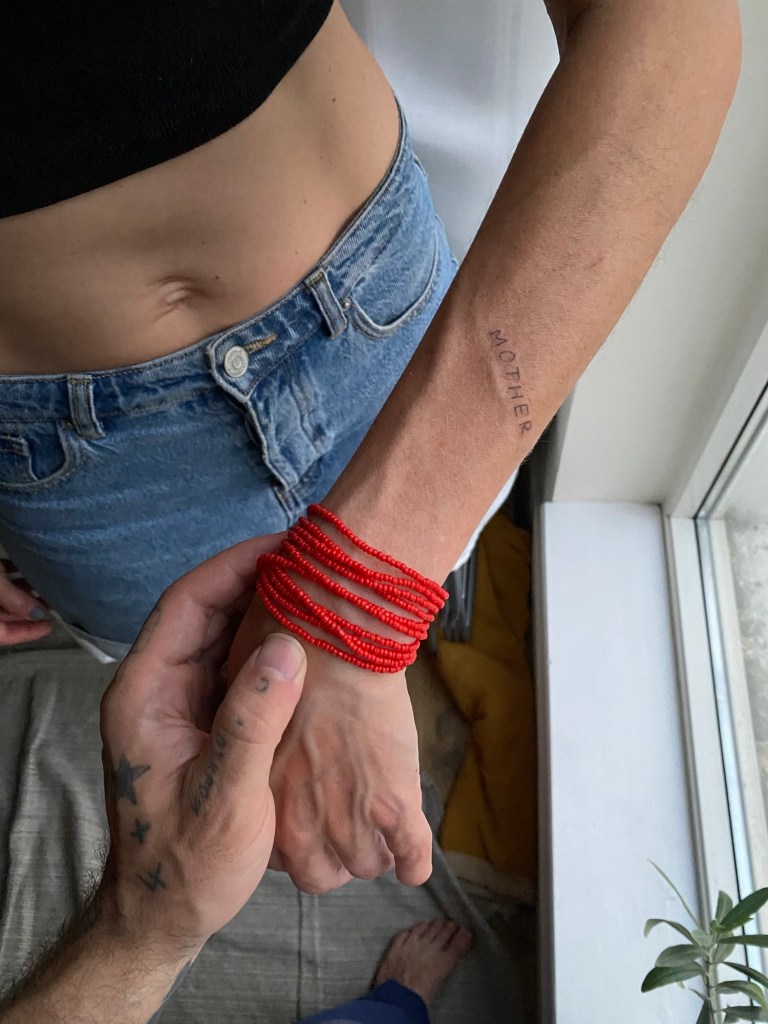
“A mother.” That’s the word I’d propose to you as a tattoo.
Interesting. Why?
Because it holds the meaning of what you do in general.
Hm. Hm! Elaborate.
No. I don’t want to elaborate on this one.
She laughed. That’s not fair! Then after a pause: When you said “a mother,” I thought—yes, of course! But I also thought: I’m not just that.
You say it like being a mother is something small.
It’s not small. But it’s not everything about me.
I see it differently. You said being a mother is being selfless. And that’s… bigger than self.
Yeah. Yeah.
Nature is a selfless mother.
She smiled and nodded.
Discover more from Your Story, By Me
Subscribe to get the latest posts sent to your email.
