I asked Ioanna, “You mentioned you’re going on a retreat. What’s your intention?”
“I’ve been practicing with Bella for a year now, and I really like her methods,” she replied. “I’m not sure I have a specific intention. Right now, I’m going through a huge shift in terms of energy and space. Honestly, I think it’s more about the fact that I really wanted to go last year but couldn’t. This year, it just felt like, ‘Oh, fuck it, I’ll go, it’ll be fine.’ No expectations. I’m just going to get there and see what happens. It’ll be my first holiday alone, without friends, family, or my partner.”
“When you said ‘fuck it’—fuck what exactly?”
“Like I’m not going to overthink it anymore.”
“Is it fuck the doubts then?”
“It wasn’t necessarily doubt. I never questioned going there. It was more about those moments when you want to do something, but then you overthink it, creating all these parameters around you: Will it be too expensive? Can I afford it? I’ll be on my own. I’d have to take five days off work. Should I spend all of them there?
So ‘fuck it’ means don’t overthink it. You love Bella’s practice, it’s in Ibizza, sunny, near the sea. What else is there to consider?”
“What brought you to London?”
“My partner studied here. He’s also from Crete, and we both knew we didn’t want to stay there. Initially, we thought London would just be a two-year experiment, a place for our master’s degrees. Now, ten years later, we’ve just bought a place here. It feels like I belong, with all its diversity—different cultures, the scene. It’s liberating to be away from home.”
“Liberty from what?”
“From a very small community and a big family. It’s a place where everyone knows everyone’s business. Everyone’s always gossiping—who’s doing well, who’s not. It’s just constant. It’s so freeing to be in a place where you’re an unknown among strangers. Here, you get to find yourself more easily, you can find yourself based on what you love, you experiment with yourself rather than keep an eye on what your auntie might say, or how you represent your family. I never lived as an adult in Greece—I left when I was 18 to study in Bucharest, which helped me detach from that small-town mentality.”
“What made you leave in the first place?”
“I wanted more than just nice weather and a beach. I wanted to explore life. You might ask, why not Athens? But Greece is still Greece, and I wanted anonymity.”
“Do you still want that?”
“Yes, I do. There was a moment in 2019… I was working non-stop—four years, holidays, weekends—no breaks. I was trying to change jobs and thought, ‘If this doesn’t work out, if I’m still working this hard and not enjoying London, maybe I should go home and be closer to my friends and family.’ That was a turning point for me. And then, thank God, the pandemic hit. I know it sounds controversial, but it was the most healing period for me. Everything slowed down, and I had time to rest and reflect: Where am I putting my energy? Am I disconnected from myself? Am I becoming a robot in this big city?”
“When you say ‘disconnected yourself,’ what do you mean by ‘yourself,’ and where is it?”
“I mean my energy. I had so many experiences by then, but did I take the time to process them? Did I realize how they shaped me? Have I grown? Developed? Is my lifestyle working for me? It’s sad that it took a pandemic for me to ask those questions.
The first trip home was only in summer 2021. I was able to work from home for almost four months, and it was the best summer I’ve ever had. It confirmed for me that I made the right choice—thank God I didn’t leave London in 2019. I’d be extremely unhappy if I had. But maybe I shouldn’t judge. When I go back to Greece for a couple of weeks, everything feels romantic, fun, and nostalgic. But when I live there, I start noticing the struggles. It’s not that anything is wrong with their lives, but I realize I don’t want that kind of stagnation. And you can argue, what’s so fun about London?”
I nodded.
“The difference is the options I have here. I can plan my week based on what interests me. I get to meet people I have nothing in common with, hear different opinions, mix up—it is very eye opening to understand different cultures. That’s not something you get in Greece.”
“Describe your energy in a couple of words.”
“Right now?”
“Yes.”
“I’m a little sad. There was a big protest in Greece about something really heavy that happened two years ago, but I don’t want to talk about it. If I detach myself from that, I think I’m just trying to find my balance. I moved to a new area after eight years of living in the same place.”
“What does this balance look like?”
“When I feel like my home is home again. That’s where everything starts.
By the way, I don’t want a tattoo with words, and not on my left arm. I wouldn’t want people to immediately access my thoughts. I’d feel awkward with words on my skin. I want it to be something personal.”
“Let’s find the words first and then…”
She cut in, “And build around it?”
“Yes.”
“Sorry if I come across—”
“No problem.”
“What does safety mean to you?”
“My home.”
“And what makes it yours?”
“It has my taste—my décor, my things. There are corners of solace and quiet, and the colors. Until recently, I thought it was all about the physical space. But now, I think home is wherever you are, and my new place will feel like home because I’m making it that way. I’m still figuring out this new reality, and the spirituality behind it.”
“What makes home safe?”
“It’s a place where I can recharge my energy and find my balance.”
“What drains your energy?”
“Worrying about whether I’ll have enough money to make changes in my flat the way I want. Or worrying about my current workplace, which is going through some financial instability. My salary has been delayed recently—even if it was just a few hours, it’s the first time it’s happened to me here in the UK. In Greece, that’s something you’re used to, but here it creates insecurity. It’s an energetic drain, like, ‘Damn, I have a mortgage. Am I going to have to deal with this insecurity every month?’”
“What are your interests?”
“I meditate, do yoga, aromatherapy, and I love reading poetry. Lately, I’ve become obsessed with dishes. I’ve had the same set since I moved to the UK, but now that I’ve moved into a new place, I feel like, ‘No dish should look the same anymore—no matching sets.'”
“Why do you meditate?”
“Because I was shit before. I never did yoga, never meditated. I was going through a burnout at work in 2019, and my partner was about to end our relationship. I didn’t even realize we had reached that point because I was so caught up in my stressed-out mind. I didn’t see that my partner, who’d been with me for so many years, had reached his limit. He couldn’t keep supporting someone who was half-depressed because things weren’t going her way. It was all in my head. And I was like, ‘Fuck! I should’ve known by now. I’ve been in therapy for six years, worked through my issues, managed my work addiction… I should know better.’
So, I don’t think I meditate because I want to meditate. I meditate because I found a way to quiet the noise in my mind. And now, I’m at a place where I just think, ‘You know what? Fuck it. It’s fine—good or bad, does it really matter? It’s just life.’”
“How did you get into it?”
“It started randomly. One weekend, I was at King’s Cross, and the studio I’m part of was hosting workshops every weekend. I’d been working there for eight years and had never paid attention to those workshops. But that day, they had an aromatherapy workshop. I thought, ‘I’m a little bored; let me try this.’ That’s when I met Jemma. She approached the workshop with a meditative mindset—everything we did, every pose, was part of the experience. It was yin in aromatherapy. She would guide us with her voice, helping us stay in the moment, connect with our bodies and breathing. She’d ask, ‘Where does it hurt? Where doesn’t it?’
So it was the scent that helped me drop into meditative mode. It was the blend of camomile, lavender, and orange. Since then, I’ve kept meditating because I like that stillness. I used to be very reactive, but thanks to meditation, I’ve reconnected with myself.”
“How do you meditate?”
“When I’m selecting my herbs, for example, I’ll go to Greenfields. I approach it in a meditative way—I’ll have music in my ears and focus on each herb, smelling it, really paying attention to what it is. Another method is when I make tea at home. But the most frequent way is in the evening, when I massage my feet, my calves, my hands, and my neck with oils. I sink into the action of it—just really being present in that moment. Does that make sense?”
“Yes, but when you said ‘I‘ve reconnected with myself,’ what exactly do you mean by that?”
“That’s a very good question. Do I even know how to answer it? It just feels… safe. Familiar. Accepted. Like the moment, the movement itself—it’s okay. There’s no judgment, no pressure to please anyone. When I’m massaging myself, I accept whatever mental space I’m in, even if I feel imbalanced. I just tell myself, ‘It’s okay.’”
“What’s the difference between mental and physical spaces?”
“I’m not sure there is a clear difference. Or maybe we don’t pay enough attention to how interconnected they are. Like, this,” she said, pointing to the pink marks slightly raised on her left lower arm. “This is a reaction to my stress. If I’d been kinder to myself, I wouldn’t have these pimples. So, I don’t really know if there’s a separation. It’s more about making sure my mental space doesn’t affect my physical one.”
“What was the cause of your stress?”
“It was the fact that I felt so grown-up getting a flat—so freaking grown-up,” she sighed. “I’ve been with my partner for about 15 years, and everyone’s always asking, ‘When are you going to get married?’ But we won’t. There’s no reason for it. I don’t believe in the church, so I’m navigating adulthood differently from my friends and family. And buying a flat… it felt huge. There were moments when I thought, ‘There was nothing wrong with my old life. Why am I doing this? Why am I putting myself through a mortgage and stress? If something goes wrong, I’ll have to fix it. I’ll have to make sure my finances are okay.’ So all that emotional stress came from the commitment I made with my partner. It made everything real—very adult. I’m 35 next week, and I just felt, ‘Shit! Stop!’
I think it was a mix of that and the insecurities at work. A lot of decisions had to be made between September and January. We moved into the new flat on New Year’s Eve, and my stress levels were over the roof. I’m surprised I didn’t have a heart attack or a stroke.”
“Do you feel safer now?”
“I still have my unsettled moments… in the house. It’s just about getting used to the space, the building, and all the new noises. My partner keeps saying, ‘You’re worrying for nothing. We’re fine. Don’t put that pressure on yourself.’ But it’s getting better now. Hell, I’m the emotional support for a friend of mine who’s going through the exact same thing! So, I think it’s progress if I’m able to be that for someone else.
It took me two months to stop labeling what I was feeling, like ‘I’m okay,’ or ‘I’m not okay.’ I’ve had so many people ask me, like my parents, and I’d just say, ‘Yeah, I’m fine, I’m fine,’ because I don’t want to worry them. It feels like I’m giving them a fake answer, though. If I were being honest, I’d say, ‘I don’t know! It’s better than it was in January, yeah. Am I feeling safer? Well… it’s my space, it locks,’” she laughed. “‘It’s okay, I got a few new plates and an ugly lemon-looking bowl.’”
“When you do aromatherapy, meditation, yoga, and read poems, is it an escape from overthinking?”
“It’s the only thing that’s been consistent through all the changes I’ve been going through. I think I’m just holding onto those activities because they’re my safe space while I try to navigate something new in my life. They keep me grounded, balanced, and protected. When everything around me feels crazy, I can always turn to them. So, I don’t think of it as an escape, but as the space I go to recalibrate, to make sure I’m spiritually nourished. It doesn’t pull me away from things—it’s my point zero, where I can find myself through the noise, so I can navigate change and uncertainty. My worries are still there, but they feel more neutral when I’m in that place. If I had to paint you a picture,” she said, pointing to the chandelier above us, “it would be like this ball, where everything around is all the things happening in your life. And in the middle, where the lightbulb is, is the space where you go back to. It’s like being Professor X, seeing everything from a neutral space, and you start to navigate how to strengthen your emotional self, so that when you step back out, you can tackle your problems.”
“Does the point zero have boundaries? And why is it separate from everything happening around it?”
“Because I need the distance.”
“Does it have a shape?”
“Actually, yes. It feels like a circle with a line.”
“Isn’t it just a thought, like any other thought?”
“Yes, but I couldn’t just think of my safe space as my bedroom. I had to create my own.”
“Can we call it a mind trick?”
“It’s definitely a mind trick. Have you ever meditated before? Have you explored the meditation where your brain creates the safe space?”
“Well, the way you describe it…”
“Weird? You can call it weird if you like—I’m fine with that.”
“No, it’s just that for me, the space you’re talking about doesn’t have a shape. It’s neither safe nor unsafe. The moment you try to shape it or label it, it becomes just a thought about it, but not the space itself.”
“I like your perspective on that. I’ve had two visions of it when it comes to the thoughts themselves. One was when I created the veil with my hands, holding the light inside. That yellow-orange glow formed an oval space where I could ground myself, where I could connect to my roots. And then a year ago, when I tried to find that same space again, my mind went to a beach in Wales. It was just me and a stag—my protector—who appeared to me and sat with me, while we looked out at the sea. Those were the two spaces I’ve explored so far, the mental spaces where I can go to neutralize everything, find balance, calm myself, and return to who I am—or who I want to become—so I can step out of my ‘lightbulb.’”
“Who would you like to become?”
“A grounded person.”
“Are you familiar with the concept of nonduality?”
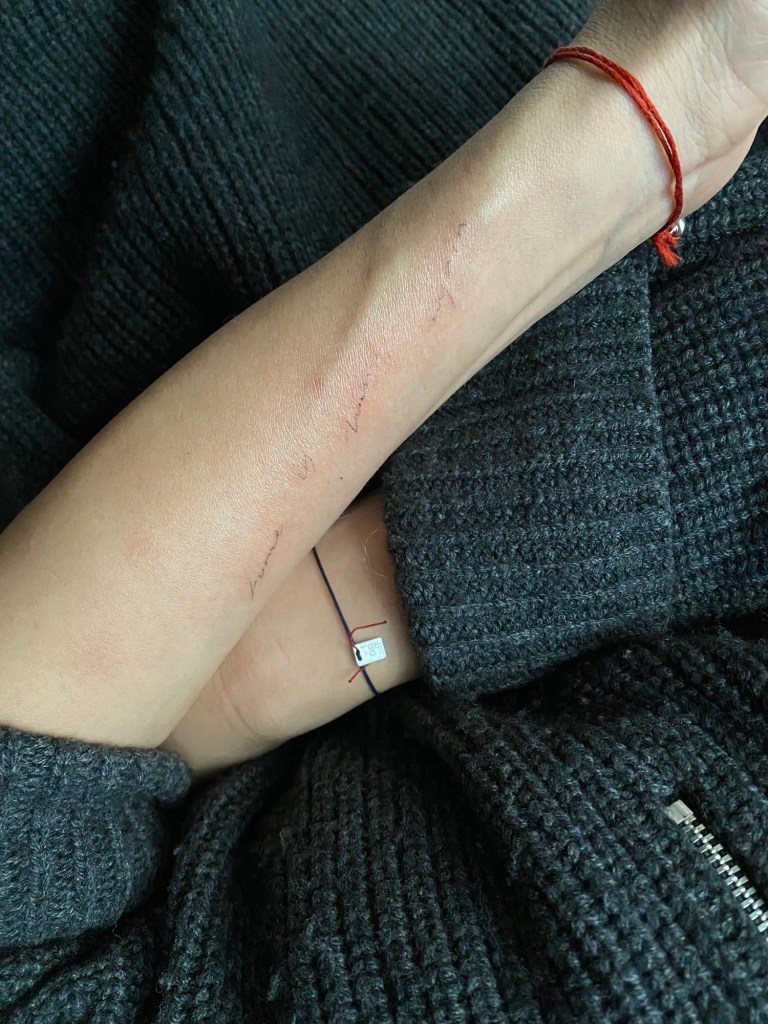
The tattoo on her left arm reads, ‘Home is home again.’
Discover more from Your Story, By Me
Subscribe to get the latest posts sent to your email.
