“What do you do for a living?”
“At the moment, I’m jobless. I’m not sure if I’m actually searching for a job or just enjoying the moment. I think I needed a break to figure out what’s next—whether I want to stay in Berlin or not. Before this, I lived in Lebanon for three and a half years. I just came back recently.”
“Are you passionate about something?”
“At the moment, I’m not.” She grinned. “That’s the problem—I don’t know. I used to be passionate about traveling, but now it just feels like a routine.” She spoke slowly, calmly, at ease.
“What inspires you?”
“New ideas. Conversations with people outside my bubble—even if I disagree with them. I love my friends, but with them, I’m in my comfort zone. I usually get inspired when I step out of it. Like today, for example—meeting a stranger, not knowing exactly what will happen. It reminds me of being thrown into cold water. But I like it.”
“What do you appreciate most about yourself?”
“My flexibility. I can adapt to new situations, even when I don’t like them. But at the same time, it feels like a weakness—like my ‘profile’ isn’t strong enough. I can adjust to so many things without much effort, as if I don’t fully throw myself into anything.
I also like that I’m a listener. That’s why this interview format feels strange—usually, I’m the one asking questions. But it’s nice to switch roles.
And lastly…I think I really care about the people I love.”
“What is love to you?”
“Reliability. Loyalty. Independence—giving loved ones the space to grow. Love, to me, is about freedom and growth. Supporting people, helping them.”
“Why can’t you decide whether to stay in Berlin?”
“I feel like I need to take the next step. Do I want to build a home here, find a job? Or move somewhere else—maybe back to the Middle East, or to Vienna? I have no clue.
On the one hand, I love the privilege of having time to think, not being forced to work. This is the first time in my life that I’ve had two months of doing nothing.”
“What is ‘doing nothing’ to you?”
“Well, I’m forcing myself to read at least one book a week instead of spending time on my phone. It terrifies me how much time I waste on it, how lonely it makes me.
I’m seeing a lot of friends.
And I have a dog. That’s actually what makes me really happy—being outside with my dog. I’m one of those people in their 30s with no kids, just a dog. And I love it this way. Without my dog, I wouldn’t spend two hours in the park.”
“Do you consider any place your first home?”
“Maybe where my parents live, a place near Berlin—I grew up there. But I’d never move back.” She laughed. “There’s nothing there, no inspiration. It’s just the grey East of Germany—whoa!—it’s pretty ugly. But I kind of like it. When people make jokes about it, I’m like, ‘I can joke about it, but not you.’
But honestly, no. I’d never move back. There’s no hope there. It would feel like taking a hundred steps backward. No. No, no, no.
And I don’t want to stay in Berlin either. It’s not cozy, not welcoming. Too big for me. Too cold.”
“What exactly are you trying to escape? Why is this place near Berlin hopeless—is it a suburb?”
“No, it’s a proper city, about two hours from here. But…I don’t know how to answer that. People there just seem so frustrated, so sad, so stuck. Nothing changes.
It’s funny you’re asking me this. It makes me realize how much being from East Germany means to me. Which is ridiculous—I was born in ‘89, when the Wall fell. But I still identify as Eastern, even though it’s the last place I’d want to be.”
“What did you do in Lebanon?”
“I worked as a project manager for a big German organization. I collaborated with local urbanist groups, helping them organize cultural events, funding them—trying to bring Lebanese and Syrian communities together, or at least ease tensions. Many Lebanese don’t like Syrians because of the occupation.”
“Why did you quit?”
“The situation in Lebanon really worsened after the blast. The economy collapsed. And after three and a half years, I was just…done. No energy left. I still love the country, and I’ll go back now and then, but I couldn’t stay.
And I’m not talking about things like power cuts—I don’t care about that. It’s the weight of being surrounded by people who’ve lost hope. People who can’t make a living anymore, or who lost everything in the bank. At some point, it became too heavy.
I really thought coming back to Berlin would make things easier, give me a fresh start. But when I arrived, I realized—oh, okay, it’s not that easy to adapt here either.”
“What did you learn from your time in Lebanon?”
“I learned to be more relaxed. To complain less.
It sounds unbelievably cheesy, but I learned how to enjoy the moment. How to stop comparing. How to let go.
I don’t know if there’s something wrong with Germans—if we just don’t know how to do that—or if it was just me who didn’t know before. Like, here in Germany, I’m impatient. But there? I don’t complain. I’m just happy.
And what I really liked there was that life wasn’t just about work. Of course, I had a job and liked it, but life wasn’t only about that. People would just sit by the sea, have coffee. Such a joy.
Here, everything is about work. About how much money you make. I don’t want to define myself by those things anymore.”
“What are the essential things you need to feel happy?”
“To be surrounded by warm people who love me, who understand me. That’s what I miss most right now.
I feel like my friends don’t always understand me anymore. And the way they complain about things—I have nothing to say about it. Do they even hear themselves?
So I don’t understand them. They don’t understand me.
Don’t get me wrong—I love them, and they know me well. But there’s a gap.”
“Do you have a dream?”
“Some of them are too cheesy to share. But…a tiny bungalow somewhere in Greece. Spending time there with people I love.”
“What was your dream ten years ago?”
“I wanted a job abroad, a boyfriend, kids.” She smiled. “I don’t fully remember—I’d have to check my diary—but I’m pretty sure it was something like that.”
“When was the last time you felt utterly happy?”
“On the way here. I was riding a bike, listening to music, passing cars with grumpy people inside. And I thought, ‘I’m going to have an interesting meeting. I’m nervous. I’m happy.’”
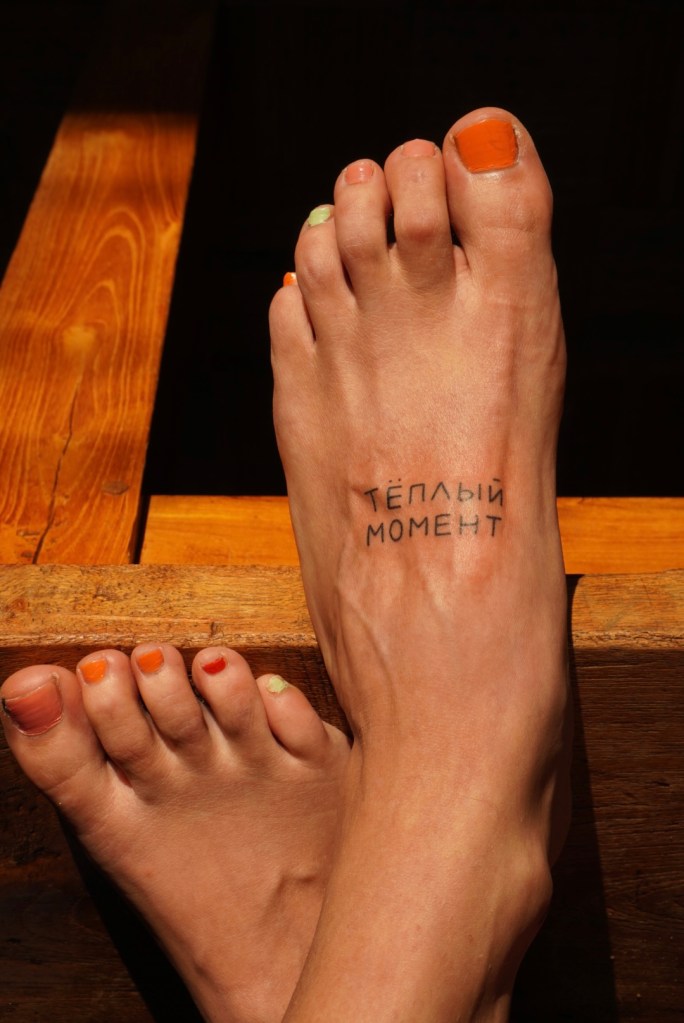
The tattoo translates from Russian to “The Warm Moment.”
Discover more from Your Story, By Me
Subscribe to get the latest posts sent to your email.
