“How did you become an influencer?” I asked.
“No idea. It just happened. I built a community, and then I started making money from it. It was never my intention, but I like it now,” she replied.
“What do you like most about it?”
“The networking. I’ve met so many amazing people through Instagram. It sounds weird or pathetic, but I get inspired by humans.”
“And what’s the hardest part?”
“Always having to be available.”
“And if you’re not?”
“Less reach. A few days ago, I broke my phone—I put a shelf on it by accident—and I was offline for fifty or sixty hours. My managers freaked out. And I realized how dependent I am on my phone. It’s too much sometimes.”
“Maybe a digital detox is in order.”
“Yeah. I’m planning a two-week holiday next month.”
“Do you have a hobby?”
“Photography.”
“What do you photograph?”
“People.”
“What do you like about them?”
“I never really thought about it. But… hands, I think.”
“What do you like most about yourself?”
“That’s a tough one. Maybe that I’m kind. Sometimes too kind.”
“How can you be too kind?”
“When I put others’ desires before my own. I end up forgetting about myself.”
“What is kindness?”
“Having a good heart. Being genuine. Caring for others. Listening.”
“What do you appreciate most in your life?”
“My dog. My life. I think I’m really privileged in so many ways.”
“What are your privileges?”
“Being European. Being a white woman who fits the beauty standard. I didn’t choose those things or work for them, but they give me power in different situations.”
“What is beauty to you?”
“In terms of appearance, when someone has a unique, imperfect feature.”
“Is there something you dislike about yourself?”
“Recently, I’ve noticed that I’m restless—always looking for more. I had a great flat, but I decided I needed a bigger one, so I moved. Now I want a better bike. It never ends. It’s annoying.”
“I read somewhere that before capitalism, people didn’t have that problem.”
“Yeah, but it feels so present now. Like online dating—Tinder, for example—you’re always swiping, looking for something better.”
“What do you think you’re actually looking for?”
“Deep connections.”
“How many?”
She laughed. “There’s no number. Not too many.”
“How would you describe a deep connection?”
She laughed. “You’re crazy. How can you describe that?”
“Maybe with words.”
“It’s something inside me, you know?”
“Yeah. Can you compare it to something?”
“Feeling whole. Like you can rely on someone.”
“Where do you feel it?”
“In my heart.”
“What do you need to be happy?”
“My dog. He’s a big part of my life. And I already have everything—home, friends, family, love, money.”
“What do you believe in?”
“I don’t believe in God. I believe in the universe.”
“What’s the difference?”
“God is made up. The universe exists. Energy exists. I also believe in love. Have you asked yourself these questions?”
“I have, but my answers always change. It seems to me that ‘energy’ and ‘universe’ are modern words for God.”
“There are still so many people who believe in God. Where I grew up, it was very Christian. I went to an all-girls school taught by nuns. We had to pray every morning, go to church once a week. It felt like a burden.”
“What’s the hardest decision you’ve ever made?”
“Breaking up with my boyfriend.”
“Why did you break up?”
“He didn’t accept me as I am. He didn’t accept my dog.”
“What does love mean to you?”
“Connection. Belonging. But I don’t think it’s healthy to say, ‘I can’t live without this person.’ That’s why I wouldn’t call my partner my ‘other half.’ That feels toxic. You can dedicate part of your life to someone, but you should remain whole without them. Does that make sense?” She laughed. “Can I smoke a cigarette?”
“Yes.”
“How do you imagine an ideal world?”
She rolled her tobacco. “A vegan world, first of all. A world without inequality. It’s crazy that some people don’t have their basic needs met, and yet we have billionaires.”
“What did you dream of ten years ago?”
“To move away from home and live in a big city. And I did.” She held out her hand. “Can you pass me the ashtray?”
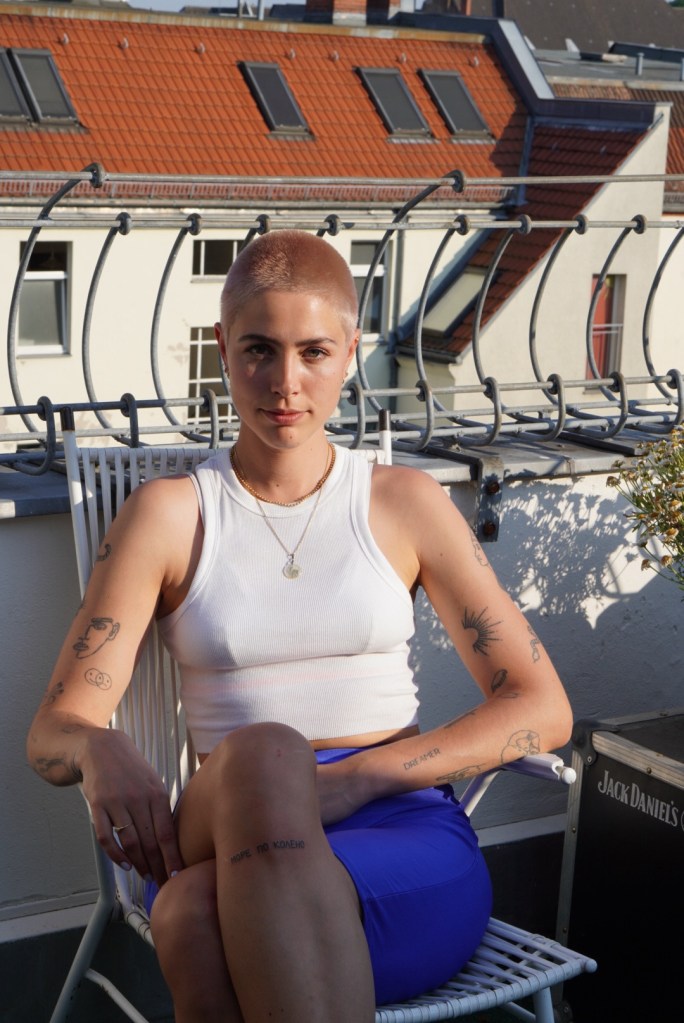
We were sitting on the open terrace of the penthouse I had rented for a few weeks, birds perched on the antennas. I handed her the ashtray.
“Oof, so hot.” She dropped it onto the table.
“If your life had a defining drama, what would it be?”
“My dad died when I was thirteen. I’ve now lived half my life with him and half without. The tricky part is, I don’t have many memories of him. My brain sometimes makes them up—like, I’ll see a photo and build a story around it. The first thing I forgot was his voice, and that’s really sad. Honestly, I don’t have a clue who he was. My mom doesn’t want to talk about him. And when I notice ways in which I’m different from her, I wonder if those parts of me come from him—someone I don’t know but would like to understand. It would be easier if I knew who he was.”
“What happened to him?”
“He was in South Africa. I was born there. He died eating a steak—it got stuck in his throat. It was a small town, and no one knew first aid.”
“If you could change the past, what would you change?”
“I’d save my father.”
“Is there a question you’d like to find the answer to?”
“What are my behavioral patterns? Why do I act the way I do?”
“Like what?”
“My longing for deep connection. I want it so badly, but as soon as I get close to commitment, I leave—even when I really want to stay. Maybe I’m not ready. So I ask myself, why? Is it fear?”
“What kind of fear?”
“Maybe fear of being vulnerable.”
She jumped out of her seat suddenly, laughing. “Oof! I’m allergic to wasps.”
“I don’t think they sting unless they feel threatened.”
“But they get aggressive easily, no?”
“Not this time of year. But in September, when they’re starving.” I paused. “What’s your dream?”
“To have enough money to buy organic food. To live in a small house in the forest—like you. Or maybe by the sea, in Portugal. I’d run a little sanctuary for rescued farm animals.”
“What’s your first memory?”
“South Africa. We had a house with a beautiful garden and a pool, but it was surrounded by high walls with barbed wire on top. One day, I fell into the pool—I was two or three. I almost drowned. My dad saved me. Since then, I’ve had this little problem—fear of deep water.”
“That doesn’t sound so little.”
She laughed. “Yeah, last year in Portugal, I tried to walk into the sea and I had a panic attack.”
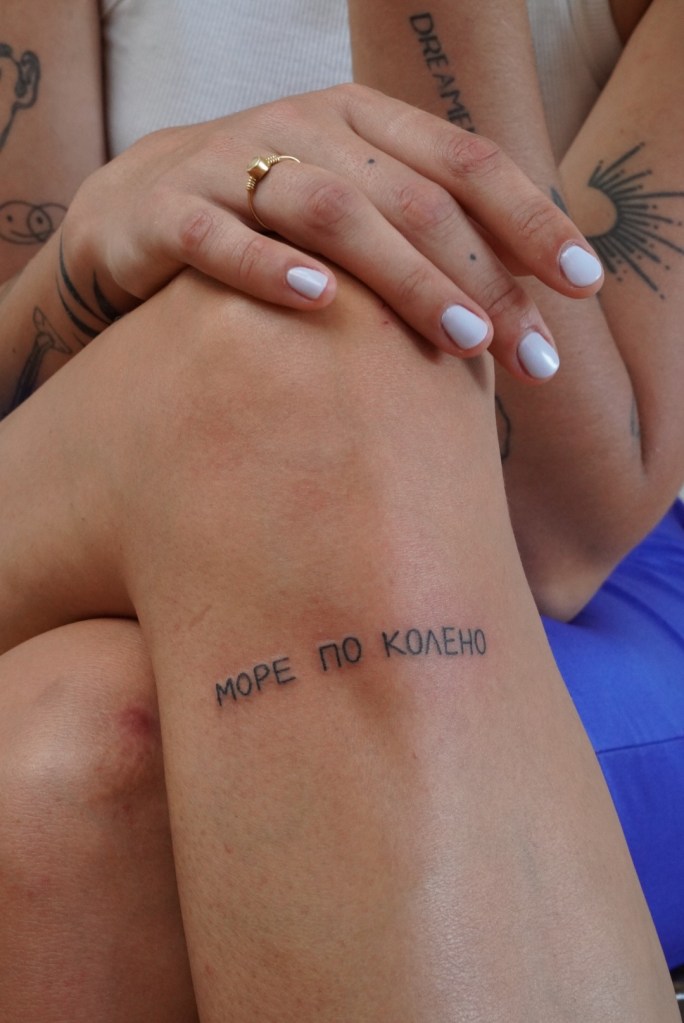
The tattoo translates from Russian as “The sea is knee-deep,” a phrase used to describe someone who is brave, fearless, daring, and skilled.
Discover more from Your Story, By Me
Subscribe to get the latest posts sent to your email.
