We met in a small hotel room at the Mercure Paris Notre-Dame Saint-Germain-des-Prés. The walls were white, interrupted by exposed old wooden beams. The room had only one chair, which I offered to Vaiora. I sat opposite her on the edge of the double bed, the white linen taut and freshly laundered.
“How do you manage professional sports while indulging in alcohol and cigarettes?” I asked.
“I balance,” she replied, her voice low and hoarse. “However much I drink, I make sure to work out just as much.”
“Is there some formula you use to calculate this?”
“No, just by feel.”
“It seems excessive—both the indulgence and the compensation. Isn’t it hard on your body?”
“Yes.”
“What motivates you to live this way?”
“Self-knowledge, mainly. And self-loathing.”
“And why self-knowledge through self-destruction?”
“Because I don’t know any other way. I’ve never tried self-love.”
“Since you’ve thought about it, what stops you from trying?”
“Inconvenience. Not knowing the outcome. Self-rejection, mostly. It programs you for failure, hopelessness.”
“So, you don’t believe self-love could work for you?”
“No. It feels… unattainable.”
“And what is love, to you?”
“I don’t know. Love, happiness, unhappiness—they’re all abstractions.”
“Yes, but abstractions we seem to understand on some level. Even without a precise definition, we know the feeling we’re discussing.”
“We exaggerate. For me, the words just below happiness and unhappiness—joy, sorrow, sadness—make more sense. I can understand joy or sadness, but happiness? I don’t think I’ve ever experienced it. The closest I’ve come is a heightened sense of joy.”
“What’s the difference between joy and happiness?”
“Joy is physical, immediate. Happiness is deeper. I wouldn’t call an orgasm happiness, nor the relief of seeing someone you love after a long time. Those are joy, not absolute happiness.”
“Does absolute happiness exist?”
“I like to think so, but for me, it’s abstract, elusive. Absolute unhappiness, though—that, I understand.”
“And what is absolute unhappiness?”
“Death within life—the apotheosis of pain, not physical but mental. It’s easier to describe when, outwardly, everything seems fine. You’re at your peak, life is relatively good—your family, your work, your friends—but you don’t exist. You’re absent, unable to define yourself, know yourself, or accept yourself in any way.”
“That’s the apotheosis of pain?”
“For me, yes.”
“And what does it mean to ‘know yourself’?”
“To accept yourself. To understand you’re alive—not just through actions or interactions but as a concept. And I don’t know how to do that. For me, it takes exhaustion to feel alive.”
“And to feel dead?”
“Through contrast. Pain reminds you you’re alive. But without external stimuli—no pain, no joy—how do you know you’re alive without being tied to the world? That’s what I wonder.”
“What is the tie?”
“Daily rituals—waking up, playing with my cat, breakfast with my mother, meeting you. Physical needs. Without the world—houses, cars, people, nature—how could we feel alive?”
“And to feel dead?”
“That’s emptiness. Absolute unhappiness. When you’re hollow, existing but absent within the living world.”
“When did you last feel that?”
“2018.”
“What happened?”
“Betrayal. Illness.”
“That doesn’t sound like emptiness—more like being overwhelmed.”
“My life situation brought me to a point where, despite all the perturbations, and everything that happened, none of it interested me or affected me in any meaningful way. It could impact my physical state—manifesting as pain—or provoke emotional reactions, but inside, there was nothing. Just emptiness, and no way out of it.”
“And how did you get out of it?”
“Everyone I knew metaphorically slammed my head against the wall. And I had no choice but to get up. I felt ashamed—unbearably so. Even when I was standing, I felt nailed to the baseboard.”
“How long were you like that?”
“Eight months.”
“Did the days feel different?”
“Events varied—treatment, feigned joy, moving, friends, comrades. But the emptiness remained.”
“And what was the betrayal?”
“The person I loved abandoned me during my illness. He didn’t tell me directly—he just blocked me, refusing to look me in the eyes. It wasn’t just the breakup that hurt; it was the lack of basic human empathy. On the day of my first chemotherapy, he blocked me completely. Occasionally, he’d unblock me just to send something cruel, then block me again before I could respond. That, to me, was the ultimate betrayal.“
“Why do you think he did that?”
“I could dissect his motives endlessly, analyze his patterns, but it no longer matters. It happened for a reason, and, strangely, it taught me something. Perhaps it served him in some way too.”
“What did it teach you?”
“I learned my minimum—how far I could fall.”
“The bottom?”
“I would say I sank below the bottom, into the abyss. I drove myself mad—stooping to cruelty, manipulation, anger, endless despair, and constant aggression toward others. I manipulated people in the most terrible ways.”
“How is this connected to the abyss?”
“It’s tied to the feeling of sinking into a filth you can’t escape, a dirt that clings no matter what you do. I reached a point where I felt a total jerk. At first, I even admired it—this descent into depravity, this scum. But eventually, I stopped caring. Whether I was shithead, befoul with excrements, I sincerely didn’t give a fuck.”
“Sincerely didn’t give a fuck about yourself?”
“About everything, absolutely everything. And I kept going, repeating the same destructive actions. Sometimes there were fewer, sometimes more, but the state of mind—the emptiness—remained the same.”
“And now?”
“Now, everything has flipped. Life matters to me. I’m curious, even hopeful.” She paused. “You know, the disease that was destroying me became secondary after his betrayal. I wasn’t desperate to die, but the priorities shifted. Surviving cancer was easier than surviving him.
And I’ve noticed something about people who go through cancer: their perspective on support changes. It’s often the hardest for the people standing by, for those who walks this path with you.”
“Why is it the hardest, why isn’t it just as hard?”
“Because they feel utterly helpless. There’s no formula for how to support someone going through this. It’s ironic—when people told me, ‘You can do it!’ I’d sulk, thinking, ‘Go in my shoes, like really? I can do it, to be sure!’ When they pitied me, I’d snap, ‘I’m not dead yet!’ And when they ignored my illness, I felt invisible. It’s a complex and very interesting thing.”
“Especially when your self-knowledge comes from self-torture.”
“Exactly. This wasn’t my first brush with a fatal illness. I’ve dealt with health problems for as long as I can remember. It’s given me a strange peace about death. I genuinely know it’s inevitable. But, just to be clear, I don’t want to die.”
“Then what do you want?”
“If happiness exists, I sincerely want my mom and dad to feel it. That’s my light blue dream.” (In Russian, the phrase “light blue dream”—‘голубая мечта’ (golybaya mechta), refers to an idyllic, often unattainable aspiration or fantasy.)
“And the final one: are you in any way related to the famed Stroganov barons and counts?”
”Yes.”
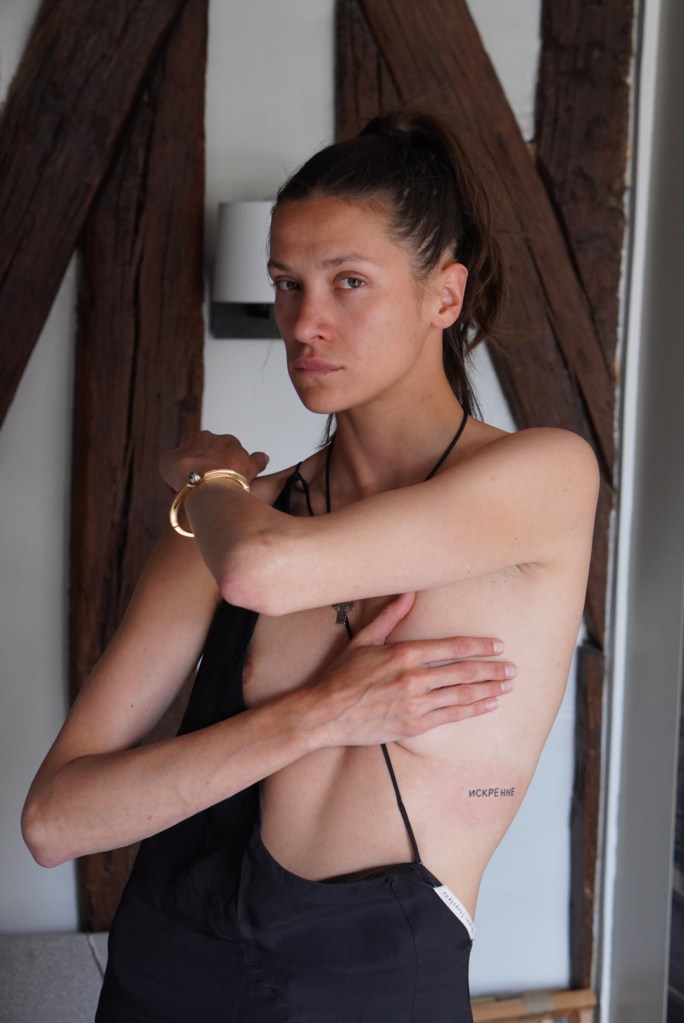
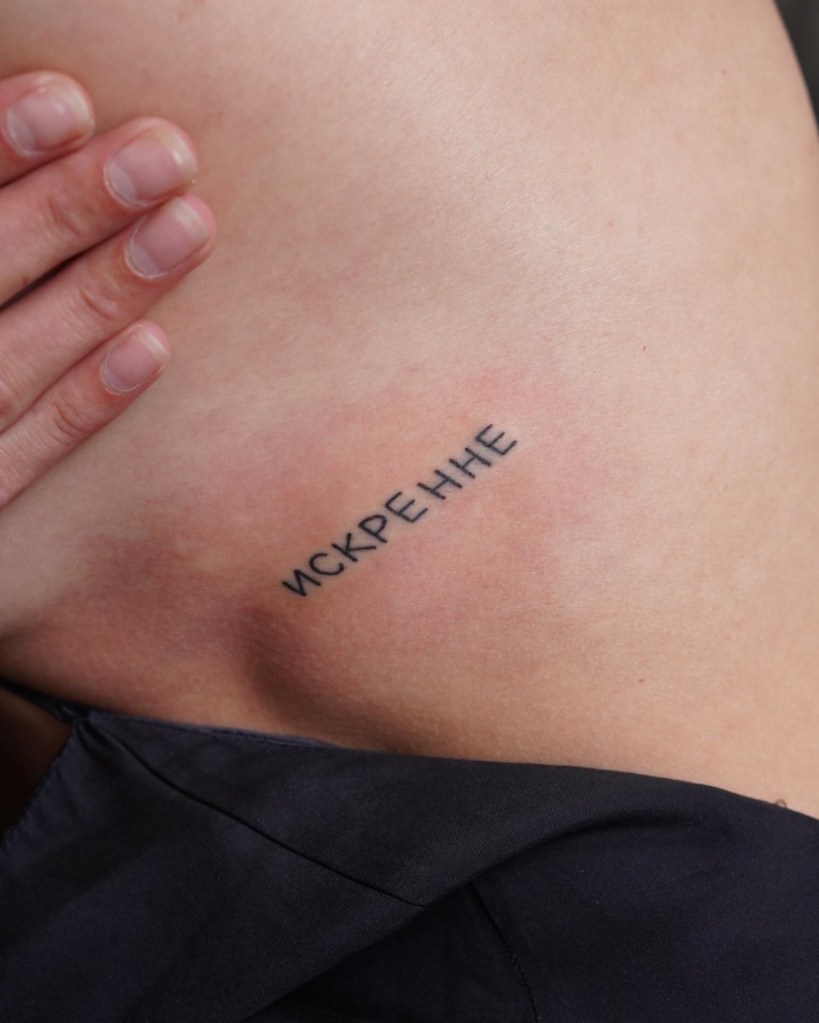
The tattoo reads “Iskrenne,” which means “Sincerely” in Russian. Derived from “iskrno,” the term conveys a sense of being candid, straight from the heart, from soul, with roots in “iskr”—signifying “near,” “close,” or “within.”
Discover more from Your Story, By Me
Subscribe to get the latest posts sent to your email.
