“What is your greatest fear?” I asked Chris.
“Being judged.”
The beep of a truck, stacked on Rue du Faubourg Poissonnière, cut through the open window of the chambre de bonne.
“And not being good enough,” he continued. “I suppose those two are linked. I understand how odd they are—I judge myself, then worry about what others think, even though it shouldn’t matter. It’s been with me for a long time, but I’ve started to deconstruct it.”
“For example, what do you feel you’re not good enough for?”
“Success. It’s tied to my father. It’s not that everything always traces back to childhood, but I’d say I’ve never felt good enough in his eyes.”
“What do you consider success?”
“That’s a good question.” He giggled. “A sense of accomplishment, more than anything.”
“And what is it you’d like to accomplish?”
“Being happy and true to myself.”
“Do you feel more pressure to be successful or happy?”
“I always felt pressure to be successful. But now I see success differently—it’s not monetary or material, but spiritual. To me, that kind of success means being happy.”
“When was the last time you felt happy?”
“Every day, when I wake up.”
“And yet, you still seek another kind of success? Is it constant happiness you want to achieve?”
“Yes,” he said hesitatingly. “I suppose I’m holding on to old fears, even though I feel different now.”
“So, you believe happiness can be constant?”
“Mm-hmm.”
“And what is happiness?”
He took a deep breath. “A lot of it, for me, comes from love and acceptance—of myself and others. Yes, self-love and love for others. And a lack of judgment. Plus, a certain freedom.”
“What kind of freedom?”
“We can’t always have every kind—financial, psychological—but for me, psychological freedom is most important.”
“Could you elaborate?”
“I’m a baker, and it’s meditative for me. When I’m working, I lose myself in joy. That ability to fully enjoy the moment is special to me.”
“And what if the moment is unpleasant?”
“When I was younger, it was hard to accept moments like that. But now, I choose to be present in them. I know not every moment will be easy, but it’s still mine.”
“If Carlota told you tomorrow that she only had a week left to live, would you still be able to enjoy the moment?”
“I would enjoy the last moments I had with her.”
“And if you broke your leg, would you be able to enjoy the pain?”
“Pain is psychological. And I find it fascinating, even appealing in a way. I think I’ve suffered a lot—psychologically, at least—and I used to reject that suffering, feeling like it was inflicted on me by my environment. But now, as an adult, I choose my environment, my life. I’m in control. So, for me, freedom lies in accepting that bad things will happen.”
“What exactly do you control? Your mindset?”
“Mm-hmm.”
“And how do you control it?”
“It’s about listening to my inner voice. I also practice meditation and spirituality. It helps me feel connected, like everything happens for a reason—good or bad. The more you reject it, the harder it is.”
“What’s the most important lesson life has taught you?”
“That love is the answer. It’s the most powerful force we know, yet it’s unexplainable. We don’t understand how love comes or goes, but we know when we feel it. I believe a lack of love—for ourselves and others—is the root of all problems.”
“Do you have a dream?”
“I have many. Recently, I’ve dreamed of living a comfortable life in Brazil, with a garden, in a place without stress or conflict—where Carlota and I can enjoy life’s simple pleasures.”
“And if Carlota were no longer in your life, would you still follow that dream alone?”
He pondered before answering. “I’d like to say yes.”
“I ask because, if your dream depends on another person, it could create pressure for them. Your happiness might hinge on their presence.”
“That’s why communication is so important. We don’t force anything on each other. We work together to make each other happy.”
“When was the last time you helped Carlota with something?”
“What comes to mind is when she got a haircut she wasn’t sure about. She said she needed my support to accept how she looked in the mirror, and I believe I helped her do that.”
“What are the things you feel insecure about?”
“Not being perfect. Making mistakes. Failing. It’s not about specific insecurities like disliking my body; it’s more the negative energy I’m trying to let go of. It’s cliché, but I feel like a caterpillar trying to turn into a butterfly, stuck in its cocoon. I feel it in my gut—something is holding me back, like an anxiety that spirals into negative thought cycles.”
“For example?”
“We’re trying to buy a house. Once we do, we’ll be left with the scraps of our savings and have to rebuild everything. It’s stressful.”
“What is it about the house that makes you anxious?”
“I bought it with my ex, and over the past five years, I built it. We separated two years ago. Now, Carlota and I are trying to buy it together. It’s taking so long—getting a loan, making everything work. It’s a great source of stress. The house has always represented security to me. But there’s a voice in the back of my head saying it won’t work, that things will go wrong.”
“Despite the anxiety, why do you cling to the idea?”
“Because it’s the perfect space for us. We’re like hermits—we love staying home. It also has a workshop, and we have so many plans for it. It would be a shame to lose it.”
“However, that house was initially a project shared with your ex.”
“We bought it together, but I built it. So it’s a deeply personal project that remains unfinished—it never became a home. With my ex, I never envisioned it as a true home. But with Carlota, I see it clearly, our future there.”
“That sounds risky to me—maybe because of my own experiences. Envisioning your future like that can create expectations that might lead to disappointment.”
“I agree, but you also have to manifest what you want.”
“Yet earlier, you said you want to be happy. Now you’re manifesting the house and your future with Carlota, but that isn’t the same thing.”
“Isn’t it?”
“No. Having a house with Carlota doesn’t necessarily mean you’ll find happiness.”
“Then what would make me happy?”
“Something you can’t lose.”
“I think the biggest issue is that if I lost the house now, I’d feel like I have nothing—financially or otherwise. I’ve poured my blood and sweat into it, so it holds a lot of value for me. It’s not that I couldn’t be happy without it, just a year ago, I didn’t even care about the house. Then I found the reason why I need it, why I couldn’t give up on it.”
“What would make this house a home?”
“We want to decorate it in a way that reflects us—our colors, our design, our furniture. It has a workshop, so we could build our future around it. Carlotta wants to try tufting rugs. Having a house also provides us the freedom to travel.”
“Is there something that makes you uneasy about it?”
“We have so many different dreams. I see all these possible paths, and I hope that no matter which one we take, we’ll stay true to each other and take care of one another. I know, whichever path we choose, it won’t be easy, but as long as we’re true to ourselves, it’ll all work out in the end.”
“Or not.”
“Or not,” he laughed. “But I’m still optimistic.”
“Yet saying ‘whichever path we choose, it won’t be easy’ doesn’t sound very optimistic.”
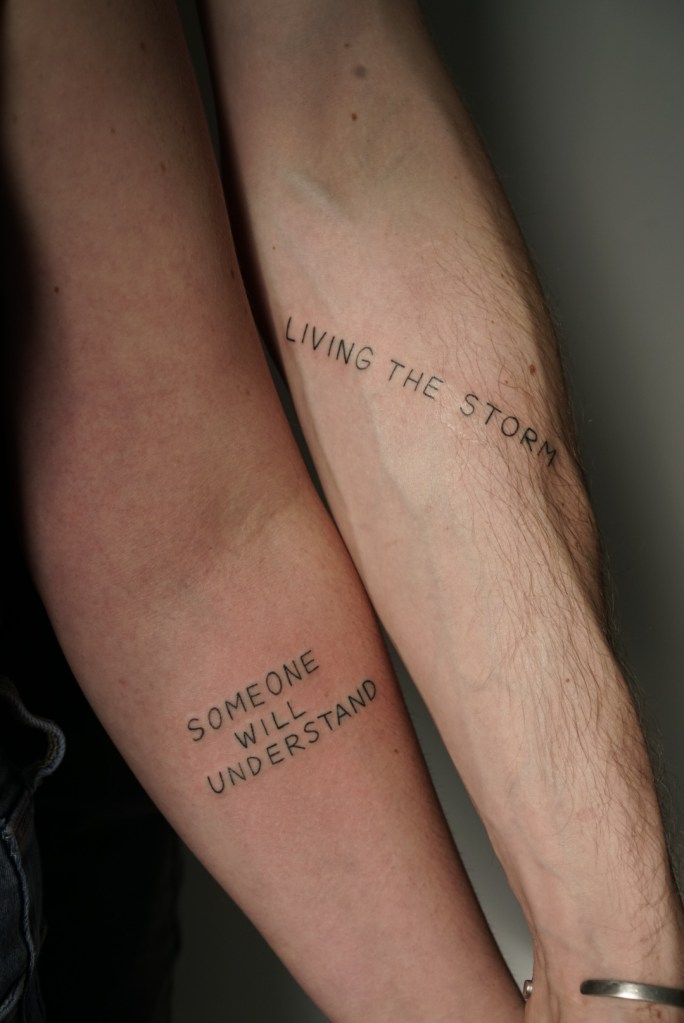
“But after the struggle, there’s hope! You know the saying—there’s a calm before the storm, but there’s also calm after the storm. The storm always comes, no matter how grounded you are.”
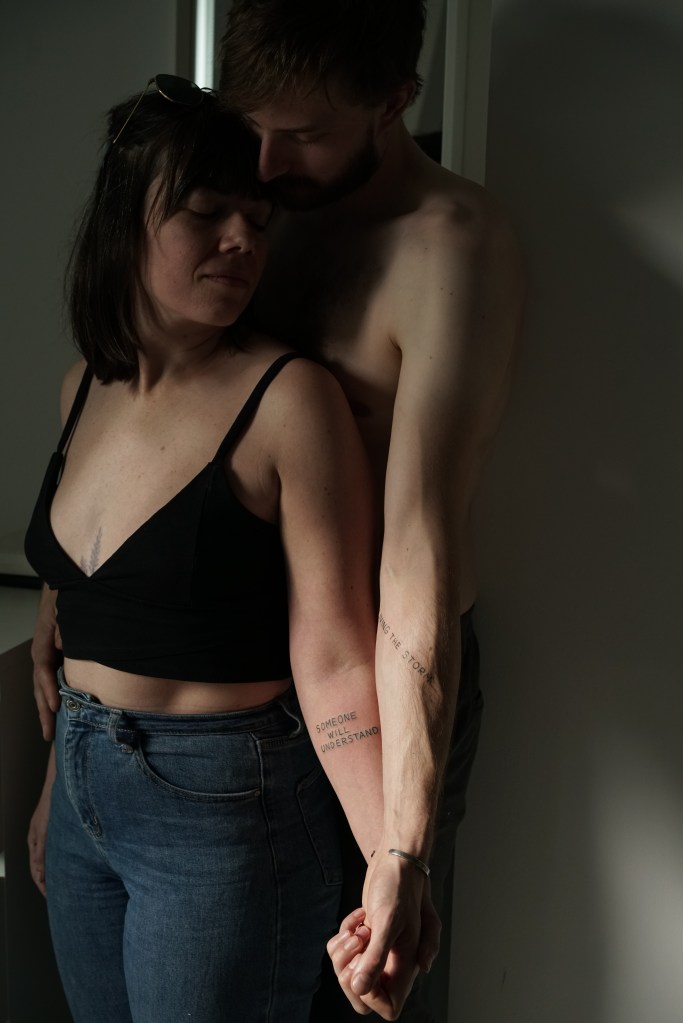
“Okay, I have an idea for your tattoo, but before we discuss it, I’d like to interview Carlota.”
Carlota sat down in front of me, her posture delicate, her expression hesitant. She was clearly shy.
“What makes you shy?”
“I’m hypersensitive, but I don’t know how to express my feelings.”
“How would you like to express them?”
“Any way I could. It would feel like a release of everything I’m holding in. But even so, I’m proud of my emotions.”
“Why are you proud of them?”
“It’s who I am.”
“But why does that make you proud?”
“I don’t know. I think emotions are something to be proud of, but actually, I’m not. I hate it when I cry.”
“Why do you hate it?”
“Because it feels like I’m not strong. And I hate how puffy my eyes get. Then I blame myself for crying. I’ve never felt accepted when I had breakdowns. My ex, for example, always criticized me for crying or for being ‘crazy’ instead of trying to understand me.”
“What do you mean by ‘crazy’?”
“I found out that I’m bipolar. Sometimes, a small thing can make me so nervous that I feel physically tense. When I’m nervous, I do this.” She showed me her hands, the skin around her nails irritated and raw. “And then I cry uncontrollably. Nothing can make me stop.”
“For how long?”
“It depends.” She smiled briefly. “Sometimes hours, sometimes minutes. I hold it in until it passes.”
“What exactly do you hold in?”
“My sensitivity. Because people aren’t ready to see it—they don’t really want to see it.”
“Who are these people?”
“I think everyone. But mostly my ex. And my family. I don’t want them to worry, especially since we’re so far apart. If they knew I was having a breakdown, they’d stress about it.”
“Why don’t you want them to stress?”
“Because they wouldn’t understand, and it would only make them sick. My father’s health is poor, and I’d feel guilty if I made it worse.”
“So you pretend you’re fine?”
“Mm-hmm.”
“Don’t they sense it?”
“Yes. My mother’s like a little witch—she always knows.”
“When was your last breakdown?”
“A few months ago, just before summer. Work was tough, and I was stressed. It always comes from stress—work, or someone treating me badly.”
“What comforts you?”
“I’ve been learning from Chris that everything will be okay.”
“What do you mean by ‘everything’?”
“Financial stability, the house. That’s a huge part of our stress.”
“And if you didn’t have it?”
“I’d probably have a breakdown.” She smiled faintly.
“What’s your greatest fear?”
“Being alone.”
“What scares you about that?”
“It’s funny because I’m a solitary person, but when I say ‘being alone,’ I mean losing my parents or not having a partner. I don’t think I could handle it.”
“What do you mean by ‘not handling it’?”
“I’d rather die. So I hope I’ll never be alone, that I’ll find my soulmate.”
“What’s so unbearable about being alone?”
“Life doesn’t make sense if you can’t share it. Imagine I had no family, no friends, no Chris. Even if I traveled and saw the world, it wouldn’t mean anything without someone to share it with.”
“But there are so many moments in life when we’re alone, when we don’t share.”
“And those moments feel lonely.”
“Do you feel lonely when you brush your teeth?”
She paused. “That’s a good question. Actually, no. But sometimes, I feel lonely even when Chris is near.”
“How does that happen?”
“It’s when I punish myself.”
“Punish yourself for what?”
Tears welled in her eyes. “For thinking I’m done.”
“Do you mean thinking about suicide?”
In a calm, detached voice, she said, “It happens, yes.”
“What stops you?”
“I remind myself that I’m strong and that I can get through it. I do my best.”
“What do you enjoy most in life?”
“Sharing. Lately, I’ve been overwhelmed—not just by work, but by meeting Chris. He’s shown me so much about myself. Remember when I said I didn’t know how to express my feelings?”
I nodded.
“He accepted me as I am, and it was… wow. Someone can understand me.”
The roar of a scooter accelerating up the street filled the room.
Discover more from Your Story, By Me
Subscribe to get the latest posts sent to your email.
