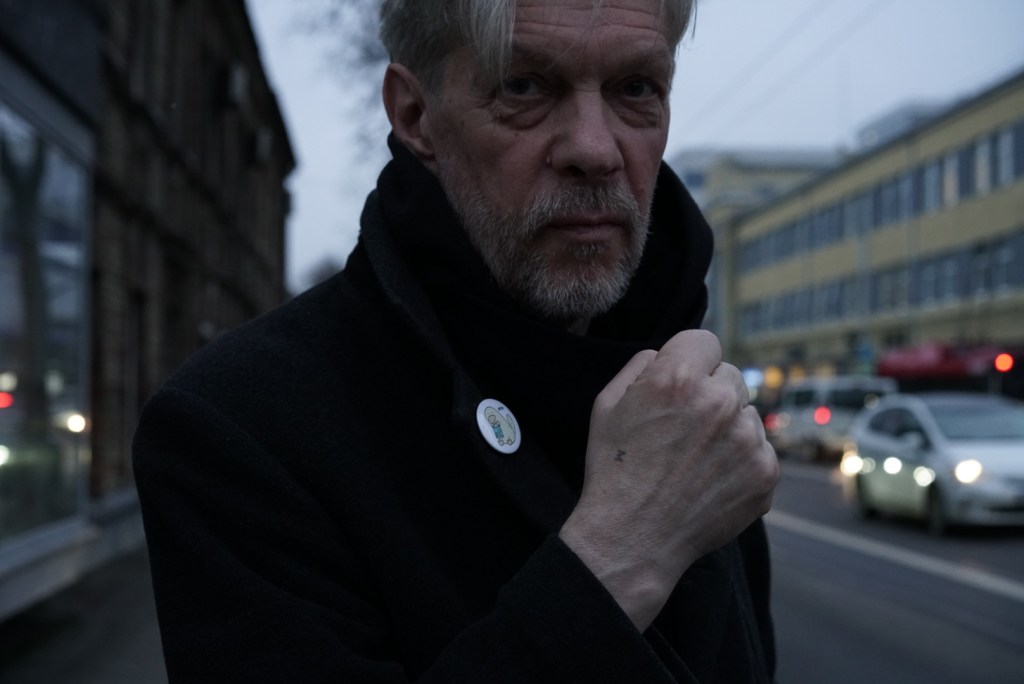
“What is freedom?” I asked him as we settled at a small table in a coffee shop in Vilnius, just across the street from his temporary residence.
“Freedom is an experience—something you must strive for, perhaps even earn. It comes at a price. The extent and intensity of your freedom are directly tied to the price you’re willing to pay.” He replied, his gaze gripping mine.
“Do I understand correctly that the price you paid was life in exile?”
“Yes, exactly. And that decision was critical for me. Two things pushed me to emigrate: first, when my close friends began to be imprisoned, I realized the shells were landing very close. Second, and even more importantly, I knew I couldn’t stay silent. If I spoke out, they would come for me. And so, I chose freedom—freedom of speech, the freedom to have a voice, the right to be myself. This was essential for me; I couldn’t imagine my life without it. My experience of cultural dissidence and the alternative cultural scene I was part of for nearly two decades in Minsk shaped me profoundly, perhaps even decisively.”
“How did it happen that your friends were detained, but you were not?”
“I don’t know. Just as I don’t know why they were imprisoned. It seems to me there was no logic to it, no clear sequence of events. What is the logic of a meat grinder? It’s a machine that grinds meat into mince—blind mechanics. One of the Soviet dissidents once said something profound: ‘I have aesthetic disagreements with the Soviet government.’ I feel exactly the same—a deep, visceral aesthetic disagreement with the regime in Belarus. I couldn’t shut up. Silence disgusted me; it was impossible not to speak. And at that breaking point, I knew the decision had to be made—I had to leave. In doing so, I took with me the one thing I couldn’t live without: the chance to remain internally free.”
“And what do you think? Is there freedom of speech here in Vilnius? Or is it just that what you want to talk about doesn’t pose a threat to the authorities here?”
“I don’t think in terms of threats here at all. In this regard, I feel absolutely safe. Can I speak publicly about what I consider important and necessary? Yes, I can. The difference is that no one here really needs it. While the people who might possibly listen to me, they probably don’t hear me at all.”
“But can you also speak freely about what is happening in politics here?”
“I’m not interested in that right now. This isn’t my politics. I don’t have the right to vote or the status of someone involved in Lithuanian politics, so I don’t feel qualified to judge it—especially since I don’t understand much about it.
Of course, I’m deeply grateful to this country for accepting me. What they’re doing to support Belarusian political refugees is invaluable and important. As for everything else, I still need time to experience it, to live it. For now, I’m not an insider. What can I possibly say about the current state of affairs here when I’m essentially a tourist? Just a set of banalities.”
“It turns out that when we emigrate, we exchange the status of insider for outsider…”
He cut me off mid-sentence. “It’s a bit more complex than that. When a new wave of emigration begins, especially in a country undergoing crisis, it’s not just individuals leaving—it’s an active, explosive mass exodus. And who leaves? It’s always the same types of people: the dissenters, the inconvenient ones, those who challenge and compete—conflicting structures, divisions, personalities. Conformists and adventurers leave. Prophets and madmen, poets and rock men, opportunists and swindlers—they all leave.
This whole chaotic wave, with all its contradictions, which in a stable country might coexist and even drive societal progress, gets pushed beyond the geographical borders. And what happens next? Instead of building relationships with the host country, we continue our old battles. We settle scores, divide resources, measure influence, seek alliances or stir disagreements. In essence, we export our internal struggles abroad.
Emigration doesn’t resolve these contradictions; it simply relocates them. And that leads to a redistribution of limited resources—resources that, in emigration, become even scarcer. I’m talking about symbolic influence and public status. Maybe someone’s financial situation improves, but socially, we lose everything. We become a performance, not for the country we’ve arrived in, but for ourselves—a closed club, interesting only to its own members.
Who in Lithuania cares about Maxim Zhbankov? No one. In reality, we’re only relevant to a specific audience: our fellow Belarusians who, like us, are caught in this strange cycle of exile and conditional significance.”
“Don’t you think it’s a matter of language? After all, we could discuss internal struggles with Lithuanians too.”
“Maybe. But it’s hard for me to predict how Lithuanians would respond, because I’m very unfamiliar with their perspective. On a broad conceptual level, imagine this: a spaceship lands on Gediminas Avenue and three hundred Martians step out, saying, ‘Okay, we’re going to live here now.’ We’d probably say, ‘Listen, you’re kind of strange.’ And they’d reply, ‘Yes, we are strange.’ We’d add, ‘But we don’t understand your language,’ and they’d say, ‘We don’t understand yours either, but we’re staying.’
To me, Belarusian emigration to Lithuania feels a lot like that. We’re the aliens—people with different logic, different vocabulary. Take the concept of ‘tutejshy’, what is it?”
“Local.”
“But no, ‘tutejshy’ is a conformist opportunist. You approached it through grammar, and I’m explaining it through context. What I mean, when unfamiliar people arrive—strangers—you have to figure out how to negotiate with them, how to build relationships. That takes effort. It’s work, it’s financial strain, it requires education and resources. And the host side already has its own problems, its own budget constraints. So, we’re perceived as a challenge—one that’s not entirely clear how to handle. On our side, despite all the respect and gratitude we feel toward the host country, we know we’ll probably never fully become one of them. We might become understandable, we might become partners or even friends—but that’s not the same thing.”
“Can you tell me about your personal internal struggle today? Who is it between, and why?”
“I suppose it’s a conflict between creative ambitions and the ability to realize them. Sometimes it feels like I can do anything; other times, it feels like I can do nothing. There are moments when I believe my work has meaning and significance, and others when it seems like no one gives a shit. In the first case, I find a kind of justification for my presence here. In the second, I feel completely stripped of it.
It’s like a pendulum—constantly swinging, no matter what I do. Each project begins with quiet despair, moves into complete hopelessness and internal anxiety, then anger and excitement take over. Something eventually clicks, and there’s a result. But once it’s done, the cycle starts all over again. It’s an existence in sine wave mode, where you’re always managing your emotions, convincing yourself, persuading yourself, healing yourself. On one side, you make yourself sick; on the other, you’re your own doctor.
When we talk about the loneliness of an emigrant, this is what it means—you’re your own scriptwriter, director, healer, and poisoner. It’s actually a powerful position because there’s no one else to blame. And it’s rewarding, too, because every victory is fully yours. Every result, every achievement, every success belongs to you, even if it lasts only as long as the project itself. And yes, in six months, you might have to search for funding all over again, with no guarantees that you’ll find it.”
“And what was different for you in Belarus?”
“In Belarus before 2020?”
“Yes.”
“There was a clear division of functions. I had my own Belarusian reality, one that existed apart from the official Belarus, where there was no place for the president, no concern for who the minister of culture was, or how many films “Belarusfilm” produced. I created an inner world populated by crazy musicians, eccentric writers, alcoholic poets, and audacious lecturers.
The authorities didn’t interfere with this reality because it posed no threat to them. We had an unspoken agreement: the strange guys like us wouldn’t seek power, and the authorities wouldn’t crush us. With this division, both sides could coexist. In this underground world, we were internally free.
But in 2020, everything broke. Philosophers were imprisoned, artists were killed, bankers entered the political arena. That delicate balance—our fragile freedom and tolerated lack of freedom—collapsed. It felt like a complete reset. At that moment, I believed we were leaving the country to build a new Belarus abroad. But what actually happened? We carried our same diseases with us. Instead of healing them, we preserved them. Now, we’re caretakers of those old dysfunctions. We remain ideologically fractured, incapable of consensus, replacing dialogue with propaganda.
I’m still waiting for the seeds of a new Belarus to grow, but I see no signs of it yet. Maybe I’m waiting too little, doing too little. Maybe I’m doing the wrong thing? Our conversation turns somehow gloomy.”
I couldn’t bring myself to ask any questions; I was too absorbed in silently empathizing with what Maxim was saying. After a brief pause, he began speaking again. “I have a friend who moved here a year after me. He wrote a text, in fragmented paragraphs, the kind I like to write. Each paragraph ended with the same refrain: ‘I’ve been here for two weeks, and I don’t understand what I’m doing here.’ ‘I’ve been here for two months, and I don’t understand what I’m doing here.’ ‘I’ve been here for two years, and I don’t understand what I’m doing here.’
It’s a beautiful poetic form, but the essence remains the same: there’s no overarching narrative behind our actions. And who, exactly, is supposed to provide us with that story? Maybe it’s for the best that no one does. Perhaps we’re learning to be alone, learning to be Europeans—if being European means being alone, creative, and, in the end, self-sufficient.
What used to sustain us—the sense of solidarity, the alternative brotherhood that flourished in the underground resistance to the regime—has changed. It’s harder to feel like part of a unified movement when I’m in Vilnius, my comrade is in Warsaw, and another is in Lisbon. We’ve been stripped of a stable locus. The mosaic of our shared experience has shattered, and the pieces don’t form a coherent puzzle anymore. Instead, each of us, in our separate places, works within our own context. We’re learning to be not just Belarusians, but Lithuanian Belarusians, Portuguese Belarusians. By joining someone else’s narrative, we begin to live by new rules, adapting to different realities. And in doing so, we ourselves become as fragmented and ambiguous as the contexts we inhabit.”
“When you supervised my thesis, you told me about movement within the system according to a personal plan.”
“Yes.”
“Doesn’t this apply to the fact that when we leave and find ourselves in a different context, that this does not mean that movement according to a personal plan becomes impossible?”
“Of course. It’s just that in the situation of emigration, the emphasis of political confrontation is removed for most people. That is, you go beyond the aggressive political order, where the political agenda becomes less significant for you because it affects you personally to a lesser extent. This changes your personal design, linking it not with the search for general freedom, but with the search for personal self-actualization, some kind of individual creative movement.”
“Do you feel self-actualized?”
“I think I could be more. I think I could shine brighter. But it’s not just about what I want—it’s also about how ready the environment is to embrace me.”
“Could you tell me about your relationship with Dasha, your wife?”
He was silent.
“What does it look like?”
He chuckled. “And what is it supposed to look like?”
“I don’t know. I think it’s different for everyone.”
“I just don’t understand what it’s supposed to look like.”
“Besides the fact that she’s your wife, what else could you say about her?”
“Well, first of all, she’s a friend and a comrade—someone close to me, the closest person. I realize now that this is exactly the kind of relationship I’ve been searching for all my life but hadn’t been lucky enough to find until her. When I talk about how the alternative cultural environment shaped me, it applies to our relationship too. Dasha came to study with me in this informal educational project I was running. If it weren’t for that, none of this would have happened. That’s why I think of it as a wonderful, amazing result. We don’t even agree with each other in a conventional way—it’s always beautiful, always constructive. With her, I feel like an entirely different person. And what’s more, I like this new version of myself far more than the one before. It’s completely natural, and deeply important, that she’s by my side. I never imagined that with all my self-sufficient loneliness, I could feel the acute ache of missing someone if I don’t see them for 15 minutes. It’s inexplicable to me—and yet, it’s wonderfully so.”
“Sounds like love.”
“Yes, of course. And like any profound feeling, it’s multifaceted. There’s room for anxiety, sometimes confusion, and even concern—like the fact that there’s a twenty-year age gap between us. Realistically, I know I’ll likely die before she does. I’m not counting the years, just acknowledging the reality of the situation. And Edith Piaf is singing for us,” he added, laughing. “Sometimes reality throws up a soundtrack so on-the-nose it would feel absurdly clichéd in a movie.”
“Returning to the idea of a personal plan, as far as I know, your cultural heroes, in addition to Belarusian ones, have often been, and perhaps still are, figures from Western culture. What I mean is that there’s a context that can feel like mere decoration, allowing you to live in a world where it doesn’t matter from which speakers Edith Piaf is singing.”
“Of course, yes. My story in this regard is quite telling. When we left Belarus, like many others, we took just two small suitcases because we didn’t know where we were going or how long we’d be gone. I left my entire music collection behind—a collection I’d been building for 20 years. I never counted how many discs I had, but it was my life’s work in a way, and all of it stayed there.
When we arrived here, and it became clear we’d be staying for more than just a few weeks, I began buying records again. Dasha laughed at me, saying, ‘What, didn’t you have enough of those already?’ But I really missed them. I started with early Elton John, then David Bowie, then Tom Waits. I wasn’t just buying these records to own them. For me, it was about reassembling the club—a place where all my cultural heroes are near, lying in a pile on the table. There’s this warmth they bring, this feeling of companionship. You can touch it at any moment, and you’re no longer alone.
And yes, this ties to my Belarusianness, because, God forgive me, my Belarusianness isn’t just about speaking Belarusian. It’s a place of assembly—a way of gathering things that resonate deeply with you. Bukowski and Kerouac, Miles Davis and John Coltrane—they’re all part of me, all embedded in me in some way. They’ve shaped me, and they’re inseparable from my sense of self, my sense of Belarusianness.”
“Why Belarusianness? Isn’t part of the magic of being human that you can meet someone from Argentina who loves Davis and Coltrane just like you, and suddenly realize you see the world through almost the same eyes?”
“Yes, of course. But I’m talking about the context of origin. The things that happened to someone in Buenos Aires or San Francisco happened to me in Minsk. And then, when a match occurs”—he clapped his hands—”it creates a spark. Like when I was in Stockholm, talking to one of the leaders of the Swedish Union of Journalists. At some meeting, some banquet, after the second glass, I said, ‘Ola Håkansson.’ And he immediately replied, ‘Oh, Ola & the Janglers, ’69,’ and clapped his hands just like this. Suddenly, there was a connection. Do you know what it was through? A match—two people coming from entirely different places but meeting at a single shared point, a specific record by a specific musician of a specific era.
That’s why, for me, Belarusianness is an open project. It’s about flexibility, the ability to actively appropriate and reinterpret, to make anything your own. But no matter where we live, we will always wear Belarusian glasses.”
“What kind of glasses are these?”
“They’re the lens of experience—of the Soviet cultural province, of being from a border nation, of nurturing inner freedom. They’re the glasses of learning to escape the empire—a process that, as practice shows, never really ends.”
“And how do you imagine the endpoint of this escape?”
“I almost want to say something stupid, like ‘the Bahamas,'” he laughed, “but I think it’s more about time passing, about letting the pain subside. Right now, it still hurts—this sense of inferiority, this dependence, this humiliating subordination to the empire. But let’s leave it here; I’ve talked enough for one day.”
*M
Discover more from Your Story, By Me
Subscribe to get the latest posts sent to your email.
