“How are you feeling?”
“Cold.”
“Are you talking about the temperature outside or your general mood?”
“The temperature outside, but in general, it’s also kind of cold.”
“What usually warms you up?”
“Strong emotions—something intense and explosive, something that creates energy. It doesn’t even have to be positive in the usual sense. Even something painful can warm me. For example, I love music. I get completely lost in it, and it warms me up, even if it’s a heart-wrenching song that can never fill the emptiness in my soul. It still brings a strange kind of heat.”
“Where is your soul?”
“Somewhere far away.”
“And the hole?”
“The hole is here,” she answered with a grin.
“But if there’s a hole in the soul, doesn’t that mean the soul must be where the hole is?”
“Maybe the soul slipped away through the hole, but it can come back. And when it does, I’ll let it back in.”
“What’s your definition of a soul?”
“It’s what makes a person’s physical shell an individual,” she replied softly, sadness in her voice.
“What makes you sad?”
“Thinking about the past. Sometimes the future, too—not because it’s uncertain, but because it’s sad to see how much of it feels predetermined.”
“What do you mean by predetermined?”
“The catastrophe of it all. I don’t have the faith or strength to pretend everything will be wonderful and joyful. And honestly, I don’t think I need that. I like my sadness, my melancholy. I even cherish it.”
“What do you like about it?”
“It’s comfortable. I like to feel it, to live through it. I like crying, even the hysteria. I know it’s a kind of masochism. Most people find comfort in happiness, but I feel at home in sadness.”
“But you say you feel good when you’re sad. Isn’t that happiness in its own way?”
“Yes, in my way. It’s not happiness as people usually define it. Society expects happiness to look like smiles and laughter, not tears and melancholy.”
“What can make you cry?”
“A song, a line from a book, a memory. So many things.”
“Do different things make you cry differently? Are some tears sadder than others?”
“Absolutely. The depth of the feeling and how much it consumes you varies. Sometimes I cry so deeply that nothing else exists but the emotion. Other times, I cry lightly, still aware of the world around me, thinking about what I’ll do next.”
“I can’t imagine that kind of detachment. When I cry, it fills everything.”
She laughed. “Does it happen often?”
“Only three times in the last ten years.”
She looked surprised. “I’ve cried like that three times this week.”
“What for?”
“Mostly the past.”
“What about the past?”
“It’s hard to talk about. One time, it was about someone I lost. He died.”
“Do you mind telling me what happened?”
“He overdosed. It was his decision to go. That’s hard to accept because I couldn’t do anything about it. It wasn’t my choice—it was his. And I just have to live with that. But it’s devastating.”
“I’m sorry. How do you think, do people have the right to end their lives?”
“Yes, and I don’t think it’s unfair to me. But it still hurts deeply, especially in winter. So much has happened in winter.”
“Didn’t much happen in summer?”
“I don’t like summer. Everyone’s so happy, smiling, and carefree. It feels invasive, almost offensive. Like their happiness mocks me.”
“Why?”
“Happy people seem suspicious, like there’s something fake about them. Something’s off, but I don’t know what.”
“What gives you strength?”
“Intensity. Passion. People. Music. Art. Literature.”
“What were the other reasons you cried last week?”
“I cried because someone treated me badly.”
“Did you feel sorry for yourself?”
“Yes. I didn’t understand why this person treated me that way. I also cried over music—a few times.”
“What did the person do?”
“He traded me for someone else. A man. That hurt deeply.”
“Why did he trade you?”
“He said I was too complicated—a woman with demons. He wanted something simpler.”
“What makes you difficult?”
“I’m a person from nowhere. Sure, I was born and raised in Moscow, and now my home is Paris.”
“Why Paris?” I interrupted.
“I have a theory: only broken people stay here. Paris is a kind of purgatory, a place where people arrive and then drift along, searching for their Virgil. Finding your Virgil is essential here—someone who guides you, shows you the layers of this city. Paris is like an endless black hole where everything is mixed up. In seven years, I’ve seen people fail the test of Paris and leave. But I love this city because it breaks people.”
“And for those born here?”
“Of course, it’s different for them. But I’m speaking about my experience. I love the way Paris constantly drags you to the bottom, forcing you to confront your own hell. Some people learn to live in their personal hell, finding small joys—hedonistic French pleasures or profound human ones. Others can’t stand it and leave, retreating to stable, predictable lives. Stability doesn’t exist here.”
“What’s your greatest achievement?”
“That’s hard to answer. Last week, at a party, I met a woman who runs a popular Telegram channel for Russians about life in Paris. She asked to interview me, saying she wanted to show her readers what successful people look like. I laughed and said, ‘Great! Which successful people are we going to talk about?’ And she said, ‘You, of course.’ I told her, ‘But I’m not successful. I don’t have achievements to share.’ So to answer your question—my greatest achievement hasn’t happened yet.”
“What exactly hasn’t happened yet?”
“I don’t like the word ‘achievement.’ I prefer ‘path.’”
“Okay, and where are you heading?”
“I’m just walking. I don’t know what tomorrow holds. Yesterday, I had a thriving career in luxury—heavy, soul-sucking luxury. For some, that made me a success. I built that career before I turned thirty, but I left it all behind.”
“Can you give me an example of what you did?”
“I worked on a project for Yves Saint Laurent. It was based on the things he loved—art, music, culture. Since he was openly gay, we sold condoms. Because he admired Basquiat, we sold his books. I curated music he liked so we could sell vinyl records. But then I gave it all up to wander through museums and embroider at home. I don’t know what’s next. Maybe I’ll become an artist or a writer. It doesn’t matter. For me, the journey itself is what’s important.”
“You say that so easily.”
“Well, I can spiral into panic and say, ‘I don’t know what I’m doing or where I’m going.’ For some, that would sound like madness. For me, it’s not madness—it’s the path.”
“What are you seeking in life?”
“I want to fall in love. It’s terrible to go through life without being in love. I miss it so much.”
“What is love to you?”
“Love is when the entire world condenses into one person, into one look. It’s wanting to hide under a blanket with them and never let them go. Oh, now I’m crying,” she said, smiling through her tears. “I want to hide from the whole world and have nothing left but love.”
“How long would you stay under that blanket?”
“Forever,” she whispered. Then, after a pause, she added, “No, maybe not forever. You could crawl out sometimes, hand in hand. I’d also like to believe in myself more. I don’t know why so many amazing people around me believe in my talents when I can’t see them at all.”
“What talents?”
“My friends say I write well. I write stories about Parisian demons. My last bad date was… I was rushing down Rue de Bac—no restaurants there, just galleries—when I spotted a fork on the ground. I picked it up and, still holding it, arrived at my date. I said to him, ‘Can you believe it? I just found a fork on Rue de Bac!’ And he shrugged, ‘It probably fell off a bistro table.’ I told him, ‘But there aren’t any bistros there. Nothing! So either someone dropped it or it fell out of a window. If it fell out of a window, maybe an old Italian lady with dementia thought it was New Year’s Eve and tossed it out?’ Then I got a little wild. I said, ‘But what if it’s the Parisian Demon’s fork? The devil usually uses a spoon to scoop up sins, like Dali’s or Dante’s devil, but in Paris, the demon is an aesthete—he eats with vintage silver. Maybe he dropped it in a hurry to punish someone?’ After that, my date stood up and left.”
“Do you still have the fork?”
“Yes! It’s on my altar of strange finds.”
“What is your greatest fear?”
“The death of someone close to me.”
“Who is that person for you right now?”
“At the moment, no one. And that’s what scares me too—the fear of being completely alone.”
“What is it about loneliness that frightens you?”
“It’s the kind of loneliness you feel in a crowd. When you’re at a party, your eyes are open, and figures move and flash around you. People are laughing, having fun, but you feel as though your eyes might as well be closed—nothing changes. You’re as alone as you were before. The only thing that keeps me from giving up is the hope that, one day, it will be different.”
“Has it been different before?”
“Yes. I was married once, but it felt fleeting. One day it was ‘I love you,’ and the next, ‘I think I don’t love you anymore.'”
“What question do you most want an answer to?”
“Does love have a scale—a maximum and a minimum? It feels like it does. The question isn’t just whether you love or don’t love, but how you love. There needs to be some nuance. For example, if I love poking you with a fork—isn’t that love too? I wonder if infinite, boundless love exists, the kind where nothing else in the world matters.”
“I think it does. That’s the kind of love where the word ‘you’ becomes ‘everything.’ You earlier said that when you fall in love, the person becomes your entire world. What if that went further? What if there were no division between the person and the world itself—where loving them also meant loving the whole world with the same intensity?”
“That’s a beautiful idea.”
“It’s something that helped me once. I realized love doesn’t disappear when the person you love isn’t there. Love is already in you, and it won’t vanish.”
“I don’t think I’ve felt that yet. But what you described reminds me of the saying that the depth of our understanding comes from the breadth of our perspective.”
“What’s the most important lesson life has taught you?”
“Not to trust people’s words. Everyone lies.”
“Yesterday I was writing one of my interviews where the person told me you should trust everyone until they give you a reason not to.”
She paused, considering. “That’s the lesson life taught me, but I don’t necessarily follow it. Actually, I don’t follow it at all.”
“What does happiness mean to you?”
“I don’t think I know what it is. But I can describe what a happy day might look like.”
“Go ahead.”
“Alright. I’d wake up at dawn, go to the park with someone I love, and spend the day surrounded by art. I love doing things together—drawing, sculpting. Recently, I was breaking vases to practice ‘kintsugi’. I ended up leaving only one piece whole—it was an antique head with dead roses growing in it.”
“Growing?”
“They didn’t grow taller, but their state kept changing. Growing in the sense of constantly transforming.”
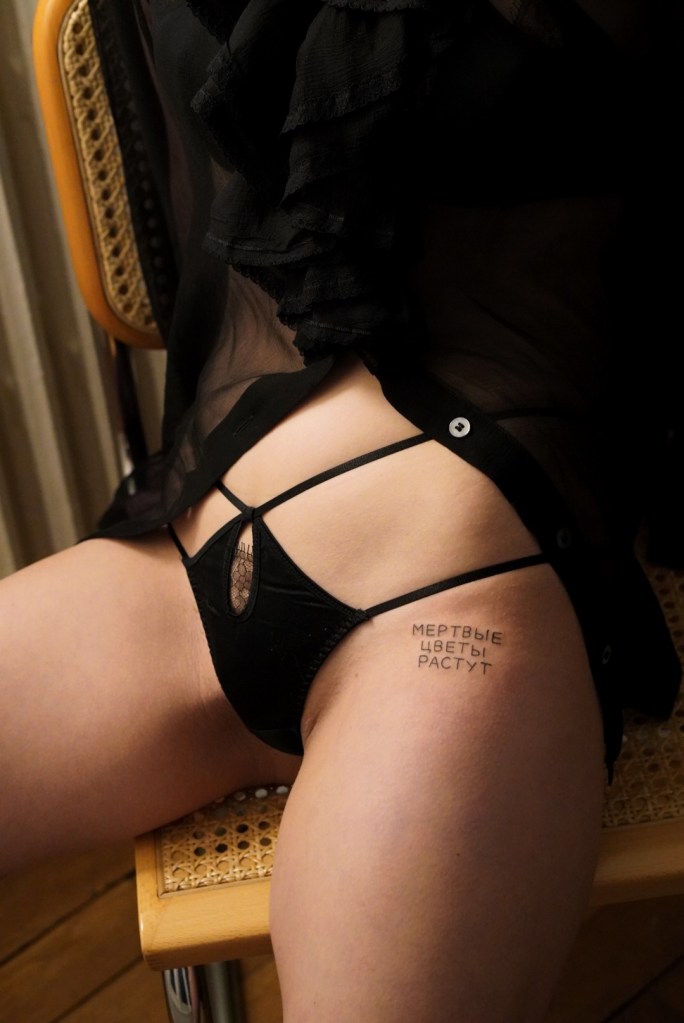
*the tattoo translated from Russian means Dead Flowers Grow
Discover more from Your Story, By Me
Subscribe to get the latest posts sent to your email.
