She came with court shoes in a bag. Without removing her black coat, she swapped her winter boots for the sleek heels, and seemed more than ready.
“Did you change to keep your feet warm?” I asked.
“No, it’s to complete my outfit,” she said, matter-of-factly.
“That’s very unusual for East Europeans,” I thought.
She sat a few meters away from me. White lace-trimmed cuffs were peeking out from the coat sleeves. Lips red.
“How have you been?” I asked, tapping the nib of my fountain pen against the paper.
“I’m in a foreign country, so I really need to earn money. I try to exhibit my art, but making it here feels like going through fire and water—and I’ve tried. I’ve learned I can’t outright say I’m from Belarus; I can only mention it casually, making sure it doesn’t sound like an excuse. Then there’s the constant pressure to attend events, to rely on my face for connections—I can’t. I tried again recently, but it left me feeling awful. I’ve decided I won’t put myself through it anymore.”
The ink flowed from the pen as I began the interview. “Alright, let’s start from the beginning. A foreign country—what does that mean to you?”
“I wasn’t born here. It’s not my home.”
“And what is home?”
“Belarus.”
“But isn’t ‘home’ just a concept tied to the nation-state? How is it different from Poland?”
“We’ve had this conversation before,” she said, exhaling. “Everything here feels strange to me—the trees, the cemeteries.”
“I still don’t get it. We’re less than 200 kilometers from Belarus.”
“Alright,” she said, leaning forward. “When something happens here, I think, they did it—not us. I feel detached, like I’m an alien element in this society. It’s them building the Museum of Contemporary Art. I want to live in a society where I can say, we build it.”
“Them and us. That division is dangerous. The wars we witness often stem from this idea. When we claim a piece of land as ours—land that, in truth, belongs to no one—we create enmity, turning others into strangers to ourselves.”
“What enmity?” she countered. “I’m not hostile. I just feel unwell and stressed. Wherever I go here, I’m in the third role.”
“In the third role,” I repeated, jotting down her words in my notebook.
She let out a hearty laugh, her black coat slipping from her knees and revealing legs clad in black nylons.
“And you want to be in the first role?”
“It’s not just that. Emigration is hard. Maybe, over time, I’ll be like you—loving all the trees, seeing the whole world as my home. But for now, I’ve never had a heart-to-heart talk with Poles,” she said, pulling her coat back over her legs.
“This isn’t really about heartless Poles, is it?”
“Okay, it’s not,” she admitted. “But I don’t fit into their system. What can I do about that?”
“What system?”
“I don’t know,” she sighed. “I just don’t have a home, that sense of safety. That’s all.”
“Did you feel safe in Belarus?”
“Of course.”
“How come?”
“I understand anyone could be imprisoned, and economically it was tough… but still, I felt the ground there. I could visit my grandma’s house, the cemetery where my relatives are buried. I felt connected, like I belonged to everything,” she explained. “Long story short, my mom and I were poor, but I worked hard and always brought something home. I did the renovation, bought a washing machine. By the time I was 25, I realized, that’s it; now I need to do something for society. So, I designed an entire bar in Grodno. Everything valuable I had at home, I moved to the bar. When people came in and I saw their happy faces, I stood there and cried. Two months later, this fuck happened (she meant the 2020–2021 Belarusian protests that faced violent persecution by the authorities). My friend was imprisoned. Then another.”
“May I ask a stupid question? Where were you during the previous elections?”
“I didn’t participate in them.”
“It sounds like you were happy back then because you weren’t fully aware of the political repressions that have been happening since Lukashenko was elected.”
“Yes, totally. But what I’m talking about here is belonging. I’ve been refused so many times to exhibit my art in Poland because my topics aren’t interesting to them. And now, since I moved from Belarus, I’m also rejected by the Belarusian artist community. I’m all alone.”
“Do you have an art idol?”
“Yes, Vrubel.”
“Was he supported by the Academy of Arts?”
“No.”
“You see?”
“Yeah. But sometimes it’s just too much, all of it together. People can’t even bother to leave a damn ‘like’ on my paintings. And I started thinking, am I that bad? It really made me question myself.”
“Are you making art to gain recognition?”
“No, but it’s strange not to have it, even among colleagues. Imagine you’re a cardiologist, and all the other cardiologists ignore you. That really crushed me. But I stood up, went to therapy, and decided to take a strong position: I don’t care about it anymore. Still, there must be someone who tells me that I’m okay.”
“Who’s someone?”
“A good question,” she said, laughing.
“Why do you make art?”
“I want to change the world for the better. For example, to end dictatorship. My recent work was about the suffering of political prisoners in Belarus.”
“Do you think your paintings can release political prisoners?”
“Yes. And I know it’s absurd.”
“I didn’t say that.”
“I think we have to define the limits of our responsibility. I used to take everything too close to heart, and it only made me suffer. I didn’t do any good that way. But then I decided—the political situation in Belarus is my responsibility. I can’t care about everything. If kids are dying from cancer, I feel for them, but I can’t carry that weight. I simply can’t be responsible for everything. Can I smoke on the balcony?”
“Yes, feel free.”
When she returned, she said, “You know, I don’t feel free because I’m afraid of life. I think it will squash me. If I can’t sell my art and have to work in Żabka (the largest convenience store chain in Poland)—they won’t even take me, and I’ll die.”
“You’ll die anyway.”
“I know. Life is cruel; it guides me. I’m not the one in command.”
“So why not accept that and stop resisting what’s natural? Maybe then you’ll stop being afraid of it.”
“True. It will squash me anyway.”
“Relax then. It’ll squash you, me, political prisoners, and sick children alike.” It wasn’t meant to be a joke, but somehow we both laughed.
“What drives you to live?”
“Voicing, the sonority of forms, the mind, the moments, the will to feel beauty.’
“And what is beauty?”
“The moments when I create something that allows beauty to happen, when I feel it—me, within her,” she said, her words carrying the weight of the feminine Russian word for beauty, krasota.
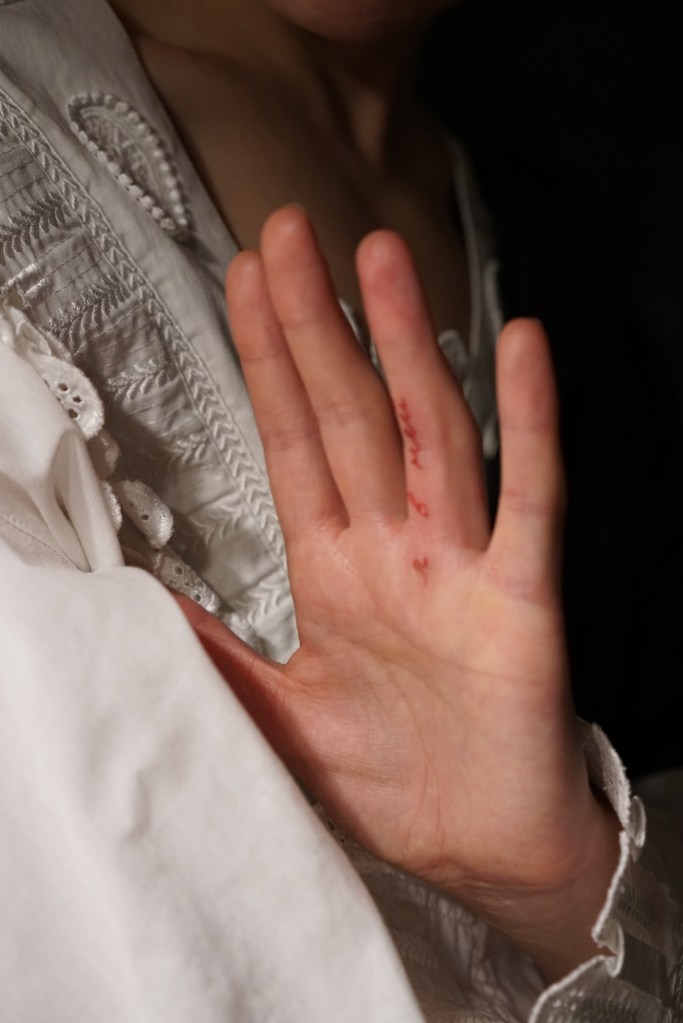
“Me within her, I like it. On your skin, it could read as ‘you are in the body of this woman.’”
She had thought it would be difficult to give consent to get tattooed—after all, she’d had no tattoos when she came—but me within her proved to be the correct password to give her confidence.
Discover more from Your Story, By Me
Subscribe to get the latest posts sent to your email.
