Her high-heeled slingbacks rested side-by-side near the wall of the apartment that she rented for a couple of nights. “FENDI” was embossed on the insoles. She had worn the same shoes two days ago, at the opening of her new tattoo studio in Paris—the seventh in her career. The low vamp design, crafted from transparent fabric, nicely revealed her dark red pedicure and the crystal cluster tattoos on her insteps. She was sitting with an unknown-to-me woman on a bench, when I sat down next to her and extended my hand in greeting. By the end of our conversation, we agreed to meet for my interview.
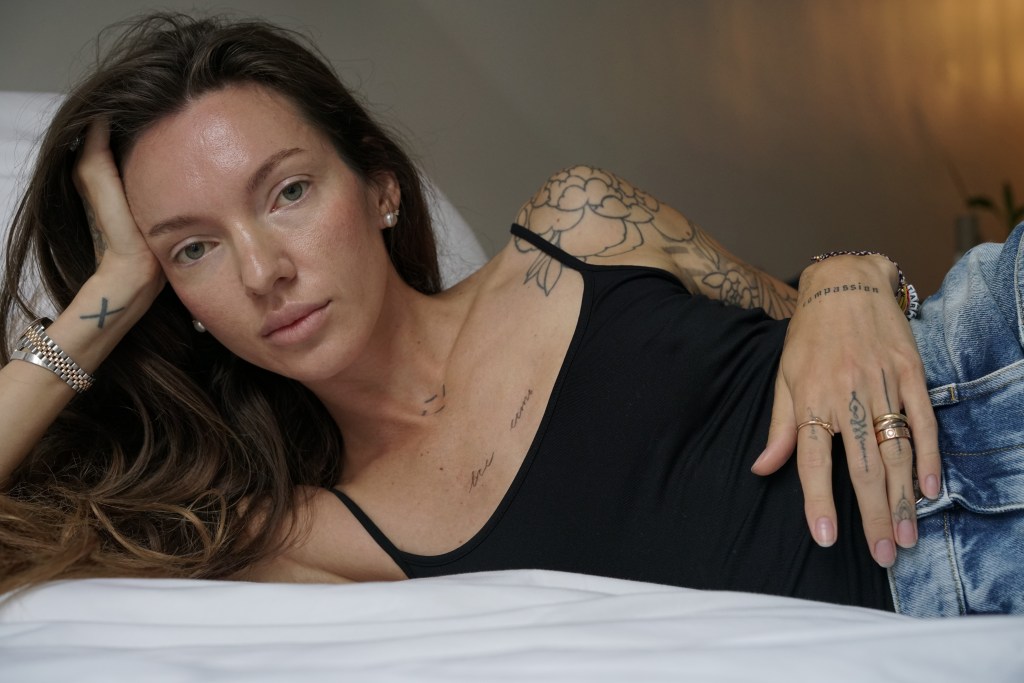
“Did you sleep well?” I asked Sasha who was looking at me from her rumpled white bed, clad in blue jeans and black crop top; her well-groomed and impossibly long hair lay beside.
“Yes!” she replied, smiling. “Even though a mosquito was biting my face.”
“I had the same problem. You know, I don’t kill mosquitoes?”
“I don’t either! My husband says a mosquito will stop bothering you when it’s full.”
“Then the one I had must’ve been insatiable. Do you mind if I record our conversation?”
“Not at all.”
“You mentioned earlier your father died in a car accident when you were six. How did that loss affect you?”
“Talking to my psychologist, I realized I have a trauma of being abandoned. I never thought my dad had abandoned me, but no one ever talked to me about his death. I was left with this feeling that a loved one could leave me at any moment. That shaped how I built relationships—I started tying people to me, often with money, hoping they wouldn’t leave. When I recognized this pattern, I had to learn to untie people. It was terrifying, especially when it came to rebuilding relationships with my family, where I was no longer the savior. Even now, when I fear someone might leave me, I unconsciously try to prevent it.”
“What do you mean by ‘tying people’? Your father didn’t leave you intentionally—he died.”
“Yes, but to my child’s mind, he disappeared. It planted the idea that anyone I love could vanish at any moment—not just through death, but in any way.” She rose from the bed to close the window, shutting out the cold, humid air and the urban rhythms of Rue Rambuteau (people produce completely different noises when cars stop: feet and words*) from coming into the room.
“Some people believe we’re responsible for the feelings of others, while others think it’s impossible to predict how people will react. What’s your take?”
“I wouldn’t do something knowing it would hurt someone, but I also won’t compromise on voicing my position or setting boundaries when it matters.”
“What are the positions you’ll stand for no matter what?”
She laughed. “I’m not sure, actually.”
“Maybe moral or ethical positions?”
“Yeah, there’re some things that come from upbringing… albeit no, those are questionable. I can’t find the answer, can you rephrase the question?”
“Can you recall a moment when you felt the urge to stand up for something? What was it?”
She nodded, her gaze distant. “It was with my grandma. I was driving her to the dentist when she started sharing these horrific stories about the war in Ukraine. Even though it happened months ago, I still think about it sometimes. She began with, ‘Do you remember Anya from the fourth floor? She was near the metro, passing by the shopping mall, when a shell hit. Everyone ran into the metro—some were injured. Anya was so mentally shaken it took her weeks to recover.’ I gripped the steering wheel, just listening, trying to process. Then my grandma continued, ‘And Anya’s mother—imagine—she found a video online. It showed a little girl playing on a teeter-totter when a shell hit. The girl was decapitated.’At that point, I couldn’t hold back. I stopped her and said, ‘Grandma, why are you telling me this?’ That was the moment I knew I had to draw a boundary. I told her I didn’t want to hear such stories anymore—ever. I even asked her to take it all back, to understand that I didn’t need those images in my reality. It was harsh, and I could see how upset she was, but I stood my ground. For the first time, I realized the importance of protecting my mental space, even if it meant being firm with someone I loved.”
“It sounds like you were protecting your sense of reality. Why is that so important to you?”
“I feel like it directly impacts the quality of my life. When I focus on the negative, it has a way of manifesting itself in my reality.”
“Would you say you prefer to see the world through rose-colored glasses?”
“In a way, yes. But it’s more than that. My inner state shapes my outer world. Like I said, I don’t want to dwell on the negative—on destruction or that anxious, unsupported feeling. So, I consciously filter the information I take in. It’s not about ignoring reality but choosing what to focus on for my well-being.”
“Would it be fair to say that you control your feelings?”
“Yes.”
“But unpleasant feelings still arise?”
“Of course.”
“Do they come because you fail to control them?”
“No—they’re inevitable.”
“So what is it you control?”
“I choose which feelings I want to experience less by focusing on the positive.”
“And how do you do that?”
“By paying attention to what is positive.”
As the conversation circled back on itself, I began to sense a growing monotony—for both of us.
“Do you have any unfulfilled desires?”
She smiled. “Yes. Last year started with questions I’d never asked myself before. I always thought I had everything—a good family, a job I loved. But then I realized something: I can’t afford to buy a house. I really want one, but for some reason, I keep walking away from it. I don’t save enough money.
I wondered, is it because of my low financial literacy? So, I started learning—reading, taking courses. I even reached out to realtors to help me find a house. But at some point, I realized what I want isn’t available to me. That was a first. I’ve never faced something I couldn’t have before.
It was uncomfortable—extremely so. I thought, Am I doing something wrong if I can’t achieve what I want? It made me question everything. I decided to take a year off from tattooing, to explore something new, to figure things out. But then it hit me: I don’t even know what I want anymore. What started as a question about how to save for a house turned into a full-blown crisis about not knowing how to move forward.”
“And yet, two days ago, you told me that just being a mother isn’t enough—you want something bigger. A house doesn’t sound very big.”
“You’re right,” she admitted, a thoughtful smile playing on her lips. “Now, when I think about it, a house feels like something small. Actually, I already have one in LA. I’m renting it, but it’s still mine in a way. Honestly, I have everything I need. The idea of buying a house? It’s probably something society has imposed on me. When I look at my life, I already have everything to truly enjoy it.”
“Why do you keep your hair so long?”
She laughed. “You mean the hair I sit on and sometimes gets in my way? I love it so long. I can’t promise I’ll never cut it, but for now, I think it’s pretty cool.”
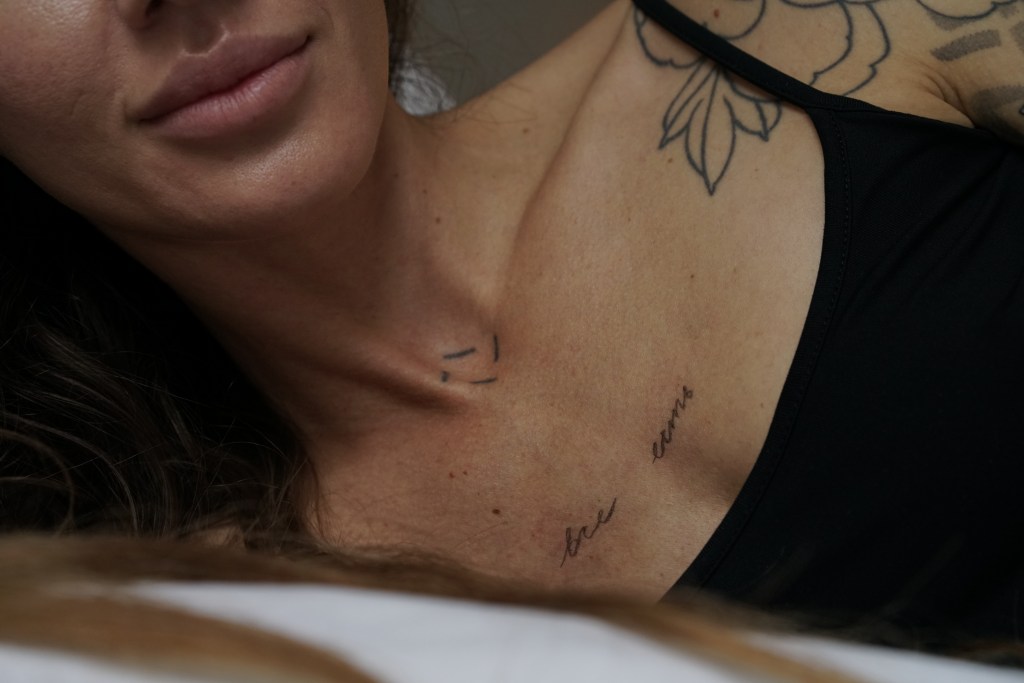
I suggested her to tattoo “having everything” in Russian—всё есть, literally “everything IS.” She lay down on the bed, her hair spread about the pillow. I knelt beside her, placing my left hand near her right shoulder. Leaning over her, I inscribed the words at the center of her chest.
“I know you skipped breakfast. What about we have lunch together?“
Discover more from Your Story, By Me
Subscribe to get the latest posts sent to your email.
